Get Full Government Meeting Transcripts, Videos, & Alerts Forever!
Get email alerts on the Firearms Probation topic
No spam. Unsubscribe anytime.
House Judiciary panel votes to reject bill that would limit courts' discretion on firearm conditions for people on probation (HB 1301)
Summary
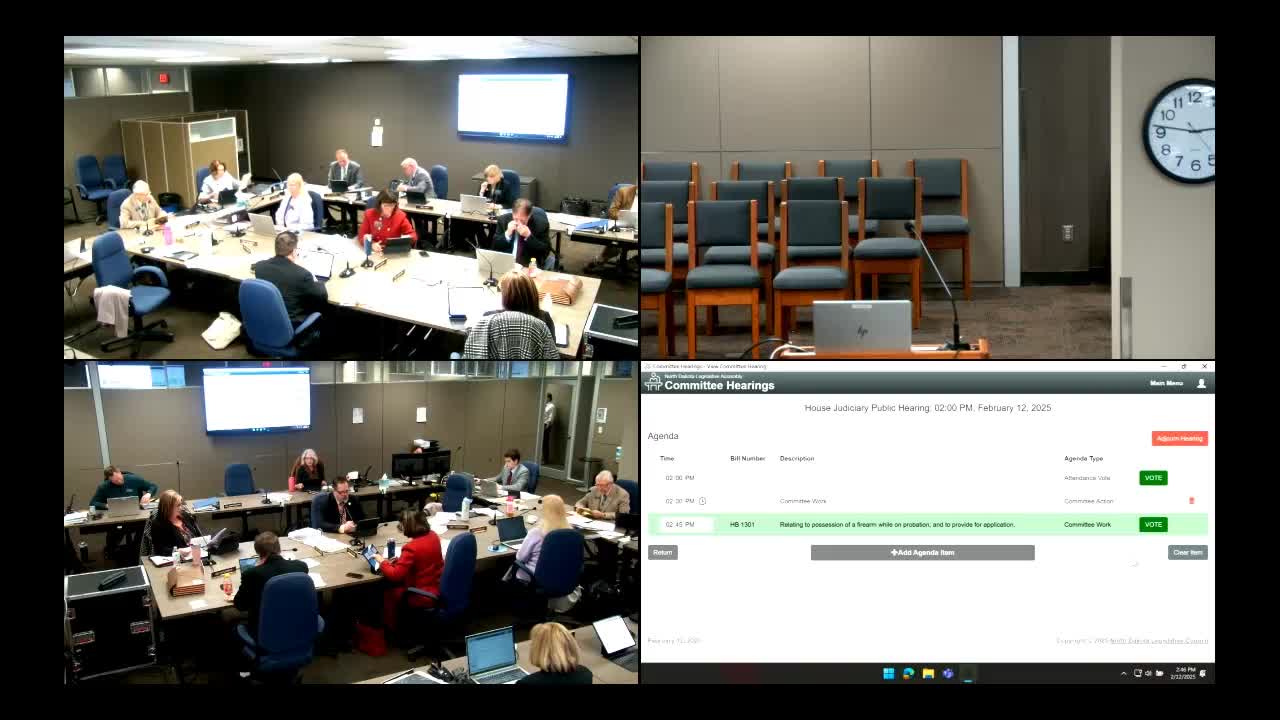
After lengthy debate about judges' authority and public safety, the House Judiciary Committee voted 11-3 to recommend "do not pass" on House Bill 1301, which would restrict courts from prohibiting firearm possession for some people on probation unless the offense involved violence or a threat of violence.
The House Judiciary Committee voted 11-3 to recommend "do not pass" on House Bill 1301 after members split over whether the measure would improperly remove judicial discretion to limit firearms for people on probation.
Supporters of the bill said it protects Second Amendment rights for people convicted of lesser offenses; opponents said it could leave judges unable to consider facts that indicate a risk to public safety. The committee initially considered an amendment from Representative Wolf to clarify which misdemeanor and infraction convictions would still allow courts to prohibit firearms; that amendment failed on a 7-7 tie. The committee later adopted the sponsor's amendment by an 8-6 vote, but a subsequent motion to recommend "do not pass as amended" carried 11-3.
Under current law, courts commonly include a condition of probation that a defendant may not possess a firearm, destructive device or other dangerous weapon while on probation. HB 1301, as discussed in committee, would bar courts from prohibiting possession while on probation or for other misdemeanor offenses unless the court determines the offense involved violence or a threat of violence against an individual. The bill also would prohibit such restrictions for infractions.
Opponents repeatedly urged preserving judicial discretion. "I think it's dangerous to make this change and pass this bill," Representative Schneider said during committee debate, adding that judges need to consider facts beyond the statutory label of the offense. Representatives from law enforcement and the state's attorneys' association, according to committee discussion, expressed similar concerns during testimony that preceded the meeting.
Supporters, including Representative Wolf, said the sponsor intended to protect the rights of people convicted only of nonviolent infractions or minor misdemeanors. "I think the intention was to be on the side of our Second Amendment rights and not taking things away before they have to be," Wolf said.
Committee votes and procedure were prominent in the debate. Representative Wolf moved adoption of the sponsor's amendment, seconded by Representative Van Winkle (first vote: amendment failed, 7-7). A later roll-call to adopt the amendment carried 8-6 (mover: Representative Better; second: Representative Oversome). The final committee action — a motion "do not pass as amended" — was moved by Representative Twight and seconded by Representative Schneider; the clerk recorded the motion as carrying 11 to 3.
Votes at a glance
- Motion to adopt sponsor's amendment (first vote): moved by Representative Wolf; seconded by Representative Van Winkle; outcome: failed, 7-7. - Motion to adopt sponsor's amendment (second vote): mover recorded as Representative Better; second recorded as Representative Oversome; outcome: adopted, 8-6. - Motion "do not pass as amended": moved by Representative Twight; seconded by Representative Schneider; outcome: carried, 11-3.
The committee asked for a bill carrier to take the measure forward after final action; one member volunteered to carry the bill after the vote. The panel recessed shortly afterward for a subcommittee meeting scheduled later in the afternoon.
Background and context
Members debated definitional and drafting issues as well: committee discussion noted that terms such as "destructive device" and "dangerous weapon" are defined elsewhere in state law and that the draft amendment duplicated language in places, which some members called a clerical error. Representative Wolff read several statutory cross-references during debate (including 12.1-17-01, a simple-assault provision), noting the difference between listed violent sections and other misdemeanor or infraction categories.
The committee's discussion highlighted the tension at the heart of HB 1301: whether to create a stronger presumption preserving firearm possession for people on probation for nonviolent offenses, or to leave judges with broad discretion to restrict firearms based on the totality of circumstances.