Get Full Government Meeting Transcripts, Videos, & Alerts Forever!
Get email alerts on the Eminent Domain topic
No spam. Unsubscribe anytime.
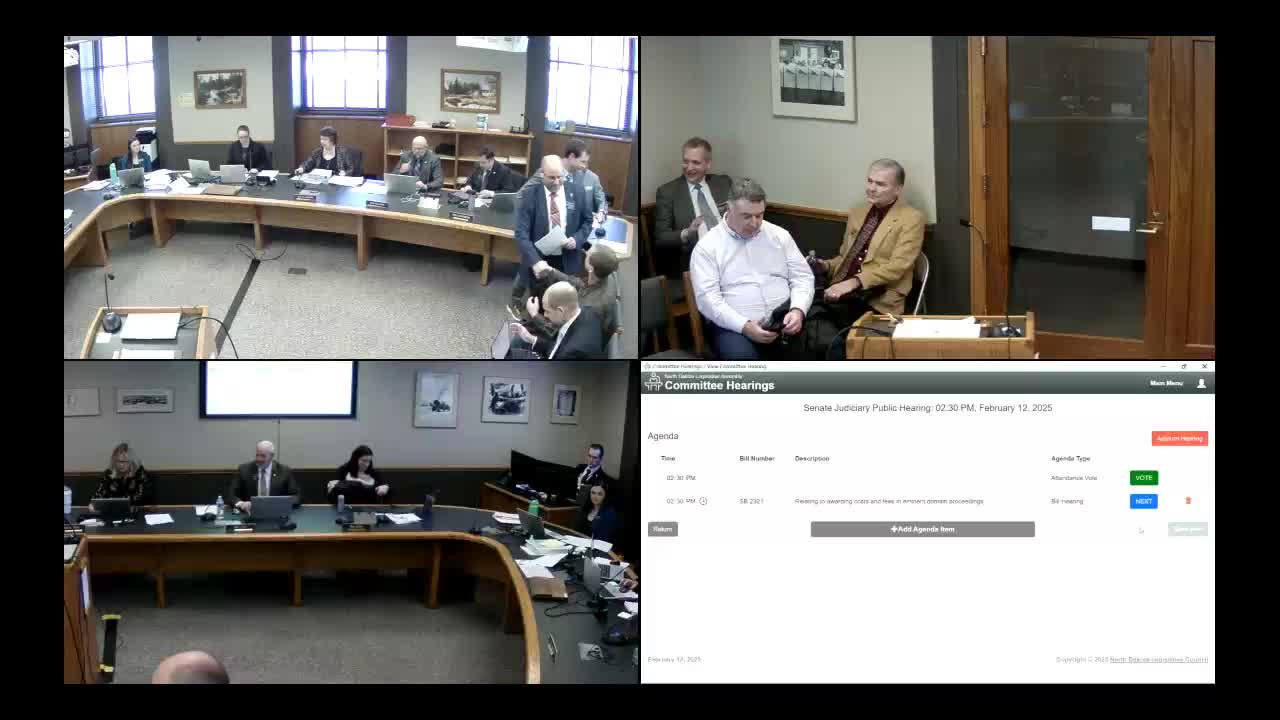
Senate hearing on SB 2321 debates whether expert fees should be recoverable in eminent-domain cases
Summary
The Judiciary Committee heard testimony Wednesday on Senate Bill 2321, which would make explicit in state law that landowners may recover expert witness and appraisal fees as part of costs and expenses in eminent-domain proceedings.
The Judiciary Committee heard testimony Wednesday on Senate Bill 2321, which would make explicit in state law that landowners may recover expert witness and appraisal fees as part of costs and expenses in eminent-domain (condemnation) proceedings.
Supporters said the change is intended to ensure landowners are made whole when a condemning authority withdraws a case or otherwise ends a matter without a judgment awarding compensation. "We want it to be explicit that North Dakota law covers that and that landowners are made whole," said Troy Koons, the unpaid lobbyist for the Northwest Landowners Association.
The bill drew support from landowners, county and district GOP leaders and attorneys who represent property owners. Derek Broughton, an attorney in Bismarck who represents farmers and ranchers and serves as general counsel to the Northwest Landowners Association, told the committee federal courts sometimes decline to award expert witness fees unless state law explicitly includes them. "All we're doing here is saying that just as the state courts already say, when we say you can recover your attorney's fees and costs in an eminent-domain action, you can recover the costs for those appraisers and your experts as well," Broughton said.
Several witnesses described the practical cost of litigation appraisals that include depositions, site visits and court appearances. Broughton estimated that in federal litigation, an appraisal used for litigation often runs between $15,000 and $30,000, depending on complexity.
Supporters also asked the committee to consider an amendment that would expand recoverable fees to some pre‑suit negotiation scenarios. Broughton and landowners described situations in which a condemning authority engaged in extended negotiations, the landowner spent time and money on counsel and experts, and at a late stage the authority abandoned the effort—leaving the landowner out-of-pocket.
Opponents included the North Dakota League of Cities and the Greater North Dakota Chamber. Stephanie Ingebretsen, appearing for the League of Cities, said municipalities use eminent domain rarely and typically for projects such as flood control, and she warned the bill as drafted could remove incentives to negotiate because fees would be more likely to be recoverable in all cases. "We are concerned that if that language is struck from the bill there will no longer be an incentive for parties to work with us and everything will go to litigation," Ingebretsen said.
Andrea Fenig, vice president of government affairs for the Greater North Dakota Chamber, said changing the statute to require expert-fee recovery in federal cases could increase costs that ultimately fall to taxpayers, ratepayers or users of infrastructure. "By allowing the court to award expert witness costs, we risk increased costs that will ultimately be paid for by the public," Fenig said.
Committee members asked how federal courts treat state-law cost provisions. Broughton and other supporters said federal courts apply state law on just compensation when federal statutes such as the Natural Gas Act provide the federal jurisdictional hook, but some federal judges have declined to treat expert witness fees as recoverable costs unless the state statute is explicit. Supporters argued SB 2321 would remove that ambiguity.
Members also pressed on limits and reasonableness. Broughton and other witnesses told senators that judges retain discretion to award only reasonable fees and to limit amounts they find excessive. Broughton said judges commonly evaluate attorney rates and the scope of experts’ work and will cap awards at what is reasonable under the circumstances.
The committee did not take action on SB 2321 and closed the hearing; members said they planned to resume consideration at the next scheduled Judiciary meeting.
Votes at a glance: No formal motions or votes were recorded during this hearing; the committee closed the hearing and deferred action to a later meeting.