Get Full Government Meeting Transcripts, Videos, & Alerts Forever!
Get email alerts on the School Construction topic
No spam. Unsubscribe anytime.
SCA outlines $20.5 billion capital plan; District 28 projects, an annex at Forest Hills, and community concerns
Summary
The School Construction Authority presented the FY2025–29 capital plan to CEC 28, listing citywide and district-level projects and budgets. Community members and council members raised questions about project tracking, a misattributed application last year, and timelines for Forest Hills High School and York High School projects.
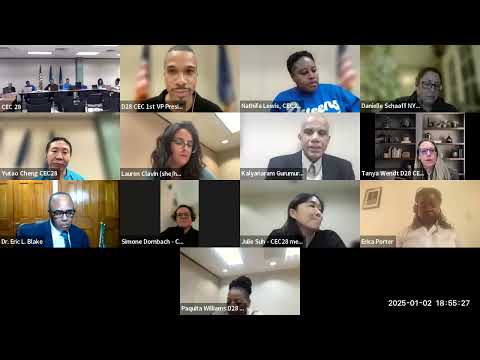
The School Construction Authority (SCA) presented its proposed FY2025–29 capital plan to Community Education Council District 28 on Jan. 8 and described both citywide budget priorities and district-level projects.
Danielle Schaff of SCA told the council the current proposed amendment for FY2025–29 is $20,500,000,000 and highlighted major budget categories: roughly $6.13 billion for capacity (new seats), $2.28 billion for “healthy schools” work, $7.5 billion for capital improvements of existing buildings, and approximately $3.75 billion for mandated programs. Other line items Schaff cited included an electrification allocation of about $1.4 billion, accessibility funding of $800 million, and dedicated technology and library dollars.
District 28-specific capacity highlights Schaff listed were the recently opened addition to PS 174 (403 seats), a PS 160 addition of 354 seats planned for September 2025, and renovations to an annex at PS 180 to add 100 seats by September 2025. Schaff also said SCA holds funding for two as-yet-unsited District 28 projects: one for 351 seats projected for September 2026 and one for 1,600 seats projected for September 2027.
Schaff reviewed how projects are created — building-condition assessment surveys (BCAS), Division of School Facilities referrals, SCA mandated repairs, and elected-official Reso A requests — and noted the agency’s annual prioritization process. She listed district projects currently in the plan including a windows project (over $10 million), two roof replacements (combined over $11 million), a power pit repair (~$2.3 million), exterior masonry (~$3.5 million), a cafeteria/multipurpose upgrade ($666,666), and a student toilet upgrade ($200,000). Schaff said the district also has 11 safety projects totaling more than $4 million and dozens of Reso A-funded items such as auditorium and library upgrades.
Council members and principals pressed SCA on a series of concerns: Forest Hills High School was discussed as an active exterior-renovation site, and Schaff said an annex of roughly 600–700 seats is planned on a service-road parcel near the Grand Central Parkway, but she had not finalized an opening date. On the Queens High School for Science at York, Schaff said SCA was not leading any relocation planning and recommended the high school district planning office and the Department of Education for updates.
Several council members and parents raised a technical and equity concern: a project submitted last year appeared in SCA’s response as “approved” but, after local follow-up, turned out to have been attributed to a different school in another district. School Construction Authority staff acknowledged a drop-down selection error and said it had adjusted the electronic form to prevent identical building-ID misattributions going forward. Schaff said SCA could not retroactively move completed work that had gone to a different building but would fix the submission process for future cycles.
SCA reminded the council of procedural deadlines: CEC top-five priority forms for SCA input were due Jan. 17 (the presenter gave an SCA email: rcinputnycsca@nycsca.org in the presentation), and borough/resolution-A schedules were cited elsewhere in the meeting (council members and the borough president’s office referenced a Reso A application deadline of Feb. 28 from the borough president’s office). Schaff said SCA would send the presentation PDF and requested principals and CEC members follow up directly with SCA project managers when needed.
Council members urged clearer and timelier feedback on submissions and suggested more direct outreach when a school’s request is misclassified, noting the practical impact of delayed or missing responses for principals and parent leaders. SCA said it had made electronic fixes to reduce the risk of future attribution errors and reiterated that capital planning is a multi-year process with projects often staged across several fiscal years.