Get Full Government Meeting Transcripts, Videos, & Alerts Forever!
Get email alerts on the Estate Planning topic
No spam. Unsubscribe anytime.
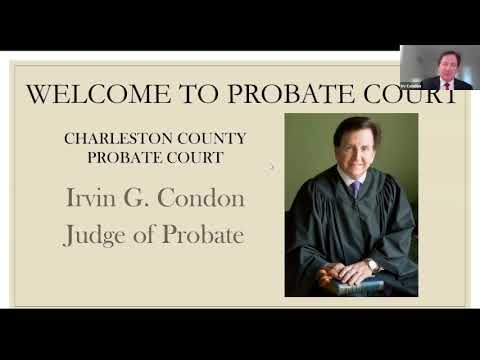
Charleston Probate Judge outlines estate-planning options, civil-commitment process and local resources
Summary
Probate Judge Irv Condon gave an hour-plus virtual presentation explaining probate court functions, estate‑planning documents, guardianship and conservatorship limits, civil commitment procedures and local resources for seniors, veterans and families in Charleston County.
Probate Judge Irv Condon of Charleston County reviewed how the county probate court handles estates, guardianships and involuntary civil commitments and highlighted local resources to help families with estate planning and elder-care issues.
Condon said probate court has jurisdiction over adult guardianships (care of the person) and conservatorships (management of money), and that family court handles guardianship matters for minors. He summarized basic estate‑planning documents — wills, durable (financial) powers of attorney, health‑care powers of attorney, declarations of desire for natural death (living wills), and revocable living trusts — and urged people to consult attorneys to confirm how assets are titled and whether items are probate or non‑probate transfers.
Condon explained why powers of attorney and health‑care proxies can help families avoid expensive conservatorship proceedings, and gave specific procedural details for probating estates in South Carolina: summary proceedings for small estates (under $25,000 with no real estate), normal administration that typically takes nine to ten months because of creditor notice requirements, a 90‑day deadline to file an inventory and appraisement after appointment, and an eight‑month creditor period measured from the first newspaper publication (or one year from date of death, whichever is shorter). He said the probate filing fee is $95 on the first $100,000 of probate assets and described the court’s electronic filing option and a $7 convenience fee for online filing.
Condon provided case‑management totals and workload context: roughly 2,200 estate cases opened per year with about 3,500 open estate files at any time; around 1,000 open guardianship/conservatorship cases; and about 1,900–2,000 civil commitment matters handled through the court’s commitment division. He described the court’s “commitment division” process as intended to secure voluntary treatment where possible and use involuntary civil commitment when necessary, including mobile crisis teams and virtual hearings at hospitals.
The judge reviewed probate mechanics: the application and appointment process, the need to give notice to interested persons, the inventory and appraisement schedules, how creditor claims are handled (allow, compromise, or disallow), bond requirements when estates are intestate, when deeds must be filed with the register of deeds (and that drafting deeds is a legal practice requiring counsel), and options to close an estate (standard closing, verified statement for a sole heir, or waiver by interested persons). He stressed that a will not probated within 10 years can be treated as if the decedent died intestate under state law.
Condon also described court programs that intersect with probate work: problem‑solving courts (veterans’ court, drug court, mental‑health court), a court‑assisted treatment program for people under civil commitment, veteran support lines and the national 988 suicide crisis line. He said the court was participating in national projects such as a rapid‑response conservatorship pilot and runs a visitor/monitoring program for people under guardianship.
On community resources, Condon listed organizations offering low‑cost or pro bono services and practical help: the Coastal Community Foundation, the Center for Heirs’ Property (including wills clinics), Martindale‑Hubbell and the South Carolina Bar lawyer referral service, Charleston Pro Bono Legal Services and Charleston Legal Access, the Palmetto Project, Trident Area Agency on Aging, Roper St. Francis (clinical programs), Wake Up Carolina (overdose prevention and Narcan training), Donate for Life and Sharing Hope (organ/tissue donation outreach). He also recommended Smart911 for medical and emergency‑response data and noted that most county libraries provide public access to the court’s e‑filing system.
Condon encouraged families to complete basic documents — at minimum a will and powers of attorney — to avoid conservatorships when possible, and to coordinate estate plans with attorneys and accountants because of tax and title issues. He offered his office’s contact information and said the court records recorded workshops that are available online.
The presentation was informational; attendees asked a few procedural questions about exemplification / ancillary probate for property in other counties and the court’s process for sending certified documents to foreign courts. Condon and Community Outreach Coordinator Jamie Robinson described the clerks’ role in preparing certified copies and said courts sometimes prefer to receive documents directly from the issuing court.
Condon closed by inviting follow‑up questions and offering individualized assistance to people preparing to probate estates or consider guardianship, conservatorship, or other elder‑law options.