Get Full Government Meeting Transcripts, Videos, & Alerts Forever!
Get email alerts on the Probate And Estate Planning topic
No spam. Unsubscribe anytime.
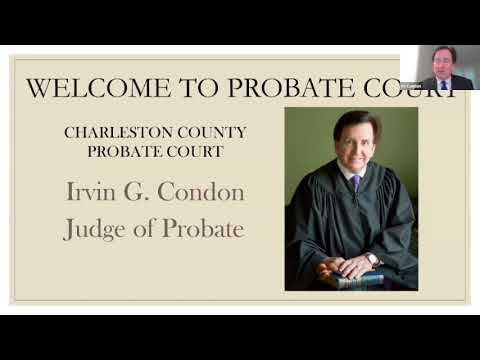
Charleston County probate judge urges residents to complete estate planning, explains probate process
Summary
Probate Judge Irv Cunningham gave a virtual seminar outlining estate‑planning tools, the county probate timeline and steps to avoid guardianship and conservatorship, and answered residents' questions about selling property during probate.
Probate Judge Irv Cunningham of Charleston County used a virtual public seminar to outline estate‑planning basics, the probate timeline and alternatives to guardianship and conservatorship, telling attendees the court handles about 2,200 estates and roughly 1,900 involuntary commitments each year.
The judge said a South Carolina will "has to be in writing. It needs to, have 2 witnesses," and urged residents to consult attorneys about trusts, durable powers of attorney and health care advance directives. He described how routine estate administration typically takes "9 or 10 months" because of the statutory creditors' notice period and other filing requirements.
Cunningham framed the seminar as an overview of the probate court's functions — from estate administration and marriage licenses to problem‑solving courts and civil commitment — and emphasized practical steps families can take to reduce court intervention. "Guardianship is of the person," he said, "and probate court has jurisdiction over adult guardianships. … Conservatorship is of the money," and both can often be avoided with a health care power of attorney, a business/durable power of attorney or a trust.
He walked through common estate planning documents: wills, revocable living trusts (and "pour over" wills), financial/durable powers of attorney and the South Carolina statutory health care power of attorney. He said the financial (durable) power of attorney "is the one document that has to be recorded" at the register of deeds to become effective in certain circumstances, and warned attendees that powers of attorney "are very useful ... but it's also very dangerous" because an agent can act broadly on the principal's assets.
On probate logistics, Cunningham gave specific timeline and fee information: a typical probate inventory and appraisal must be filed within 90 days of appointment, personal representatives must send an "information to heirs and devisees" notice within 30 days, and the court's required newspaper creditors' notice runs once a week for three consecutive weeks; the creditors' period begins on the first publication. He said the court's filing fee is "$95 on the first $100,000 of probate assets," and described the court's three informal/formal paths to open and close an estate (summary proceeding, normal administration, contested petition).
Cunningham also addressed practical questions from attendees. When a participant asked whether a condo with a mortgage could be sold during probate, the judge said a sale may be possible before the creditors' period ends if the will includes a power‑to‑sell clause or the court grants authority, but buyers and title insurers often require court approval or escrow of proceeds until the creditors' period expires. He added that the property "is subject to the mortgage" and that lenders generally will work with estates on sales to avoid taking title.
He described probate‑adjacent programs and resources available locally: electronic filing (the court's vendor charges a one‑time $7 account fee), recorded public workshops and videos, the Coastal Community Foundation and its Center for Heirs' Property, Charleston Pro Bono Legal Services, South Carolina Legal Services, Martindale‑Hubbell attorney listings, the Palmetto Project, Trident Area Agency on Aging and veterans' services such as the Ralph H. Johnson VA Medical Center. Cunningham also noted problem‑solving courts run by the probate bench, including drug court, mental health court and a veterans court, and said courts increasingly use virtual procedures to reduce transports for commitment hearings.
The judge pointed attendees to the statutory South Carolina forms for health care powers of attorney and discussed advance directives (living wills), the "Five Wishes" document and physician orders for life‑sustaining treatment (POLST), which he said is being piloted locally at the Roper St. Francis cancer unit. He cited the U.S. Supreme Court case involving Nancy Cruzan to explain why written instructions matter for end‑of‑life care.
Cunningham closed by reminding residents that probate staff provide help, that many probate forms and recorded workshops are available online, and that court staff would distribute the slides and resource links after the seminar. He encouraged people to complete basic documents to reduce family burden and avoid court‑ordered guardianships and conservatorships.