Get Full Government Meeting Transcripts, Videos, & Alerts Forever!
Get email alerts on the Stormwater Infiltration Policy topic
No spam. Unsubscribe anytime.
State Water Resources Control Board holds public Q&A on proposed stormwater infiltration policy
Summary
State Water Resources Control Board staff held a public question-and-answer webinar on a proposed statewide stormwater infiltration policy, outlining how the policy could be implemented through municipal stormwater permits and answering technical and legal questions from engineers, groundwater agencies and other stakeholders.
State Water Resources Control Board staff held a public question-and-answer webinar on a proposed statewide stormwater infiltration policy, outlining how the policy could be implemented through municipal stormwater permits and answering technical and legal questions from engineers, groundwater agencies and other stakeholders.
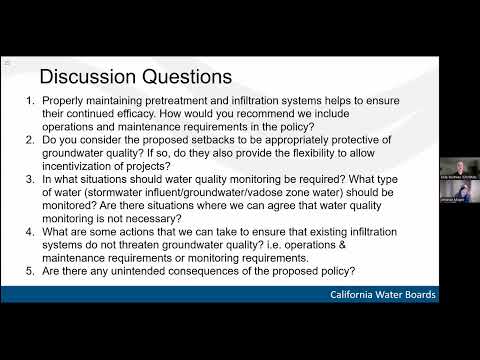
The session focused on how the policy would be applied and regulated, including whether it would be implemented through MS4 municipal stormwater permits, how setbacks and monitoring would be determined, and how the policy would coordinate with other state and federal programs. Staff said the board aims to issue a draft for public comment by the end of 2025.
The board’s presenters described the policy as a risk-based, statewide starting point intended to make infiltration projects clearer and more feasible. State Water Resources Control Board staff Kelly said, “Our goal is to not reduce streamflows. Our goal is to manage the stormwater that is kind of extra to those base flows.” Staff acknowledged limits to the board’s authority and said the policy is not intended to override local engineering analysis or other agencies’ responsibilities.
Participants raised technical and programmatic concerns. Several speakers asked whether the policy would apply to small priority development projects included in MS4 permit requirements; State Water Resources Control Board staff Amanda said the policy is expected to be implemented through MS4 permits and that applicability will depend on the size and type of the infiltration system. The policy team said they intend the policy to provide minimum setback guidance but allow local engineering analyses to justify alternatives.
Consultants and engineers pressed for clear definitions for “partial infiltration” and for thresholds that would trigger the policy’s requirements. Ash Karanthaman of Rick Engineering asked how the draft sets minimum vertical and horizontal setbacks and whether partial infiltration BMPs would be covered; staff said setbacks were developed from a literature survey of manuals and international practices and that whether partial infiltration is subject to the policy will depend on system volume, size and land use type.
Groundwater sustainability interests urged the board to consider rural applications. Barbara Washburn of the Slough House Resource Conservation District, a groundwater sustainability agency in the Cosumnes Basin, said local agencies are using infiltration to address overdraft and that some counties are preventing dry-well work pending a board policy. Staff acknowledged the point and said they would consider guidance applicable to some rural situations as well as urban areas.
On industrial and commercial permits, staff said they are coordinating with the Industrial General Permit (IGP) reissuance team. Participants noted that the current IGP references meeting drinking-water secondary maximum contaminant levels (MCLs) before infiltration; staff said the policy will seek flexibility so site-specific studies and local permitting authorities can demonstrate when infiltration will not harm groundwater and therefore avoid a blanket pre‑treatment requirement.
Staff described a risk-based monitoring approach: higher-risk infiltration systems could require monitoring of infiltrated stormwater and downgradient groundwater, while low-risk systems would need less or no monitoring. On enforcement and liability, staff said they hope the policy will reduce uncertainty rather than increase exposure that currently discourages infiltration projects.
Participants asked about coordination with other agencies. Staff said they are working with the Division of Drinking Water, the Department of Toxic Substances Control and site‑cleanup staff, and plan outreach to the Department of Fish and Wildlife. On the federal side, staff noted the U.S. Environmental Protection Agency still oversees underground injection control (UIC) classification and requires systems such as dry wells to be self‑registered in EPA databases.
Several attendees asked whether the policy would address water rights or ownership of water once it reaches groundwater. Staff said water rights and ownership after recharge are outside the board’s scope. The board instead intends the policy to clarify when infiltration is appropriate and how to evaluate risk to groundwater quality and local hydrology.
Staff gave a tentative timeline: a draft policy for public comment and possible scientific peer review by the end of 2025, with incorporation into municipal stormwater permits as those permits are renewed (municipal permits generally renew on five‑year cycles). Staff also said they will continue outreach and accept emailed comments at storms@waterboards.ca.gov.
Meeting participants offered technical suggestions for the draft guidance, including clearer definitions for partial infiltration, guidance on coordination with local groundwater agencies to avoid localized flooding where groundwater is shallow, use of site‑specific studies as alternatives to prescriptive MCL requirements, and consideration of retrofit options for existing BMPs.
While the Q&A generated technical and jurisdictional questions, no formal actions or votes were taken during the webinar. Staff said the policy is intended to provide a statewide starting point for minimum safeguards and to leave room for local engineering analyses, local permitting discretion and coordination with other regulatory agencies.