Get Full Government Meeting Transcripts, Videos, & Alerts Forever!
Get email alerts on the City Manager Interviews topic
No spam. Unsubscribe anytime.
Palatka commissioners interview city manager finalists, add emergency agenda item to deliberate
Summary
The Palatka City Commission interviewed three finalists for city manager — Mr. Thomas, Mr. Komisky and Mr. Jones — hearing each candidate's 30/60/90-day plans and experience with grants, utilities, airports and labor relations. Commissioners then voted to add an emergency agenda item to deliberate the interviews; a voice vote carried the motion.
Palatka
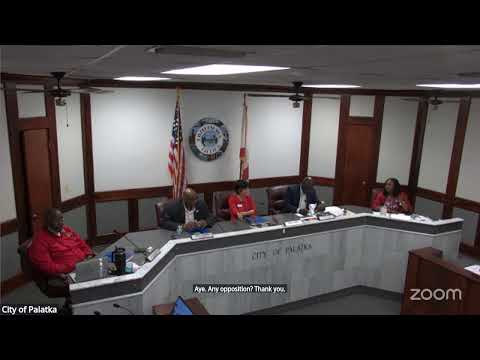
The Palatka City Commission on an evening session interviewed three finalists for the city manager post and then voted to add an emergency agenda item to deliberate the day's interviews.
Commissioners heard presentations and 30/60/90-day plans from the three applicants, asked follow-up questions about grants and capital projects, and discussed questions for future candidates before moving to add a deliberation item. After the interviews, a motion to add an emergency agenda item to deliberate the findings was made and seconded; commissioners responded "Aye" on a voice vote and the motion carried.
Why it matters: The commission's decision on a city manager will shape Palatka's operational priorities, budget strategy and relationships with state and regional partners. Candidates emphasized rapid organizational assessment, community outreach and securing outside funding.
Candidate presentations and key points
Mr. Thomas, a city manager candidate, presented a practice 30/60/90 plan he said he has used in prior municipal roles, emphasizing 1-on-1 meetings with each elected official, tours of neighborhoods and department-by-department assessments. "This is the 90 day plan that I've used probably for the last 15 years," he told commissioners, describing goal-setting with department directors and quarterly updates.
On grants and alternative funding, Thomas said he works with teams to prepare shovel-ready capital projects and stressed the importance of matching funds and post-award accounting; he said he would not accept grants unless the municipality could meet match and management requirements. He raised a personal budgeting concern about recruiter reimbursements and said earlier reimbursement clarifications influenced his decision to remain a candidate; he referenced pending recruiter reimbursements of about $3,000 to $4,000.
Mr. Komisky, another finalist, described early outreach to stakeholders and auditors of city services to identify 'pockets of money' and potential partnerships. He detailed creative approaches taken in prior towns, including negotiating pretreatment with a major industrial customer and land-applying biosolids to lower disposal costs. Komisky also discussed regional collaboration for economic development and the importance of meeting large utility customers before rate decisions.
Mr. Jones, the third finalist, cited a recent $25,000,000 federal grant his team won for a public transportation facility as the most significant recent award he helped secure. Jones described turning wastewater sludge management into a revenue-generating operation in a prior post and said he led efforts to adjust state-level bonding rules to improve municipalities' capital financing options.
Questions from commissioners covered grants, water/sewer and road projects, airport operations and labor negotiations. Candidates described hands-on experience with consent decrees, capital planning, coordinating with state regulators, negotiating union contracts and implementing performance management systems for department directors.
Action added to agenda
After the interviews, a commissioner moved that the commission add an emergency agenda item to deliberate the findings of the interviews conducted that day. The motion was seconded and carried on a voice vote; no roll-call tally was recorded in the transcript. Commissioners then agreed to a short recess before proceeding with deliberations.
Next steps
Commissioners indicated deliberation would move forward in the immediate meeting sequence (an emergency item was added) and that the commission would also address the issue on the regular agenda the following day. The commission instructed staff to provide revised interview questions and to ensure consistency across candidate interviews.
Notes on process and public context
Candidates were asked to provide 30/60/90-day plans and to explain their experience with capital projects and union negotiations. Commissioners sought concrete examples in candidate answers; during the interview sequence commissioners asked that each question prompt candidates to "provide examples" where applicable. The public portion of the meeting included candidate presentations and commissioner Q&A only; no formal appointment or final decision was announced in the transcript.