Get Full Government Meeting Transcripts, Videos, & Alerts Forever!
Get email alerts on the Public Safety topic
No spam. Unsubscribe anytime.
Idaho State Police present FY26 budget requests, highlight fentanyl unit, lab expansion and staffing shortfalls
Summary
Idaho State Police outlined a range of FY26 enhancement requests including a fentanyl-focused interdiction unit, forensic staffing and a $4.99 million fund shift tied to the highway distribution account; director Colonel Bill Gardner warned of trooper vacancies and pay competition.
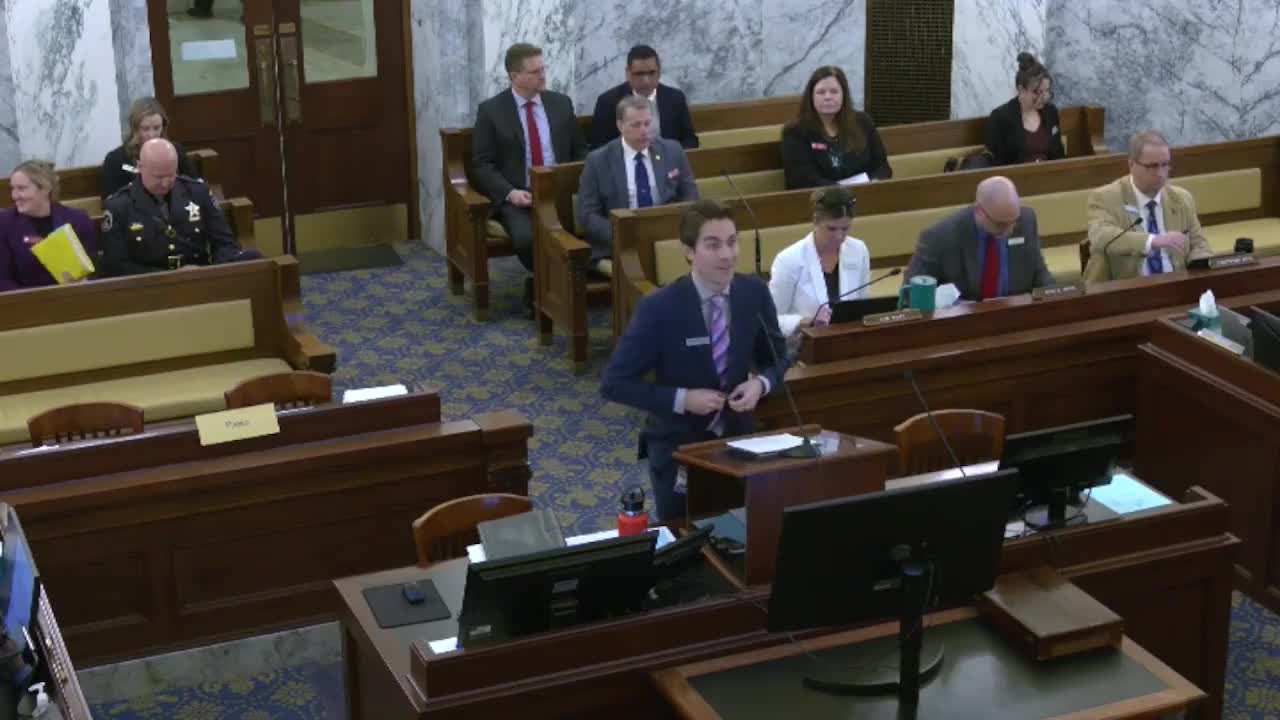
The Joint Finance-Appropriations Committee on Feb. 12 heard the Idaho State Police budget review, during which agency leadership described enhancement requests for fiscal 2026 that aim to expand fentanyl interdiction, forensic capacity and investigators while warning the Legislature that vacancies and pay disparities are hurting coverage in parts of the state.
Noah Peterson, budget policy analyst with the Legislative Services Office, presented the division overview and said the Division of Idaho State Police has roughly 583.67 full-time equivalent positions and is organized into seven budgeted programs including patrol, investigations and forensic services. He summarized three major dedicated funds (Project Choice Fund, Drug Enforcement Donation Fund, and the Idaho Law Enforcement Telecommunications Fund) and described a spike in 2023 one-time appropriations that carried through 2024 and affected estimated expenditures.
Peterson listed the agency’s FY26 enhancement requests: a 10-FTE fentanyl mitigation unit with $1,043,300; conversion of temporary forensic contractors to full-time roles; a forensic and dispatcher retention pay increase; two fleet service positions (2 FTE, net $63,300) to reduce contracting costs and clear an upfitting backlog; a four-person special investigations unit dedicated to Idaho Department of Correction facility investigations (4 FTE, $757,300, including $314,000 one-time for vehicles/computers); a forensic deputy lab manager (1 FTE, $118,200); an estimated DNA-collection fiscal impact ($168,100); and a requested HDA (highway distribution account) fund shift of $4,995,500 and 37.48 FTE to preserve current patrol operations if HDA revenue falls out of the law enforcement fund under prior statute changes.
Colonel Bill Gardner, director of the Idaho State Police, described operational effects and priorities. “Over the last year, we've seized over 65,000 fentanyl pills, over a pound of fentanyl powder and 150 pounds of methamphetamine,” Gardner said, citing interdiction successes that underpin the request for expanded fentanyl-focused capacity. Gardner also said staffing shortages are concentrated in some regions; he told the committee he is losing troopers to cities and other states and that vacancy rates are especially pronounced in northern Idaho. “We can't even get fully staffed,” he said, urging the committee’s continued attention to pay and retention.
Gardner and staff described two lab projects: a new, full-service forensic laboratory proposed in Meridian to consolidate and expand forensic services, and a renovation/expansion of a Twin Falls facility focused on drug identification to support prosecutions in the Burley–Twin Falls–Rupert area. The agency requested a deputy lab manager to help supervise growth while the new Meridian lab is completed.
Other items presented included a supplemental request of $268,100 for a remote housing unit (originally planned for Mackay; now proposed for Fairfield in partnership with the Idaho Transportation Department), an ILETS disaster recovery site request ($233,000 ongoing), a transfer to move digital forensics personnel to the Forensic Services Program (2 FTE, net zero), a federal-funds appropriation shift of $659,700 to match contract structures, a $50,000 federal grant request to comply with SORNA (the Adam Walsh Act), and a conversion of part-time contracted investigators for the sexual-assault kit initiative into permanent positions to enable POST certification (net zero transfer; 2 positions discussed).
Peterson noted the governor’s recommendation included a $500,000 one-time Millennium Fund allocation for a “fentanyl takes all” communications campaign; the Division of Financial Management administrator, Lori Wolf, clarified the governor recommended that amount as one-time Millennium Fund spending and that the Millennium Fund committee would review it.
Financial officer Christine Otto explained the agency’s posture on converting contractors to employees: the change was intended to allow post certification and not to increase overall spending materially (except employee benefits). She also said there are billed amounts and some multiyear revenue/expense timing that affect year-to-year estimated expenditures for federal grants.
Committee members pressed the agency on staffing and IT centralization. Senator Cook and others asked about the Office of Information Technology Services (OITS) modernization proposal to move IT positions to OITS; Peterson said the governor recommended moving 16 (rather than the agency’s requested 20) IT FTEs and that doing so produces a net increase in operating costs reflecting service contract differences. Senator Woodward displayed a chart (prepared by LSO) showing population growth and trooper counts and warned that growth has outpaced patrol staffing; Gardner said he is committed to working with DHR and DFM to present a staffing solution and noted particular difficulty recruiting in some northern Idaho locations.
On criminal-finance investigations, Gardner recommended administrative subpoena authority narrowly tailored to financial information in drug and human-trafficking cases to help trace and freeze illicit funds more quickly.
No formal committee votes on ISP enhancements occurred during the hearing; committee members and staff asked follow-up questions, and agency leaders said they would provide additional details on lab timelines, federal grant balances, and OITS position moves on request.