Get Full Government Meeting Transcripts, Videos, & Alerts Forever!
Get email alerts on the State Prisons Security topic
No spam. Unsubscribe anytime.
After staff shootings, Idaho DOC seeks surveillance tech, transport unit expansion and body‑worn camera pilot
Summary
The Idaho Department of Correction asked lawmakers for funds to add digital mail scanning, drone detection, phone‑call transcription, an expanded transport bureau and a body‑worn camera pilot after an attack on staff during a medical transport last spring.
The Idaho Department of Correction asked the Joint Finance‑Appropriations Committee to approve several security and operational enhancements in the State Prisons division, citing a spring incident in which three IDOC staff were shot while conducting medical transport.
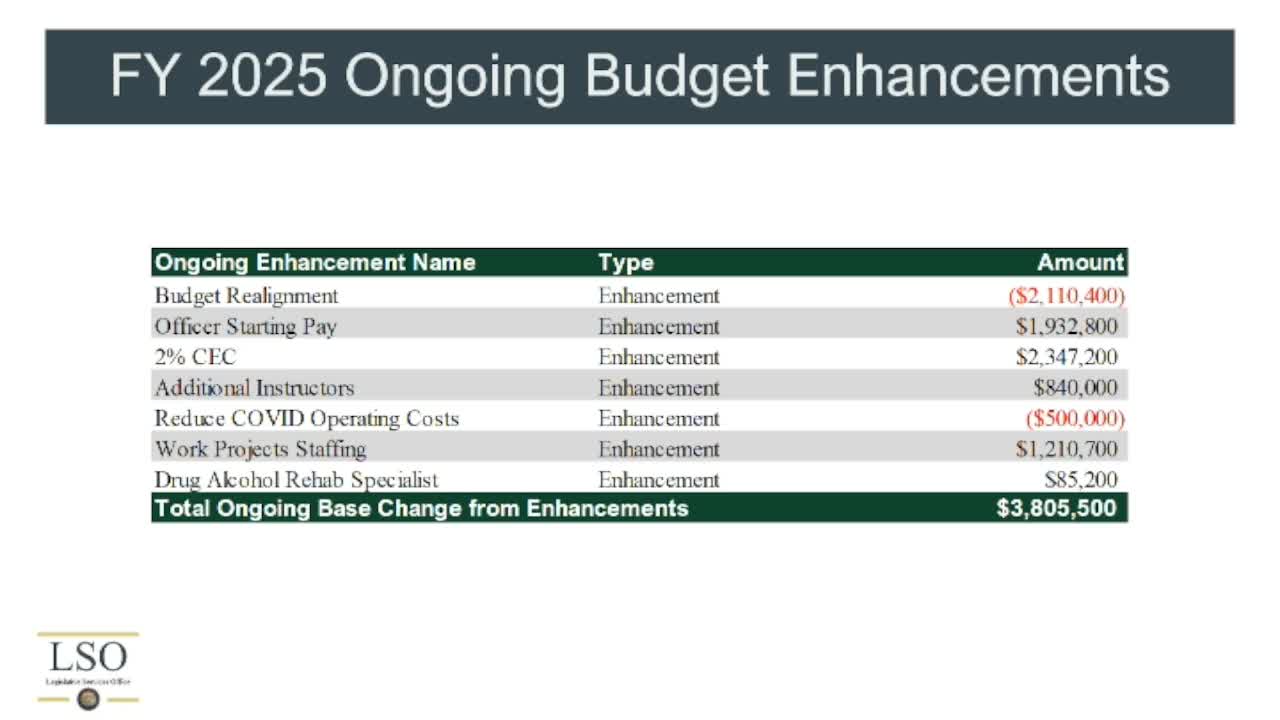
Noah Peterson, LSO budget analyst, said the agency proposes both one‑time supplementals and ongoing funding. One‑time requests for fiscal 2025 included a $1,148,000 expansion of the transport bureau (12 new positions and vehicles/equipment) and a $1,051,000 body‑worn camera pilot, largely financed with federal funds and a small general‑fund match. A supplemental of $795,000 was requested to begin implementing advanced surveillance technology this fiscal year.
For ongoing costs in fiscal 2026, the agency requested $2,397,000 for surveillance technology (broken down by agency estimates as about $1,011,000 for digital mail scanning, $385,500 for drone detection, and $1,000,000 for phone‑call transcription and analysis called ‘‘LEO’’), and $965,500 to fund 12 ongoing transport positions. Peterson said the LEO technology would transcribe and analyze phone calls — IDOC residents made roughly 4 million calls totaling about 49 million minutes in 2023 — and the mailbox scanning would divert physical mail for off‑site scanning to remove a porous entry point for contraband.
Director Josh Tewalt told the committee the requested items respond to vulnerabilities exposed during the transport incident. He described modern contraband methods — including treated inks and semi‑autonomous drones — and said mail digitization and drone‑detection systems would reduce risks and free staff to focus on higher‑value security activities. On transporting inmates, Tewalt described how facility staff currently handle emergency transports as an ‘‘other duty as assigned’’ and said the transport expansion provides a trained, equipped option to handle high‑risk movements without repeatedly pulling line staff from posts.
Committee members questioned whether creating 12 transport FTPs duplicates positions already handling transport and whether existing posts could be reallocated. Peterson and Tewalt said overtime hours driven by transports at high‑security facilities are significant (tens of thousands of overtime hours at some facilities) and argued the expansion addresses sustained workload and training needs rather than creating redundant posts.
The agency also requested funding for replacement items and small capital: a skid‑steer (snow removal) for St. Anthony’s work camp was proposed as a one‑time purchase; the governor’s recommendation instead proposed ongoing contracting for snow removal at $30,000 to avoid buying a seasonal‑use vehicle. The committee asked the Department of Facilities Management to clarify the buy‑vs‑contract decision and the director said the department will seek the most efficient approach.
No formal appropriation action occurred during the hearing. The director and analysts committed to providing additional detail on workload, overtime hours, and procurement options to help the committee evaluate the tradeoffs between one‑time purchases and ongoing contracting.