Get Full Government Meeting Transcripts, Videos, & Alerts Forever!
Get email alerts on the Recidiviz Case Management topic
No spam. Unsubscribe anytime.
Idaho DOC asks Legislature to fund expansion of Recidiviz data tools for prisons and supervision
Summary
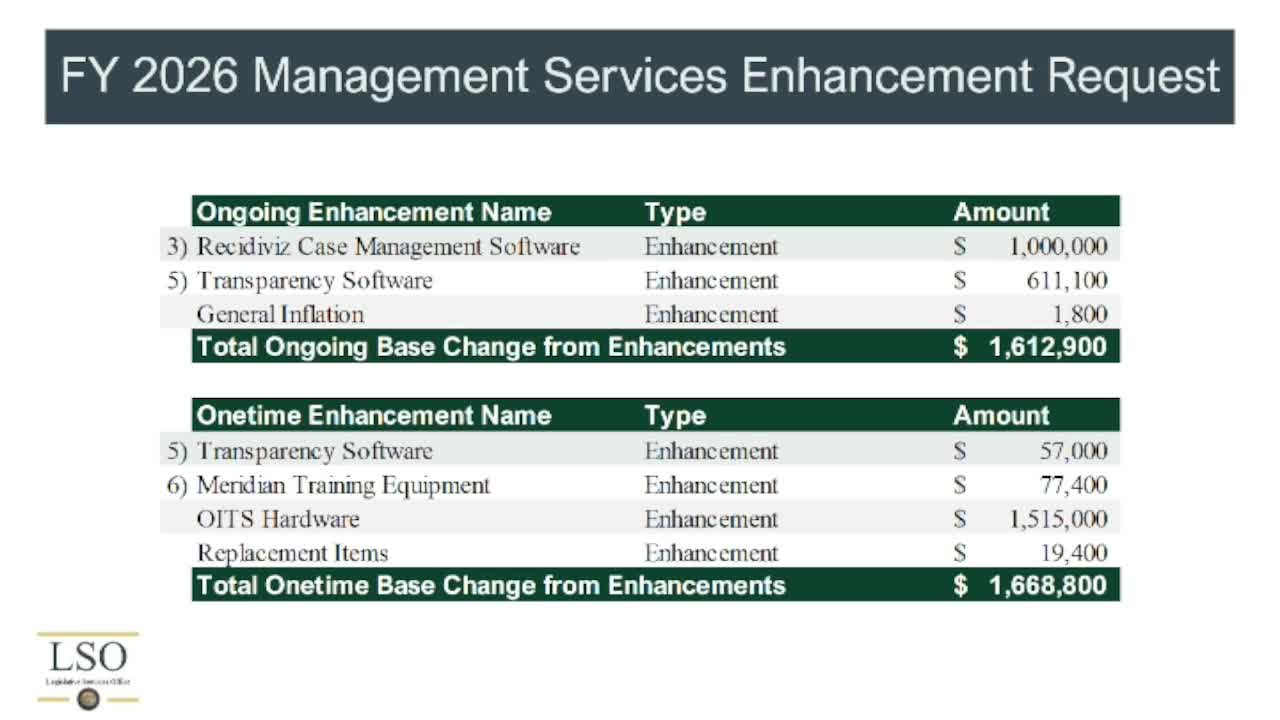
The Idaho Department of Correction asked the Joint Finance-Appropriations Committee to fund ongoing development of Recidiviz tools that have been used in probation and parole and are proposed for use inside prisons; agency leaders said the nonprofit partnership leverages private philanthropic matching but committee members asked for outcome data.
The Idaho Department of Correction requested ongoing funding to expand its partnership with Recidiviz, a nonprofit data-aggregation and analytics group, to bring tools now used by probation and parole into the state prison case-management environment.
Noah Peterson, budget and policy analyst with the Legislative Services Office, told the committee the Management Services Division received an appropriation tied to a recidivism case‑management software effort and that prior one‑time federal funding had supported initial work. He did not provide hard ROI figures for the committee during the presentation.
Director Josh Tewalt described Recidiviz as a nonprofit technology partner that pulls data from disparate, legacy systems, automates time‑consuming back‑office work and produces case‑triage tools for officers and case managers. ‘‘In probation and parole, we’ve created case‑triage tools so POs don’t have to review each client manually — they get reports that show where to prioritize their time,’’ Tewalt said. He said the intent in prisons is to automate back‑end tasks for case managers and to use the information to improve classification decisions in near real time.
Tewalt said Recidiviz matches state spending with private philanthropic dollars, and that every public dollar is leveraged against foundation funding. Committee members pressed for tangible outcome data and cost‑benefit information before committing ongoing general‑fund dollars.
Senator Cook asked for hard ROI data; Peterson said he did not have tangible metrics on hand and offered to obtain them from the agency. Representative Tanner asked for examples of the dashboards and cost calculators the tool can produce; Tewalt said the department can share the dashboards used in supervision and that staff use them for leadership, supervisory and officer‑level decisions. Senator Zieterfeld asked about matching funds; Tewalt said Recidiviz draws philanthropic support from multiple foundations and said the agency would provide transparency about funders to the committee.
Committee members expressed recurring concerns common to federal‑to‑state pilots: whether the department controls the underlying data, whether the vendor can or does manipulate outcomes, and whether short‑term federal funding will create long‑term general‑fund obligations. Tewalt answered that Idaho controls the source data through data‑sharing agreements and that Recidiviz pulls data from state systems rather than recreating it; he said the nonprofit helps the agency compare outcomes with anonymized peer jurisdictions.
The committee did not take an immediate vote on ongoing funding. Staff said they would provide outcome data and dashboards the department uses to help members evaluate the program’s effectiveness and to inform any request for annualized funding.
For now, the record shows the department proposing to transition functionality developed with one‑time federal and philanthropic funds into an ongoing, state‑funded effort pending the committee’s review of outcomes and cost comparisons.