Get Full Government Meeting Transcripts, Videos, & Alerts Forever!
Get email alerts on the State Budget topic
No spam. Unsubscribe anytime.
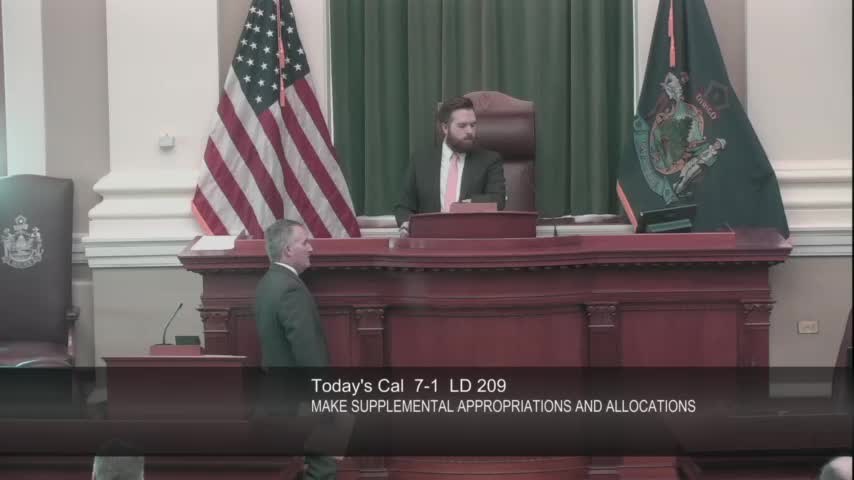
House approves emergency supplemental budget to close MaineCare shortfall, fund spruce budworm response
Summary
The Maine House passed a supplemental appropriation (House Paper 131, LD 209) to shore up MaineCare payments and fund an immediate spruce budworm response, after hours of debate and several amendments were indefinitely postponed.
The Maine House on Feb. 11 approved a supplemental budget (House Paper 131, LD 209) designated as an emergency measure to close an anticipated MaineCare funding gap, pay health providers and nursing homes, and provide time-sensitive funding to address a spruce budworm threat in northern Maine. The body adopted Committee Amendment A and sent the bill to the Senate after closely divided votes.
The budget package aims to appropriate general‑fund dollars to the Department of Health and Human Services so MaineCare can continue paying provider claims, and to provide funds this spring for targeted spraying and forest protection against a likely spruce budworm outbreak. Lawmakers repeatedly described the measure as narrowly focused on “urgent” items that must be financed immediately rather than a substitute for the larger biennial budget.
Supporters said the emergency measure was necessary to avoid immediate disruptions to the state’s health‑care system. “This funding gap needs to be closed,” a member of the Appropriations and Financial Affairs committee said during debate, citing a Department memo warning that, without immediate action, the state would begin capping payment cycles and making partial payments to providers in March. Committee and floor speakers described over $400 million in provider payments at risk and said MaineCare serves roughly 400,000 Mainers — about one in three residents — and a higher share in many rural counties.
Opponents and some Democrats pressed for additional priorities that were not included in the emergent package, most notably a cost‑of‑living adjustment (COLA) for direct care workers that several members said had been promised previously. “I cannot in good conscience vote for a budget that continues to pay ... yet does not pay our vital direct care workforce what they were promised,” Representative Verata said during floor remarks, urging the body to send the measure back to committee for further negotiation.
Other speakers framed the vote in broader fiscal terms: some Republican members said prior majority budgets had created the present shortfall and urged more bipartisan work before approving supplemental spending; other Democrats and committee members said the measure had been pared down in committee to emergency items only and that delay would risk service interruptions and supplier failures across hospitals, nursing homes and home‑ and community‑based providers.
The bill also includes a time‑sensitive appropriation to enable aerial or targeted spraying of infested stands using narrower, insect‑specific products and insect growth regulators; supporters described that spending as inexpensive “fire insurance” to prevent vast forest loss, major job losses in wood‑dependent communities and heightened wildfire risk if outbreaks are left untreated.
Votes at a glance - Acceptance of Appropriations & Financial Affairs committee report on House Paper 131 (LD 209): approved, 74–71. (Clerk announcement: “74 having voted in the affirmative and 71 in the negative.”) - Indefinite postponement votes on several floor amendments that would have changed policy (examples below): each motion to indefinitely postpone prevailed by recorded roll calls (tallies listed in the detailed actions). These postponements left the supplemental focused on the committee’s emergency items. - Adoption of Committee Amendment A to LD 209 (floor action to approve the committee’s package): approved, 73–71. - Second reading / passage to send to the Senate (as emergency supplemental): approved (committee amendment adopted and bill ordered sent to the Senate; recorded tallies during the session reflected closely divided votes as above).
What was debated - MaineCare finance: Committee members described a projected shortfall that would cause the state to run out of money to pay provider claims sometime in May unless the Legislature appropriates general‑fund dollars immediately. Speakers said a large share of hospitals, nursing homes, behavioral‑health providers and long‑term‑care organizations rely on MaineCare revenues and operate on thin margins; at least one large behavioral health provider reported limited cash reserves and warned of closure without timely payments.
- Direct care worker wage increase: Some legislators pressed that the package failed to include a previously discussed COLA for direct care workers who provide daily, in‑home and institutional supports; members opposing the bill said failing to deliver that increase broke a prior promise to the workforce and argued for returning the measure to committee to secure the adjustment.
- Spruce budworm response: Members described the eastern spruce budworm as a recurring, severe forest pest with outbreak cycles that can defoliate fir and spruce across millions of acres. The supplemental includes emergency funds to deploy targeted, narrower‑spectrum biological or insect‑growth‑regulator materials this spring to reduce outbreak potential and limit long‑term economic and job losses in timber‑dependent communities.
- Process and timing: Members on both sides criticized the speed and the partisan backdrop of the session: proponents said the committee narrowed the governor’s original, broader proposal to urgent, time‑sensitive items and negotiated bipartisanly in AFA; opponents said the underlying biennial budget choices had produced the emergency and called for returning the matter to committee to seek broader agreement.
Procedure and next steps The House adopted Committee Amendment A and completed second reading, ordering the bill sent to the Senate as an emergency measure. The Senate will receive the supplemental for its consideration; if approved as emergency legislation by both chambers and enacted, certain appropriations could take effect immediately to avert the payment disruptions described on the floor.
Ending Lawmakers acknowledged the measure was a pared‑down emergency fix. If the Senate approves LD 209, the Department of Health and Human Services will have appropriated general‑fund authority to continue MaineCare payments and the state will be positioned to carry out a time‑sensitive spruce budworm response this spring. Legislators who objected said they would continue to press for the omitted priorities — chiefly a promised COLA for direct care workers — as work on the broader biennial budget continues.