Get Full Government Meeting Transcripts, Videos, & Alerts Forever!
Get email alerts on the Tax Conformity topic
No spam. Unsubscribe anytime.
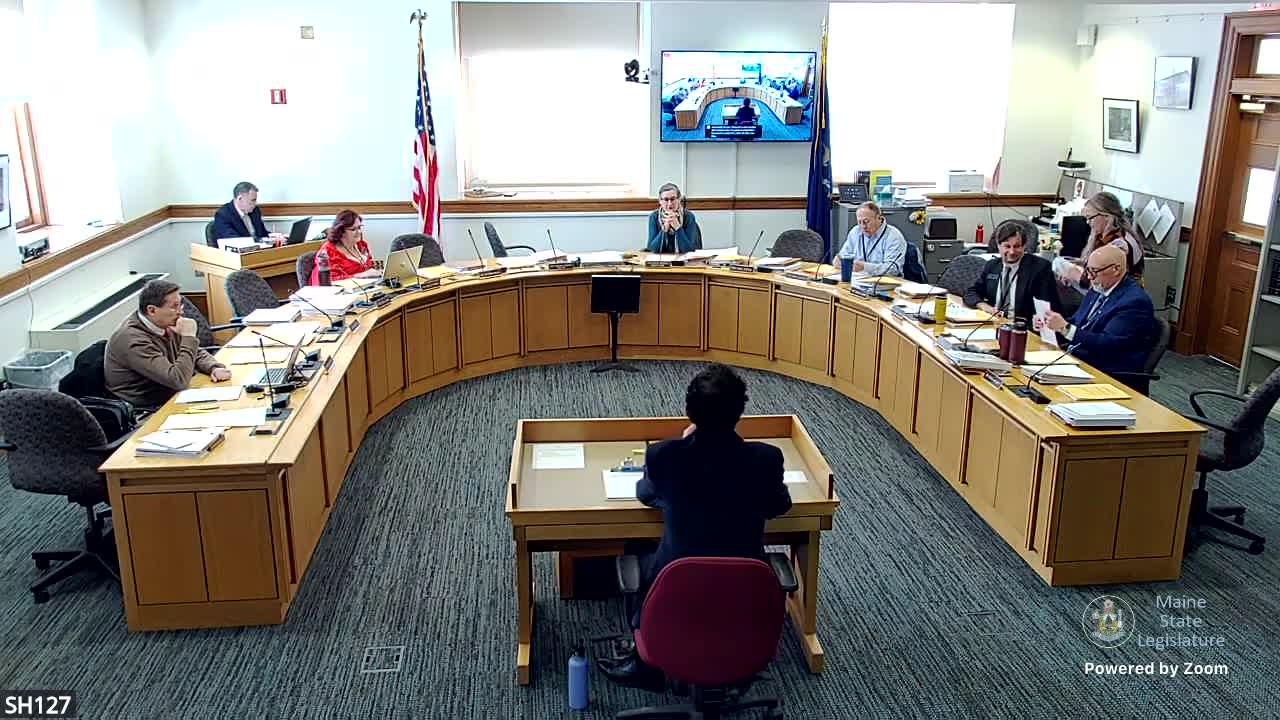
Maine revenue officials brief taxation committee on federal tax conformity, timing and form challenges
Summary
Maine Revenue Services staff told the Joint Standing Committee on Taxation that the state uses static conformity to link its income tax code to the federal Internal Revenue Code, but timing differences, form development and several limited state 'decouplings' create recurring administration and budgeting challenges.
Deputy Tax Policy Counsel Daniel D'Alessandro of the Office of Tax Policy told the Joint Standing Committee on Taxation that Maine broadly conforms to the federal Internal Revenue Code but uses targeted deviations for budgetary and policy reasons.
"When you fill out your federal return, you get to a line called adjusted gross income. You then can copy that onto your state return," D'Alessandro said, describing the mechanical link between federal and state filings and why many compliance rules track Washington. He said Maine generally uses static conformity — adopting federal law as of a specified date — and then enacts discrete state law changes when it intentionally decouples from a federal provision.
That distinction matters for taxpayers and state administration because timing of federal changes, federal legislative calendars and the state statute that defines the conformity date determine whether the state must redesign forms or add lines to collect nonconformity items. D'Alessandro summarized the workload: the agency develops draft forms and instructions in late summer and fall, sends them to vendors and completes quality control in December so filing can open in late January.
The committee heard several examples. D'Alessandro cited bonus depreciation as a common state decoupling: "Bonus depreciation is a big one. It has a real revenue impact for the state." He also said Maine previously decoupled from the federal standard deduction, the personal exemption and the child tax credit to limit state budget exposure as those federal items were scheduled to change.
Committee members pressed on process and timing. Representative Rachel Friedman asked how the legislature handled the extensive federal changes produced by the Tax Cuts and Jobs Act, which generated late debate and a special session at the state level. D'Alessandro said the magnitude and partisan nature of that federal bill made the state response more contentious and delayed final conformity action in that cycle.
D'Alessandro also walked the committee through constitutional constraints. He cited Article IX, Section 9 of the Maine Constitution — the clause that bars the legislature from "surrender[ing] the power of taxation" — and explained how that provision limits full rolling conformity. "Complete rolling conformity to the Internal Revenue Code is too much of a delegation," he said, while noting the legislature has authorized limited rolling conformity in specific areas such as section 529 college-savings plans.
On next steps, D'Alessandro said the administration typically prepares a conformity bill that would set the conformity date (the memo referenced December 31, 2023 as an example) and identify narrow decouplings. He told members the department expects congressional decisions on expiring provisions to continue to create pressure on the state calendar, especially for provisions that expire or are extended late in the federal year.
Senator Nicole Grochowski, chair of the Joint Standing Committee on Taxation, and Representative Kristen Cloutier — who is sponsoring two agency bills referenced in the discussion (one on process and one the standard conformity measure) — said the committee will hold public hearings and continue to engage with Maine Revenue Services as the bills are scheduled. No formal votes were taken during the briefing.
Why this matters: conformity choices affect how quickly Maine taxpayers can file, whether state refunds can be issued on schedule, and how state revenue projections respond to federal changes. The committee was advised that the practical approach used by past administrations — preparing draft forms consistent with likely conformity and reserving lines or instructions for late changes — has allowed filing to open on time while the legislature resolves statutory authorization.