Get Full Government Meeting Transcripts, Videos, & Alerts Forever!
Get email alerts on the Healthcare Affordability topic
No spam. Unsubscribe anytime.
Maine health affordability office: per-unit prices — especially outpatient hospital prices — are driving cost growth
Summary
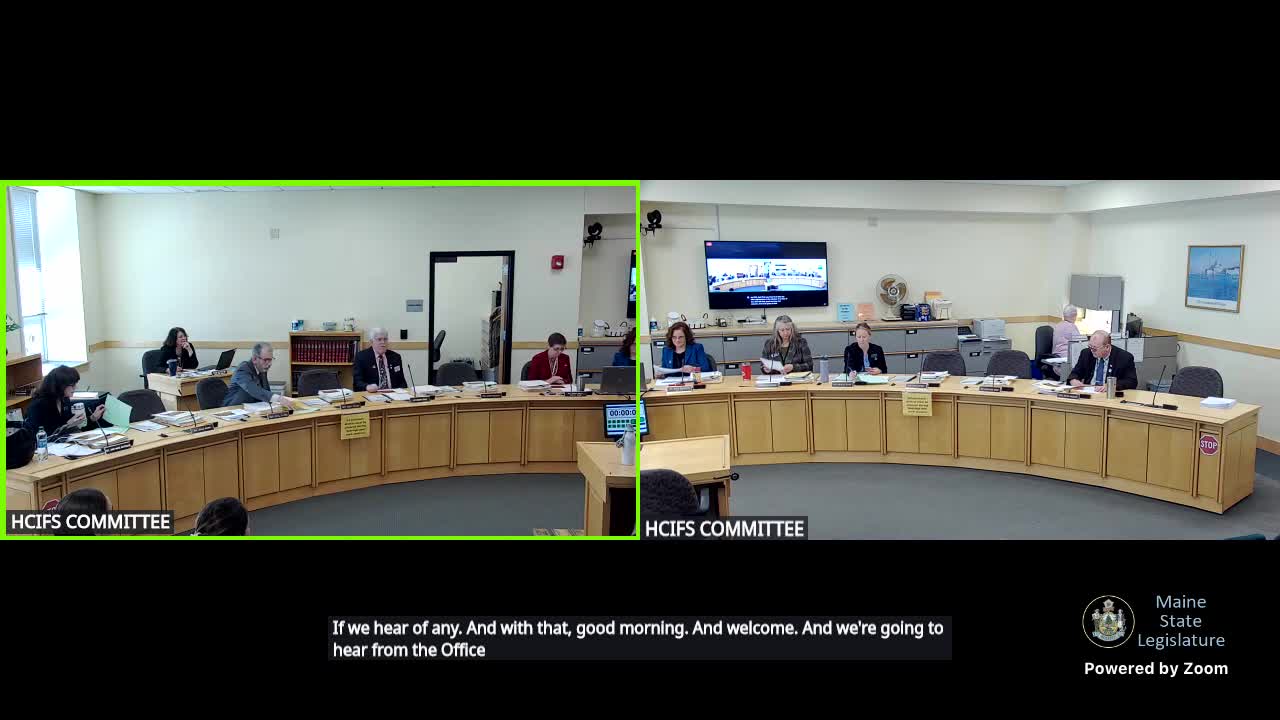
Meg Garrett Reid, executive director of the Office of Affordable Health Care, told the Health Coverage Insurance and Financial Services Committee during a scheduled meeting that rising per-unit payments — particularly for outpatient hospital services — are a major driver of increased health care spending in Maine and outlined the office’s 2025 priorities: provider-market oversight, aligning payment incentives, and exploring commercial-price regulation.
Meg Garrett Reid, executive director of the Office of Affordable Health Care, told the Health Coverage Insurance and Financial Services Committee during a scheduled meeting that rising per-unit payments — particularly for outpatient hospital services — are a major driver of increased health care spending in Maine, and that the office will prioritize provider-market oversight, aligning payment incentives, and exploration of commercial price regulation in 2025.
Reid, who described the Office as “a small, independent executive agency,” said the office was created by the legislature in 2021 and formally established in 2023 when she was confirmed as its first director. The agency now has a three-person staff and supports a 13-member advisory council chaired by Trevor Putnocki and vice-chaired by Kate Endy. Reid said the office has published new hospital payments and utilization dashboards in partnership with the Maine Health Data Organization (MHDO) and vendor HSRI and will use those data to inform future policy work.
Why it matters
The office’s analysis, drawing on CMS national health-expenditure data and state claims work, shows hospital services account for about 40% of Maine’s total health expenditures, physician and clinical services about 20%, prescription drugs about 12%, and dental services about 4%. Reid told the committee that while prescription drugs have been a policy focus, hospital and physician services represent a larger share of total spending. She said the increase in commercial-market spending appears driven more by rising payments per service than by higher utilization.
What the office reported
Reid summarized several data findings for the committee. Using commercial claims analyses, the office and MHDO produced dashboards that separate three measures for inpatient and outpatient spending: payments per capita, payments per unit (a proxy for price), and utilization (number of services used). In those charts, Reid said, “the payment per unit line, that green line that reflects essentially price, for services, has gone up fairly significantly and particularly significantly in the outpatient, spending category.”
The office also shared work by actuaries and consulting partners that examined insurer rate filings for 2025. Reid said the average 2025 rate increase in the individual market analyzed in that work was 9.1%, and that a major share of that increase was attributable to medical unit cost; “the far left bar, the medical unit cost where the average increase, across all the carriers that were analyzed was 4% or just under 4%,” she said. Reid and the contractors also attributed portions of rate changes to changes in utilization and pharmacy cost and utilization.
Consumer impact
Using estimates produced with the Urban Institute, the office estimated that average household spending on health care in Maine is about 10% of household income (the study covered all payers, including MaineCare). Reid gave an illustrative example: a family of four making about $93,000 would spend a little over $12,000 a year on health care costs (including premiums and out-of-pocket spending). Reid noted the distribution of costs varies widely — some individuals have very low annual spending while many others face much higher burdens.
Policy priorities and next steps
Reid said the office has identified three priority areas for 2025: provider-market oversight and competition (including attention to private-equity and consolidation trends), aligning incentives to promote efficiency and quality (including monitoring and supporting alternative payment models), and exploring regulation of commercial prices for health care services. She described the office’s role as data-focused and as a convener to bring payers and providers together on solutions.
Facility fees and reporting
On facility fees, Reid said the office reviewed laws in 16 other states and concluded Maine’s approach — including an early standardized claim form law (2005) and subsequent legislative action — is among the most comprehensive. She noted one potential gap: telehealth facility fees are specifically limited in some other states, and Maine’s 2005 law predated the expansion of telehealth. Reid also reported unevenness in how the standardized-claim requirement is applied in practice based on MHDO data and conversations with hospitals and carriers, and she flagged PL 2023, ch. 521, which requires physical-location information on claim forms as a tool that should improve future enforcement and analysis.
Public option study
Reid summarized a public option study the office submitted last year that reviewed three models: a MaineCare buy-in, a state-administered plan that resembles MaineCare but operates in the commercial market, and a federal basic health program model for people between certain income bands. She said the report concluded there is no one-size-fits-all public option and that any public-option design must clearly define which population it is intended to help.
Committee engagement and follow-up
Several legislators asked for more detailed breakouts and follow-up analysis. Committee members pressed for: a Maine-only estimate excluding MaineCare enrollees; a clearer inpatient/outpatient differentiation of hospital services; and more detail on whether consolidation of hospitals and acquisition of physician practices are affecting outpatient prices. Reid said the office plans deeper dives in 2025 and to use the MHDO dashboards and claims data to explore causes and potential policy responses.
Actions identified at the meeting
- The office said it has published hospital services payments and utilization dashboards with MHDO and HSRI (published).
- The office delivered a facility-fee report to the committee and noted implementation issues and a possible telehealth gap (delivered).
- The office reported it had submitted a public option study last year and summarized the three models analyzed (submitted).
- The committee chair announced an intent to take LD 310 (taken out of order for the day) and anticipated tabling LD 238 and LD 239 in afternoon work sessions (anticipated tabling; no formal vote reported in this transcript).
Closing
Reid told the committee the office will return with deeper analyses and convene stakeholders to develop targeted policies, emphasizing that the office’s 2025 work will move from building a shared data foundation toward considering concrete policy options.