Get Full Government Meeting Transcripts, Videos, & Alerts Forever!
Get email alerts on the State Budget Labor topic
No spam. Unsubscribe anytime.
Maine Department of Labor outlines $400M biennial budget, highlights PFML rollout and assistive-technology requests
Summary
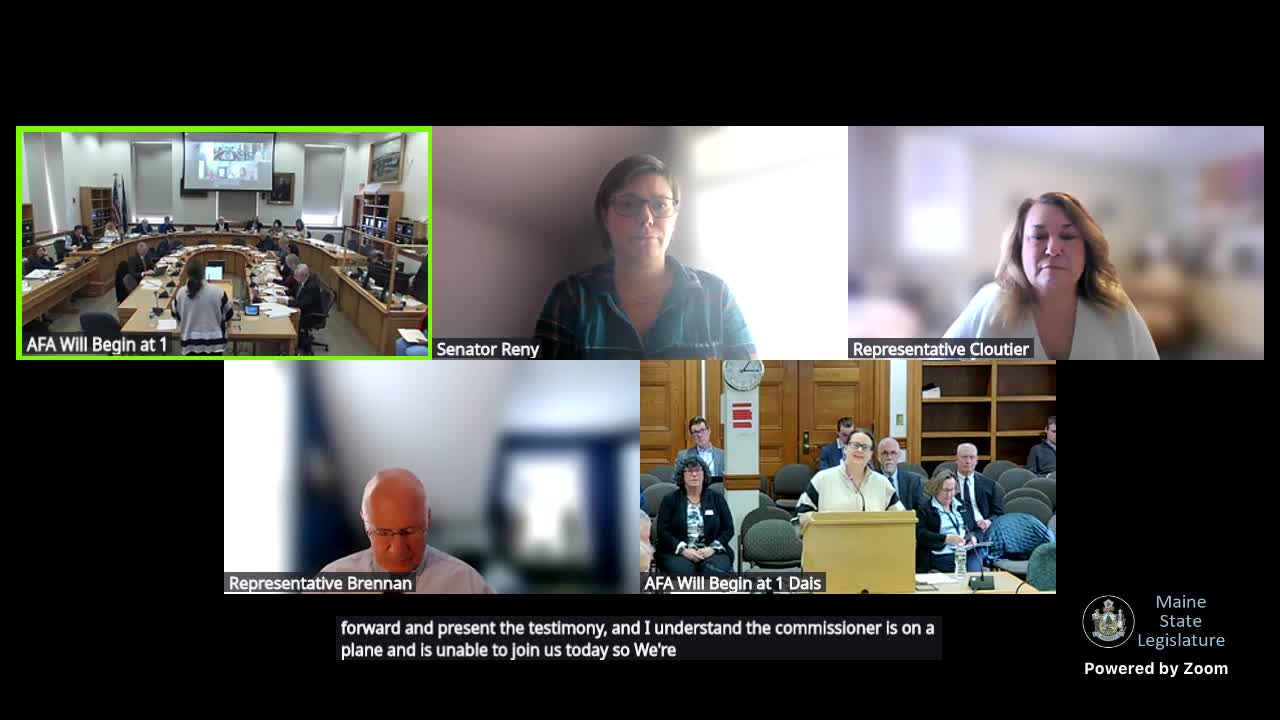
Deputy Commissioner Kimberly Smith of the Maine Department of Labor told the Legislature’s Joint Standing Committee on Appropriations and Financial Affairs and Labor that the department’s proposed biennial budget totals just over $400 million per year and includes multiple staffing and program requests to support the Paid Family and Medical Leave rollout, appeals capacity and services for people with disabilities.
Deputy Commissioner Kimberly Smith of the Maine Department of Labor told the Legislature’s Joint Standing Committee on Appropriations and Financial Affairs and Labor that the department’s proposed biennial budget totals just over $400 million per year and includes multiple staffing and program requests to support the Paid Family and Medical Leave rollout, appeals capacity and services for people with disabilities.
"Like many states, both blue and red, Maine is facing a tight budget environment," Smith said, summarizing the administration’s approach to balancing program preservation with targeted investments and some spending cuts. She added, "We look forward to working with you over the coming months to enact a budget that supports the greatest asset of all, the people of Maine."
The nut graf: Smith presented line-item detail across the department’s bureaus and programs and identified the Paid Family and Medical Leave (PFML) implementation, a transfer that would create a standalone Division of Administrative Hearings, and new assistive-technology staff for the Division for the Blind and Visually Impaired (DBVI) as among the most consequential requests for the coming biennium.
Smith said the department’s total budget is "just over $400,000,000 per year," with roughly $250,000,000 budgeted for unemployment benefit payments and about $150,000,000 covering staffing, contracted workforce development and program costs. She told lawmakers the General Fund contribution would be about $16,500,000 per year and that the General Fund baseline would rise roughly $1,800,000 compared with the prior biennium, including $1,100,000 to cover negotiated salary and benefit increases.
Paid Family and Medical Leave: timing, costs and staffing
Smith reviewed PFML implementation timelines and funding. She said the statute staggered implementation so contributions begin in 2025 and benefits begin in 2026. Quoting departmental figures, she said the fiscal note estimated $25,000,000 was transferred into the PFML account to cover implementation costs incurred before contributions began. "Employer registrations began this month and so far about 17,000 Maine employers have completed the process," Smith said. She said ongoing operating costs are expected to be just over $13,000,000 per year and paid from program contributions.
The department requested two staffing-related PFML initiatives: restoring a formerly reduced office associate position to full time and establishing three labor and safety inspector positions to join the Wage and Hour Division beginning next January. Smith said the inspector positions were in the original fiscal note but were not included in the initial staffing cohort because they would not be needed immediately at startup.
Division of Administrative Hearings: transfer and statutory language
Smith described a proposal to move the Department’s Division of Administrative Hearings out of the Bureau of Unemployment Compensation and reestablish it as a standalone Division that would hear appeals across unemployment, PFML and labor-law citations. That package would transfer 13 positions from Employment Security Services and add four hearings officer positions to the new Division. Smith said the statutory language for that transfer appears in the budget bill as Part PPP; she characterized the change as a relocation of authority rather than an expansion of new regulatory powers.
Blind and visually impaired services: staff and technology requests
Smith said DBVI’s budget is primarily about $4,600,000 in General Fund dollars and roughly $4,700,000 in federal funds. The department asked for three assistive-technology specialist positions to provide in-house training on emerging tools, including AI-powered object recognition and real-time image description, and requested $200,000 in General Fund dollars to procure assistive devices and software. Smith said the specialists would replace higher-cost contracted services and noted those positions would be funded through an existing federal grant while the technology procurement would come from the General Fund.
Unemployment, employment services and apprenticeship programs
Smith gave top-line figures for other programs. She said the unemployment program’s operating budget is about $36,000,000 in federal funds plus $9,800,000 in other special revenue with no General Fund dollars. Employment Services — career centers and partner programs that help jobseekers with training and placement — includes roughly $800,000 in General Fund support, $24,000,000 in federal funds and $10,000,000 in other funds, Smith said. The department proposed creating baseline allocations to continue work started with the Main Jobs and Recovery funds (MJRP) and to make a previously part-time career-center consultant a full-time position.
Labor enforcement, hearings and collections
Within the Bureau of Labor Standards, Smith outlined three initiatives totaling $300,000 in General Fund "all other" that would pay for dedicated IT support for the bureau’s case-management system, additional resources for collections when citations become final and funds to support appeal hearing officers. Smith said the department anticipates higher hearing costs due to both an increase in appeals and the cost of holding hearings and plans to transition contracted hearing officers to the Division of Administrative Hearings. She also noted a request to add three labor and safety inspector positions (described above under PFML staffing) to strengthen wage-and-hour compliance and classification enforcement.
Rehabilitation services and supports for deaf and hard-of-hearing residents
Smith described Rehabilitation Services’ federal Pathways to Partnership grant and two limited-period positions the department wants to continue through June 2027. She said increased demand for communications and telecommunications equipment for people who are deaf or hard of hearing has prompted a request to increase a special-revenue allocation; the equipment is funded via a transfer from the Public Utilities Commission paid by surcharges on analog and cellular accounts, and Smith said the commission indicated the transfer could be accommodated without a rate increase. Smith also said contractual costs for civil-rights and advocacy support for deaf and hard-of-hearing individuals have risen "following the Lewiston tragedy," increasing the need for funds.
Why it matters and next steps
Committee chairs opened the hearing and asked members of both committees to introduce themselves before Smith’s presentation; no formal committee action occurred in the transcript excerpt. The department’s requests would affect benefits administration, appeals capacity, enforcement staffing and services for people with disabilities. Lawmakers on the Appropriations and Labor committees will review the department’s budget language and the associated statutory parts (including language noted by the department as Part PPP and other language in the draft bill) as they consider adjustments during the budget process.