Get Full Government Meeting Transcripts, Videos, & Alerts Forever!
Get email alerts on the Land Use topic
No spam. Unsubscribe anytime.
Miller Ranch PUD amendment would raise allowable homes from 193 to about 1,400; county officials press for studies and buffers
Summary
Developers proposing a PUD amendment for the 970-acre Miller Ranch in Elbert County say the plan would increase allowed housing from 193 units to about 1,400, keep roughly 40% open space and rely on two existing metro districts for infrastructure; county officials and neighbors raised questions about traffic, water, schools and lot compatibility.
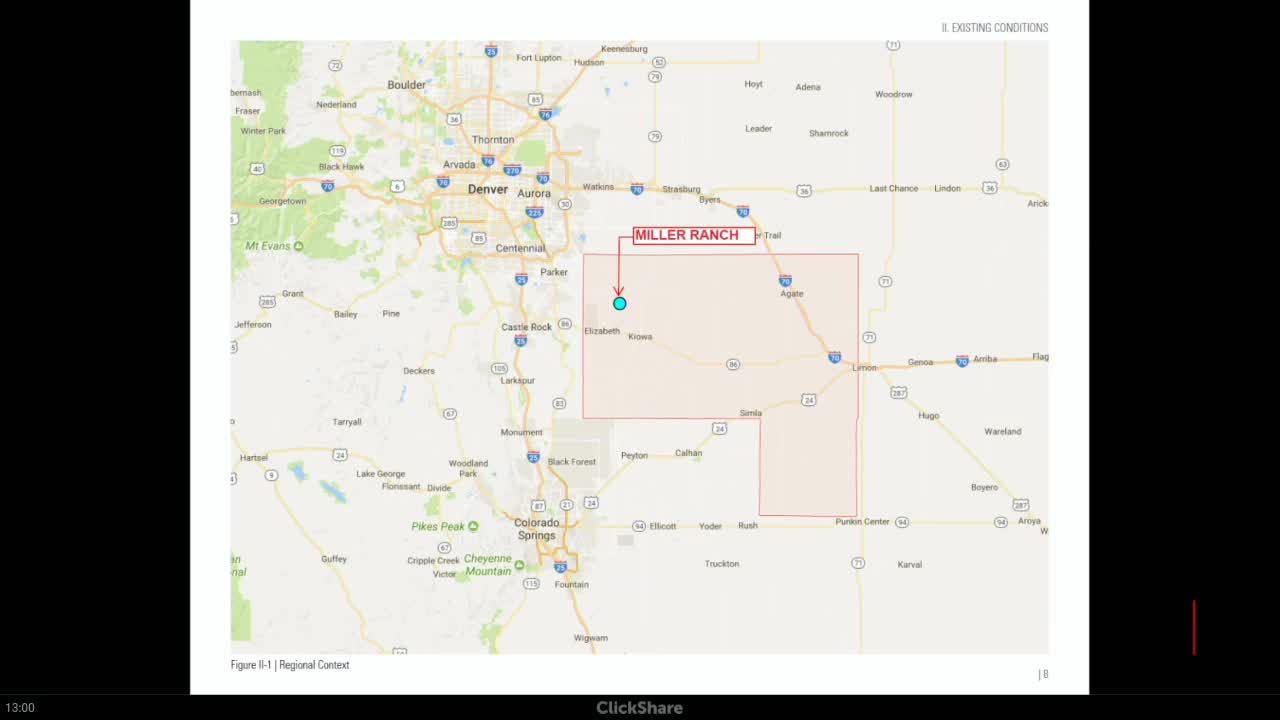
Developers seeking to amend the Miller Ranch planned-unit development (PUD) in Elbert County presented a concept brief on a proposal to increase the allowed units from the original 193 to roughly 1,400 on about 970 acres and said they would preserve approximately 40% open space.
Doug Hatfield, who identified himself as a member of the CND Land Company that purchased Miller Ranch, said the applicants are “here to continue to listen and learn and work with you and the community to do something that’s palatable for all.” He and partner Corey Phillips described the filing as a PUD amendment intended to allow smaller lots and more attainable home price points.
Mark Denreuder, Elbert County director of community and economic development, said the original Miller Ranch PUD was approved in February 2007 for 193 units and noted the property remains vacant. County staff and commissioners pressed the applicants for detail on required studies and on how the amended PUD would be phased and serviced.
The applicants’ land-planning consultant, identified as Garrett Graham of PCS Group, said the concept map shows clustered neighborhoods with neighborhood parks, a community center and an open-space fringe. He described proposed lot sizes ranging from roughly one-acre lots to quarter-acre lots and smaller lots (referred to in the presentation as "eighth-acre" in places), and said the submitted concept shows a mix of lot sizes rather than multifamily housing. The applicants said they removed some lots along the northern and western property edges after community feedback to create larger buffers.
County officials and several commissioners asked for specific studies. Graham said the first PUD submittal will include a traffic letter and that a full traffic study is expected to be completed within about a month and provided during the formal application process. He also said a water study is under way; the applicants named “Dina Telly water consultants out of Boulder” as the firm conducting that work. The applicants said a preliminary drainage study has been submitted.
On utilities, the presenters said two existing special districts tied to Miller Ranch — the Miller Ranch Water and Sanitation District and the Miller Ranch Metro District — remain in place and would be responsible for paying for water, sanitation treatment and infrastructure; the applicants said no bonds were issued when the districts were created and that the applicants now serve on the districts’ boards.
Commissioners and other officials asked about public safety, schools, timing and development pace. The applicants said the development would likely be built in four to five phases over roughly four to six years though they acknowledged it could take longer depending on market demand. On schools, the applicants said they would contemplate either land dedication or cash in lieu; a county official reported that the local superintendent said a bond measure to fund new schools would be unlikely and that expanded school capacity might rely on charter schools.
Several commissioners and attendees said the proposed densities are incompatible with surrounding properties, which include large rural lots. Commissioners suggested shifting higher densities toward the interior of the property and larger lots near the perimeter to create a transitional buffer; the applicants said they had discussed that internally and had already increased outer-lot sizes in some locations.
No formal actions, votes or approvals were taken at the concept brief. County staff said that, during the formal application process, referral agencies — including fire, law enforcement, emergency medical services, road and bridge, and the school district — will review the submission and provide feedback to planning staff before the matter advances to the planning commission and the board of county commissioners.
The concept brief concluded with applicants saying they will continue to revise the plan and provide additional materials to county staff and commissioners as requested.