Get Full Government Meeting Transcripts, Videos, & Alerts Forever!
Get email alerts on the Conservation Water topic
No spam. Unsubscribe anytime.
Budget includes funds for farmland conservation, Duck River planning and a $100 million water-distribution seed fund
Summary
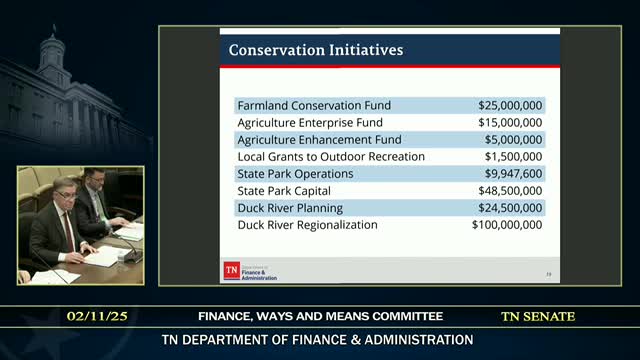
Bryson said the FY26 proposal funds farmland conservation ($25M), watershed planning for the Duck River ($24.5M) and $100M seed money for a regional water-distribution plan to reduce pressure on the Duck River; senators asked how the Duck River work could serve as a model statewide.
The administration proposed investments to preserve farmland, grow the state park system and address water supply and habitat concerns in the Duck River watershed.
Bryson said the budget "sets aside 25,000,000 for a farmland conservation fund" to help preserve farmland. He described the Duck River as "the most biologically diverse river in the nation" and proposed $24,500,000 to develop a plan for water use, habitat protection and river management in the Duck River watershed. In addition, Bryson said the budget includes "$100,000,000 in seed money for a water distribution plan" that would build pipeline capacity to bring water into the fast-growing region to reduce reliance on the Duck River.
Nut graf: The administration described the Duck River investments as a combination of planning, habitat protection and infrastructure to serve growing communities while reducing ecological pressure on the river. Senators asked whether the administration plans to replicate the Duck River approach for other watersheds and how grant and local allocations will be distributed.
Several members thanked the governor for the funding and asked for additional details; Bryson said the governor's executive order and planning will consider lessons for other watersheds, and that staff will provide follow-up on local grant distributions and project details.
Ending: Members asked for more detail on local grant earmarks and expressed support for conservation and the water-distribution planning effort.