Get Full Government Meeting Transcripts, Videos, & Alerts Forever!
Get email alerts on the School Safety And Threat Assessment topic
No spam. Unsubscribe anytime.
Departments present school‑safety update: Safe TN app, homeland agents, threat assessments and grant monitoring
Summary
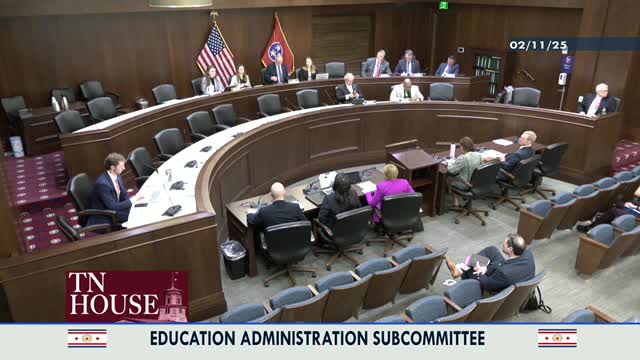
Officials from the Tennessee Department of Education and the Office of Homeland Security briefed the Education Administration subcommittee on ongoing school safety work, including the Safe TN reporting app, behavioral threat assessments, homeland agents in counties and the status of school safety and SRO grants.
State education and safety officials told the Education Administration subcommittee they are continuing a multi‑pronged effort to reduce threats to schools through prevention, security measures and behavioral threat assessment.
Shannon Gordon, chief operating officer for the Tennessee Department of Education, described the department’s distinction between "school safety" (prevention, mental‑health supports, threat‑assessment teams and training) and "school security" (physical measures such as cameras, locked doors and crisis response). Gordon said local education agencies must maintain Save Act coordinators, share building plans with local law enforcement, conduct annual drills and perform safety assessments in coordination with the Department of Safety and Homeland Security.
Greg Mays, deputy commissioner for the Tennessee Office of Homeland Security, said the office treats threat assessment as a critical component and has nearly completed hiring homeland agents placed in every county to support local threat assessments and responses. Mays cited national research showing that most averted attacks were stopped because someone reported the prospective attacker or reported abnormal behavior; he described the office’s work investigating school threats and intervening when students show capability and intent.
Officials described the Safe TN app, developed by the Office of Homeland Security and funded with federal grant dollars, which allows anonymous tip submission and is monitored 24/7. Mays said tips from the app and other sources (local law enforcement, social media, school staff) are investigated and can trigger multidisciplinary threat assessments and interventions, which may involve mental‑health providers, juvenile courts or temporary removal from school if a threat is deemed credible.
Committee members asked how safety assessments interact with the state-funded school safety grants. Department staff said most grant projects are reimbursement‑based and districts submit documentation to receive funds; districts may prioritize purchases and, under grant rules, can move equipment among schools based on evolving needs. Elizabeth Stroker, legislative director for the Department of Safety, said the detailed safety assessments themselves are not public because releasing them could disclose vulnerabilities; the departments provide aggregated trends and quarterly reports to the General Assembly.
Officials said the departments coordinate follow‑up and compliance: the Department of Education’s regional safety liaisons monitor district grant documentation and the Department of Safety and Homeland Security provide technical assistance and threat assessment expertise. Mays emphasized the importance of reporting and community awareness, saying the most concerning threats are those the system does not know about.
What’s next: Departments will continue monitoring grant implementation, conducting safety assessments, and supporting local threat assessment teams. Officials said additional hiring and training to maintain homeland agent coverage remains ongoing.