Get Full Government Meeting Transcripts, Videos, & Alerts Forever!
Get email alerts on the Capital Bonding topic
No spam. Unsubscribe anytime.
Budget proposes bonding nearly $930 million of capital projects; administration frames bonding as prudent leverage under AAA rating
Summary
Commissioner Bryson outlined a plan to bond nearly $930 million for capital projects, which would raise annual debt service; administration said the state remains well below the funding board's 6% debt-service ceiling and proposed an annual comptroller debt-capacity study.
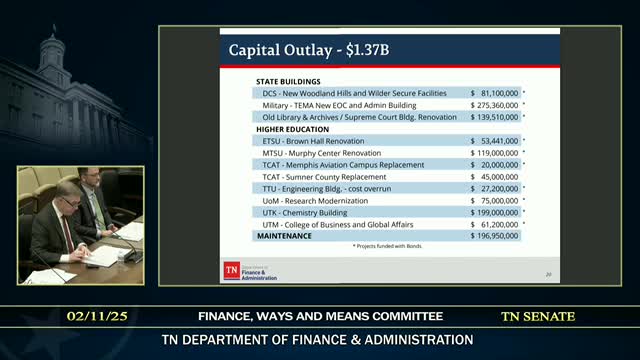
Commissioner Bryson presented a capital plan that would use bonding to advance a set of state and higher-education projects and described the debt profile the administration expects if bonding proceeds.
Bryson said the projects proposed for bonding "would total almost $930,000,000 in total debt resulting in $87,500,000 in new debt service for the general fund and $9,200,000 for this facilities revolving fund or FERF. When expiring debt service is netted out, the total increase in debt service will be $61,700,000." He emphasized the state's conservative fiscal position and the desire to preserve the state's AAA credit rating while using moderate debt as a leveraging tool.
Nut graf: The administration argued that borrowing now can reduce total cost because construction inflation has been fast relative to interest rates; it described guardrails: adhere to the funding board debt policy (debt service not to exceed 6% of state tax revenues) and proposed the comptroller conduct a debt capacity study each year the state issues new debt.
Senators asked procedural and cost questions: how the budget budgets debt service (administration answered the practice is to budget at a conservative yield and then true up when actual bond yields are known), whether the practice represents a policy change (administration said the funding board policy remains unchanged but the administration decided to use available bonding capacity), and how bonding affects capital and cash available for transportation.
Ending: Members were told a capital hearing will be scheduled later in session for detailed review of project lists, financing assumptions and expected market yields.