Get Full Government Meeting Transcripts, Videos, & Alerts Forever!
Get email alerts on the State Budget topic
No spam. Unsubscribe anytime.
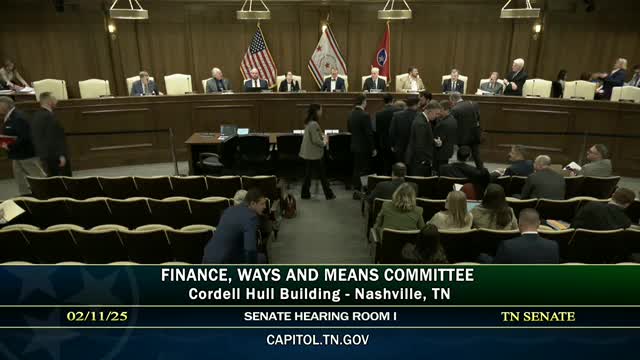
Commissioner Bryson presents FY26 budget overview, cites modest revenue growth and use of one-time funds
Summary
Commissioner Bryson told the Senate Finance, Ways and Means Committee the governor's FY26 budget assumes 2% tax revenue growth, relies on previously reserved recurring funds used as one-time investments, and proposes targeting $3.6 billion of available recurring/nonrecurring resources for FY26 spending.
Commissioner Bryson, of the Department of Finance and Administration, presented the governor's FY26 budget overview to the Senate Finance, Ways and Means Committee, saying the budget assumes modest tax growth and uses prior one-time reserves to smooth spending.
Bryson said the administration expects state tax revenue to grow about 2% in FY26, telling the committee the state "expect[s] state revenues to grow slightly to $29,500,000,000 compared to $27,000,000,000 in FY '25." He said total revenues for FY26 will be affected by the end of federal COVID-era programs and estimated total available revenues are "just north of 3,600,000,000" in additional funds the budget can spend.
The nut graf: Bryson framed the proposal as a conservative plan that uses previously accumulated recurring funds that were spent on one-time capital or other nonrecurring items in high-growth years so those dollars are available again when growth slowed. He described a multi-year pattern in which recurring revenue surpluses were used for nonrecurring investments (TCAT master plan, road projects) and then became available again to smooth FY25-to-FY26 budgeting.
In detail, Bryson explained the administration used $1.3 billion of recurring revenue for nonrecurring spending in FY23 and roughly $2.6 billion in FY24, and that the FY25 budget included $973 million of recurring revenue applied to nonrecurring needs. "In this FY '26 budget, we plan to use 411,000,000 of recurring revenue for nonrecurring expenses that will be available for the FY '27 budget next year," he said. He also pointed to unusually large FY24 reversions (about $1.5 billion) that increased FY25 available balances.
Committee members pressed staff on specific line items. Senator Hensley asked whether refunds for F&E taxes were included; Bryson replied that the administration has refunded about $1.3 billion to date and "are recognizing about $113,000,000 in this budget and leaving some residual in that fund" because of extended deadlines for some claims. Other senators asked for clarification about accounting differences between the budget book and later appropriations; staff said timing and print deadlines explain some apparent duplication.
Bryson also highlighted agency-led base reductions: agencies offered a 1% reduction exercise yielding more than $94 million of savings rolled into the FY26 proposal, and he noted the state is realizing recurring savings from the OPEB paydown plan implemented in prior years.
Ending: Bryson closed by urging continued partnership between the administration and the legislature as the committees review department-level budgets and follow-up work on specific items, and he invited members to submit more detailed questions to agency staff.