Get Full Government Meeting Transcripts, Videos, & Alerts Forever!
Get email alerts on the State And Local Government topic
No spam. Unsubscribe anytime.
Senate committee hears University of Tennessee Institute for Public Service overview; consent calendar item moved
Summary
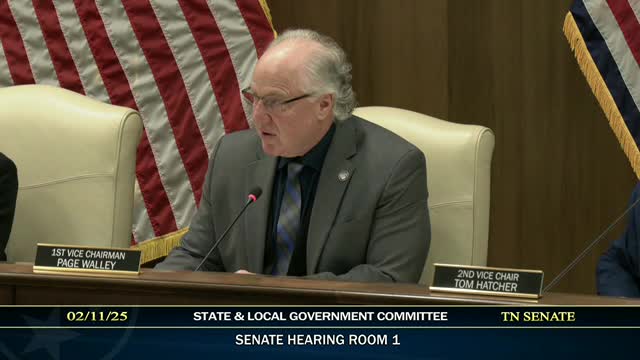
The Senate State and Local Government Committee heard a presentation Feb. 11 from Dr. Herb Byrd, vice president for public service at the University of Tennessee Institute for Public Service, on the institute’s statewide programs and approved moving SJR0007 from the committee’s consent calendar to the Calendar and Rules Committee.
The Senate State and Local Government Committee heard a presentation Feb. 11 from Dr. Herb Byrd, vice president for public service at the University of Tennessee Institute for Public Service, detailing the institute’s statewide programs in economic development, law enforcement training, municipal and county technical assistance, language services and opioid-abatement support.
Dr. Herb Byrd told the committee the institute documents “over $2,000,000,000 of customer reported economic development” statewide and described programs that served manufacturers, municipalities and counties, law-enforcement agencies and language-access needs. He highlighted a 10-day manufacturing “boot camp” for incarcerated individuals, law-enforcement leadership training developed for the Memphis Police Department, and the SMART initiative that helps counties plan opioid-abatement spending.
The presentation matters because the institute provides training and technical assistance used by local officials and public-safety agencies across all 95 Tennessee counties, influencing workforce development, emergency planning and how local governments spend opioid-abatement funds.
Dr. Byrd said the Center for Industrial Services last year served 355 manufacturers and generated most of the institute’s reported economic impact; the center expects to generate more than $2,500,000,000 in customer-reported impact in 2025 and will provide economic and workforce development training to at least 320 economic developers. He described the manufacturing boot camp as a 10-day program delivered in correctional facilities and local jails, intended to teach entry-level manufacturing skills and reduce recidivism: “They literally go into jails and they take a group of inmates that are not far from release,” Byrd said.
On county and municipal services, Dr. Byrd described CTAS (County Technical Assistance Service) and MTAS (Municipal Technical Advisory Service) work after recent flooding, a county-official orientation program called COOP, and plans to offer emergency-management and solid-waste certificate programs. He said MTAS helps cities with financial statements, wastewater arrangements and fire-hydrant maintenance programs.
On public-safety training, Byrd described the Law Enforcement Innovation Center’s (LEIC) work for Memphis — an executive-level leadership academy and courses on human trafficking, forensic photography and Spanish-language instruction for officers — and said LEIC will focus this year on cyber and technology training and a new executive leadership program. He noted the institute’s language services provided Spanish and Arabic interpretation of the Nashville mayor’s “state of metro” address and that the institute offers a Japanese kanji aptitude test.
Byrd summarized the SMART initiative (Substance Misuse and Addiction Resource for Tennessee), saying it worked with over 50 counties last year to develop lawful opioid-abatement plans and intends to help more than 70 counties this year. He called for evaluations of local programs and said the institute is hiring a research and evaluation specialist to measure program effectiveness.
Committee members asked questions about the manufacturing boot camp and law-enforcement training. Senator Jackson asked whether the boot camp ran in state facilities or local jails and whether the institute follows participants after release; Byrd said sessions have run in each grand division of the state and in both state and local facilities, and that institute field consultants follow up with manufacturers and program participants to track placements.
Committee business: the committee approved the consent calendar motion to move SJR0007 to the calendar and rules committee. The clerk recorded eight “aye” votes and the motion carried. Chairman Wally announced a department-of-corrections FY2025–26 budget presentation scheduled for Feb. 18 and a pre-meeting for committee members the same morning; no votes will be taken at that pre-meeting.
The committee adjourned after the presentation and questions.
"We believe we have the opportunity and do make a positive difference each and every day," Dr. Byrd told the committee, closing his remarks.
Votes at a glance
- Motion: Move consent calendar (includes SJR0007) to Calendar and Rules Committee. Moved by: Chairman Wally. Second: not specified. Recorded vote: 8 yes, 0 no, 0 abstain. Outcome: approved (moved to Calendar and Rules).
- Motion: Adjourn. Moved by: Senator Lowe. Second: not specified. Outcome: approved (meeting adjourned).