Get Full Government Meeting Transcripts, Videos, & Alerts Forever!
Get email alerts on the Opioid Prevention topic
No spam. Unsubscribe anytime.
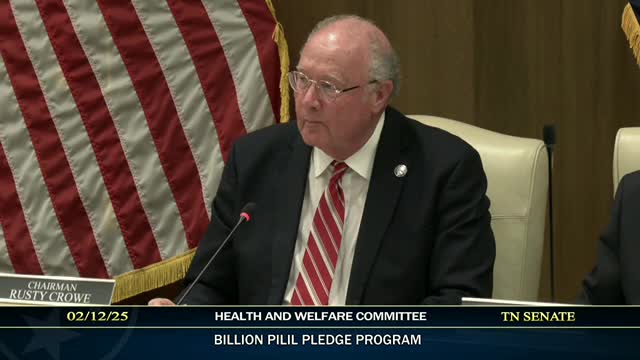
Goldfinch Health presents opioid-prevention "Billion Pill Pledge" to Senate committee; early Tennessee results show reductions in post-surgical opioid scripts
Summary
Goldfinch Health told the Senate Health and Welfare Committee its Tennessee program, funded by the Opioid Abatement Council, has helped over 240 patients at two facilities and reduced average opioid prescriptions after surgery by more than 40 percent in participating sites.
Goldfinch Health co-founder and pharmacist Brand Newland and Michael Doty, director of provider success for Goldfinch Health, described the company’s ‘‘Billion Pill Pledge’’ prevention program and its early results in Tennessee. Newland said the program launched in Tennessee on July 1, 2024, after the Opioid Abatement Council awarded grant funding to support a two‑year effort.
Why this matters: Goldfinch aims to reduce unnecessary opioid exposure after surgery by implementing enhanced recovery after surgery protocols, multimodal pain management, patient “prepared for surgery” toolkits and nurse navigators. Committee members asked about clinical training, hospital participation and scalability; witnesses said initial results show reduced prescribing and readmissions.
Program details and early results: Newland cited CDC data in committee materials, reporting that Tennessee dispensed 58.6 opioid prescriptions per 100 residents in 2023 (a 5% decline from 2022). Michael Doty said Goldfinch’s Tennessee program has helped more than 240 patients across two facilities in roughly six months, reducing average opioid prescriptions after surgery in those facilities by over 40 percent; more than half of enrolled patients used fewer than 10 opioid pills, and the program recorded zero readmissions among those patients while they were enrolled. Doty said the current OAC grant funds up to 2,500 procedures in Tennessee and that the program was offered to participating hospitals at no charge while OAC funding covers operations.
Committee questions and replies: Senators asked about nurse-navigator training, hospital obligations and data collection. Doty said nurse navigators receive training in the opioid crisis, pain management and the surgical pathways relevant to participating patients, and that the program collects prescribing and readmission data and reports back to hospitals. On financing and scale, witnesses said the program hopes to identify sustainable funding beyond settlement dollars, mentioning potential partnerships with TennCare or other payers.
Ending: Committee members expressed interest; witnesses said the Tennessee pilot builds on earlier work in Iowa, where Goldfinch reported reductions in pills dispensed and refills, and asked legislators to consider sustainable funding options to expand reach.