Get Full Government Meeting Transcripts, Videos, & Alerts Forever!
Get email alerts on the Lottery Funding topic
No spam. Unsubscribe anytime.
Officials warn of lottery revenue shortfall; sports-wagering funds expected to partly offset gap
Summary
State higher-education officials told a legislative subcommittee that lottery-funded scholarship revenues are tracking about $40 million below earlier projections and that sports-wagering transfers and reserve accounts are expected to blunt the gap; they urged caution on new or expanded lottery-funded programs.
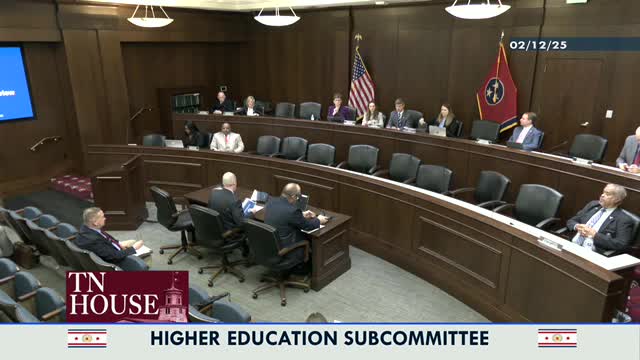
State higher-education officials told a House higher education subcommittee on Wednesday that lottery-funded scholarship revenues are running well below earlier projections for the current fiscal year, creating a potential budget gap for lottery-funded programs.
Lou Hanneman of the Tennessee Student Assistance Corporation and the Higher Education Commission and Peter Abernathy, the commission’s chief compliance officer, provided the committee with program counts, revenue projections and descriptions of contingency mechanisms. Hanneman said the state administers 13 lottery-funded programs that together serve roughly 60,000 students and that lottery-funded programs total about $470 million annually. He said state-funded programs outside the lottery, principally the Tennessee Student Assistance Award, total about $113 million per year.
Hanneman told the committee that the funding board’s November projection for lottery revenues this year ranged from $456 million to $479 million, but first-half receipts have fallen short by about $40 million. "We are through first 2 quarters, and we are about 40,000,000 under that projected rate," he said. If current receipts hold, Hanneman said the office would expect about $428 million in lottery receipts for the year.
Abernathy explained how receipts flow through the system and how sports-wagering revenue has been used as a backstop: the Lottery Corporation remits quarterly revenues to the Lottery for Education account, which pays HOPE, Aspire, dual-enrollment, Reconnect, Helping Heroes and other lottery programs. Abernathy said that, by law, if lottery receipts exceed scholarship costs in a year, a transfer (currently projected at roughly $30 million) goes to the Tennessee Promise endowment; the endowment and its investment earnings then fund Tennessee Promise scholarships.
Committee members asked whether the shortfall might reflect shifting consumer behavior to online gaming or sports wagering. Hanneman deferred specifics to the Lottery Corporation but said sports-wagering privilege tax receipts have provided a second revenue stream this year that will partly offset the shortfall. He noted that sports-wagering privilege tax amounts are transferred under current law and that HB6004 (the Education Freedom Scholarship legislation, cited in discussion) redirected sports-wagering funds to a treasurer-managed account for K–12 maintenance projects but preserves a rule that sports-wagering dollars will make the lottery whole in a shortfall year before other transfers occur.
Officials emphasized contingency accounts: the Lottery for Education account holds a $10 million one-time reserve and a $100 million shortfall account that can be drawn down; any use of the shortfall account must be restored over subsequent years. Hanneman and Abernathy also warned that natural program growth — especially in dual enrollment, which has grown 182% in five years, and Tennessee Reconnect adult enrollment — could increase lottery-program expenditures in coming years.
Committee members pressed for follow-up data. Representative Lehi asked whether the state gets a larger share when consumers buy lottery tickets compared with betting online; Hanneman said he would obtain the detailed figures from the Lottery Corporation. Representative Glenn asked what would happen if sports-wagering receipts cannot cover a lottery shortfall; Hanneman described the shortfall-account mechanics and said a multi-year shortfall could force prorating awards or tightening eligibility, though he noted the state has rarely needed to take such steps.
Officials framed the current numbers as cautionary rather than catastrophic: they said the situation to date can be managed through sports-wagering transfers and reserve accounts but urged lawmakers to account for the revenue risk when considering new or expanded lottery-funded programs.