Get Full Government Meeting Transcripts, Videos, & Alerts Forever!
Get email alerts on the Recycling And Epr topic
No spam. Unsubscribe anytime.
Tennessee Environmental Council urges extended producer responsibility, highlights recycling and restoration programs
Summary
The Tennessee Environmental Council told the Senate Energy, Agriculture and Natural Resources Committee that Tennessee faces a landfill-capacity problem and an economic opportunity if the state adopts an extended producer responsibility policy and expands recycling infrastructure.
The Tennessee Environmental Council told the Senate Energy, Agriculture and Natural Resources Committee that Tennessee faces a landfill-capacity problem and an economic opportunity if the state adopts an extended producer responsibility policy and expands recycling infrastructure.
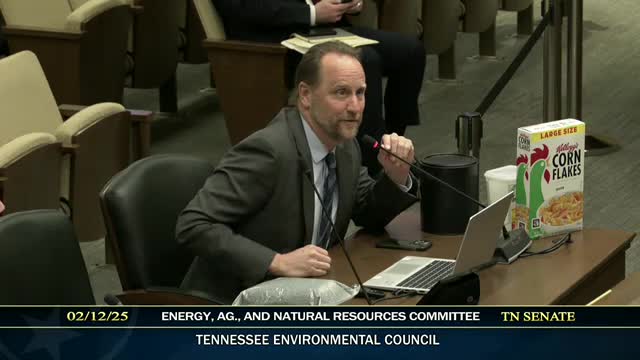
At the committee meeting, a Tennessee Environmental Council representative summarized the organization’s statewide recycling roundups, tree-planting and watershed restoration programs and urged lawmakers to consider producer-funded recycling to capture materials that manufacturers need.
The council representative said, “Tennessee urgently does need an extended producer responsibility policy that would solve this, that would connect all those dots we saw, that would pull the materials out of our landfills, create thousands of jobs every year, and millions of dollars in revenue to support that industry.”
Why it matters: presenters told senators that much of Tennessee’s municipal waste is recoverable and that manufacturers in the state — including aluminum and glass users — want more post-consumer material. For producers and recyclers, capturing that material could reduce pressure on landfills while supplying local industry with feedstock.
Presenters described multiple programs the nonprofit runs or supports. The council said it planted its ceremonial 1,000,000th native tree on March 9 at Bicentennial Mall State Park and now works with volunteers and partners to distribute seedlings across the state. The organization reported more than 25,000 volunteer planting locations historically and said it is aiming for about 100,000 trees this year, with Tree Day on March 15, 2025.
On composting, the council reported about 1,500 participants in a residential composting initiative and said participants have composted more than 300 tons of food scraps. The presenter added the average Tennessee household discards about nine pounds of food scraps per week.
On waterways, the council said roughly one-third of Tennessee streams are listed as impaired by the Tennessee Department of Environment and Conservation and described long-term riparian-buffer work that included planting more than 4,000 native trees in a single creek over 15 years to improve water quality and habitat.
The council also described a recycling-roundup program funded in part by the U.S. Environmental Protection Agency and TDOT that organizes community drop-off events for hard-to-recycle items (mattresses, electronics, tires, scrap metal, textiles). The group said 20 roundups recycled more than 500,000 pounds of material and that one June 2024 event at Middle Tennessee State University processed about 500 cars over four hours.
Cody Marshall of The Recycling Partnership, introduced by the presenters, explained EPR: “EPR is extended producer responsibility, and it is where you take the responsibility of funding the operations and the capital needed for a program to the producer as opposed to the local government,” he said, noting 25 states have EPR laws of various kinds and that neighboring North Carolina has an electronics EPR law.
Rosa Loxamana, identified as vice president for sustainability at Grangus, told the committee her plant in Carroll County uses about 62% recycled aluminum in its feedstock and that manufacturers are seeking more recycled-content supply from local recycling channels.
On funding, committee members asked presenters about grants. The presenters said the Tennessee Environmental Council’s budget totals about $1,400,000, that the organization receives a roughly $200,000 TDOT grant for litter and recycling supports in addition to other state grants, an EPA grant of about $500,000 for roundups, and a Department of Agriculture ‘‘3-19’’ program award of roughly $150,000 over four years for stream-restoration work. The presenters said TDOT maintains an approximate $15–$17 million grant fund statewide for litter cleanup and related projects; the Tennessee Environmental Council characterized its own funding as assembled each year from multiple grants, sponsors and donations rather than a permanent endowment.
Committee outcome and next steps: the session included questions from senators but no committee action on legislation. Senator Campbell asked presenters to clarify EPR mechanics; Senator Pote asked about nonprofit status and grant funding. Committee Chair Shane Reeves thanked presenters and invited further collaboration but took no formal action during the meeting.
The meeting returned to committee business and was adjourned without votes on bills or policy measures.
Ending: presenters asked the committee to consider producer-funded policies to scale recycling infrastructure; committee members signaled interest and asked for more details but did not introduce or vote on legislation during the session.