Get Full Government Meeting Transcripts, Videos, & Alerts Forever!
Get email alerts on the Transportation Infrastructure topic
No spam. Unsubscribe anytime.
TDOT describes rapid response to Hurricane Helene; estimates $510 million in damage
Summary
Tennessee Department of Transportation officials told the Senate Transportation and Safety Committee that emergency response after Hurricane Helene reopened most routes within days, with an estimated $510 million in damage and significant federal reimbursement requests under way.
At a meeting of the Senate Transportation and Safety Committee, Tennessee Department of Transportation officials described emergency operations after Hurricane Helene that reopened most routes within days and set repair timetables for remaining work.
The presentation focused on Upper East Tennessee, where intense rainfall and river surges caused widespread bridge failures, road washouts and isolated communities. TDOT officials said they mobilized hundreds of staff, strike teams and contractors to restore critical connections and begin permanent repairs.
TDOT Commissioner (name not specified) opened the presentation, telling the committee, “we have had unprecedented challenges in 2024, but we've also had extraordinary achievements.” Will Reed, TDOT chief engineer, said the meeting was intended to “talk to you about what what we feel is a culmination of a lot of the the hard work that our folks put in day in and day out to be able to, respond when things like this happen.” Region 1 Director Steve Borden described the storm’s local effects: “It happened rapidly. It happened quickly.”
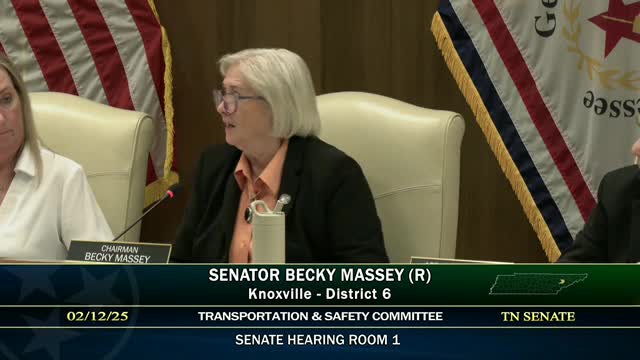
Why it matters: committee members and TDOT leaders stressed that transportation access was essential for rescue operations, delivery of services and community recovery. Chairlady Massey, chair of the Senate Transportation and Safety Committee, and several senators praised TDOT staff and contractors for rapid mobilization and round‑the‑clock work.
What TDOT reported
- Closures and immediate response: TDOT logged 49 route closures in the event’s immediate aftermath and reported that 42 of those routes were reopened within days, with the remainder put under contract for repair. Region 1 reported multiple bridge failures; Borden said crews lost 13 bridges along the Nolichucky River corridor and five bridges on TDOT’s system in the event’s early phase.
- Personnel and tempo: TDOT said it had more than 800 employees working in the hardest‑hit areas at one point and recorded roughly 90,000 man‑hours on recovery without an incident, which TDOT credited to safety training and cross‑training. Officials described rapid mobilization of strike teams, bridge inspectors, surveying crews, geotechnical staff and contracting personnel.
- Repairs and temporary fixes: TDOT described a “reconnect first” approach: reopen at least one lane where possible to restore access, then continue work toward permanent repairs. Officials said interstates and state routes were returned to partial service within days, and permanent construction is rolling forward concurrently. TDOT told the committee it used expedited contracting and a progressive design‑build delivery for a high‑profile replacement of the No. 107 bridge over the Nolichucky River in Greene County; that project is planned for completion in June (year not specified in testimony).
- Bridge inspections: TDOT officials said teams assessed roughly 278 state and interstate bridges in seven days and more than 500 total bridges (state and local) to determine safety for traffic and to sequence repairs.
- Funding and federal requests: TDOT estimated the event’s impact at approximately $510,000,000. Officials said the Federal Highway Administration (FHWA) Emergency Relief account held about $218,000,000 nationwide at the time of the event; Tennessee received an initial $32,000,000 in quick‑release funds, then another $70,000,000, and TDOT reported it was pursuing a third quick‑release request for an additional $178,000,000. TDOT and committee members said federal reimbursement is expected but will be processed over months or years; TDOT said having state cash on hand and expanded delivery authority under the Transportation Modernization Act allowed immediate contracting and response.
Timelines and remaining work
TDOT outlined near‑term milestones for remaining major repairs: several major bridge projects are under contract or in construction, with specific projects listed by region directors (examples given in testimony included April and May milestones for some mountain routes and a June completion target for the progressive design‑build replacement of the Nolichucky bridge). Officials also said a permanent repair program was underway for I‑26 and I‑40 lanes that had been restored initially by temporary measures.
Committee reaction and next steps
Senator Mark Pote commended the agency and asked directly about costs; TDOT restated the $510 million estimate and summarized the FHWA quick‑release funding described above. Committee members repeatedly praised TDOT staff, contractors and volunteers. Chairlady Massey and TDOT leaders said they would return to the committee for budget hearings and further briefings as recovery work continues.
Ending
TDOT officials closed by reiterating the scale of the response and the agency’s reliance on cross‑regional support, federal partners, and expedited contracting to restore access. Committee members thanked the employees and noted continued oversight and future budget review would follow as TDOT moves from emergency reconnection to permanent reconstruction.