Get Full Government Meeting Transcripts, Videos, & Alerts Forever!
Get email alerts on the Criminal Justice topic
No spam. Unsubscribe anytime.
Subcommittee approves bill creating specific offense for blocking executive protective details
Summary
House Bill 120 would create a Class A misdemeanor (and in aggravated cases a Class E felony) for obstructing or refusing to leave areas where protective-service personnel are assigned; the subcommittee voted 7-1 with one present not voting to advance the bill.
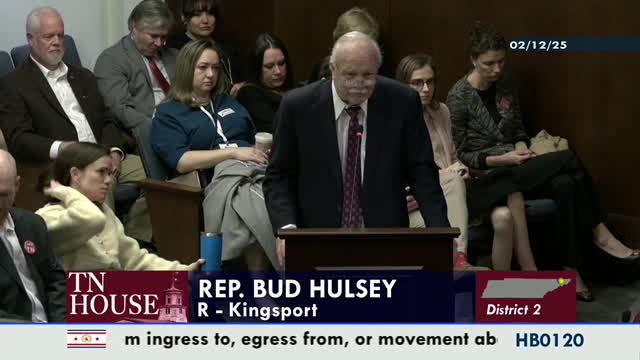
House Bill 120, presented by Representative Bud Hulsey, would make it a Class A misdemeanor to block or refuse to leave an area where an executive protective-service detail (for example, the governor's protective detail) is assigned; the bill provides for escalation to a Class E felony in aggravated or threatening circumstances.
Hulsey said the measure is intended to give a statutory basis for charging individuals who obstruct protective personnel, rather than relying on more general charges such as failure to obey a lawful order. The Department of Safety’s legislative director Elizabeth Stroker and Colonel Matt Perry of the Tennessee Highway Patrol testified in support, describing incidents elsewhere and the need to protect officials and their details. "Chairman Hulsey did a great job explaining what the bill does," Stroker said.
Members asked whether the statute would clearly identify protective personnel and whether it could apply beyond elected officials; witnesses said protective units would identify themselves (Colonel Perry: "we will absolutely identify ourselves") and that the bill is intended to cover elected officials and persons the executive protection troopers are assigned to protect. Representative Russell compared the proposal to Secret Service practice; witnesses agreed the objectives are similar.
The clerk reported a subcommittee vote of 7 ayes, 1 nay and 1 present not voting; the chair announced the ayes prevailed and the bill will go to the full House Judiciary Committee.