Get Full Government Meeting Transcripts, Videos, & Alerts Forever!
Get email alerts on the Legislation topic
No spam. Unsubscribe anytime.
Iowa House reads roughly three dozen bills on first reading, refers them to committees
Summary
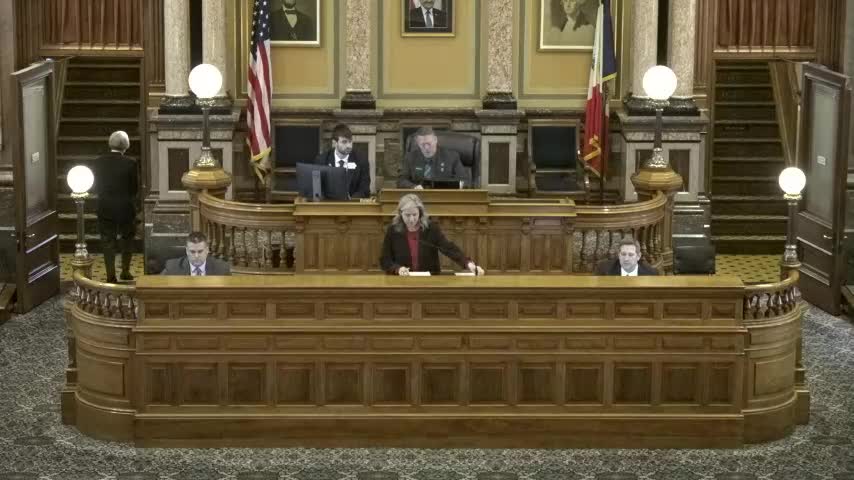
During a floor session, the House of Representatives read approximately 38 bills on first reading, covering education, child care, public safety, taxes and health topics, and referred each to committee. The House adjourned by voice vote.
The House of Representatives read approximately 38 bills on first reading during the floor session; most were not ready for committee action and were assigned to standing committees for further consideration.
The introductions covered a wide range of policy areas, including K-12 education and school athletics, child care assistance and reimbursement rates, dental practice rules, health and public-safety measures, tax provisions and a high-profile criminal-justice proposal tied to fentanyl-related deaths. The clerk read each bill title, identified the sponsor and announced the committee referral. Most first readings were followed by the clerk’s statement that the bill was "not ready for commitment" and the bill was sent to the named committee.
Notable bills read on first reading included: House File 331 (Bergen), a bill to implement requirements related to organizations that sponsor or administer extracurricular interscholastic athletics and to create a conference realignment committee; House File 333 (Brown Powers), a bill to provide access to feminine-hygiene products in public school restrooms with an appropriation; House File 341 (Ellert), a bill relating to state child care assistance payments; House File 351 (Shipley), a bill to remove psilocybin and psilocin from the list of substances classified as schedule I under the Iowa Uniform Controlled Substance Act (referred to Public Safety); House File 364 (will), a bill establishing a standing appropriation to the Department of Health and Human Services to make free radon test kits available to homeowners and renters; House File 365 (Dunwell), a bill proposing a cause of action for murder in the first degree by delivering, dispensing or providing fentanyl and fentanyl-related substances; and House File 358 (Jacobi), a bill increasing the individual income tax credit for volunteer firefighters, volunteer emergency medical service personnel and reserve peace officers (referred to Ways and Means). The House also received a Senate-file first reading on school funding that would set the state percentage of growth for the budget year beginning 07/01/2025 and adjust provisions related to state property tax replacement payments; that Senate bill was placed on file.
The clerk repeatedly indicated that introduced bills were on "first reading" and "not ready for commitment," and specified committee referrals in each instance: common referrals included Education; Health and Human Services; Judiciary; Public Safety; Ways and Means; State Government; Labor and Workforce; Transportation; Economic Growth and Technology; and Veterans Affairs. Where the clerk identified an individual sponsor in the read titles, the transcript shows the sponsoring representative’s name attached to the bill title.
There was no floor debate recorded on the bills during the reading sequence; the clerk’s reading concluded the sequence of introductions. Following the bill introductions, Representative Sitson (Winnebago) moved that the House adjourn until Thursday, Feb. 13, at 8:30 a.m.; the motion was adopted by voice vote and the House adjourned.
Many of the introduced measures would, if advanced, affect school districts, child care providers, health programs administered by the Department of Health and Human Services, volunteer emergency responders, licensed dental professionals and taxpayers. Committee consideration and any changes will be necessary before any measure can reach a final House vote.