Get Full Government Meeting Transcripts, Videos, & Alerts Forever!
Get email alerts on the Municipal Taxation topic
No spam. Unsubscribe anytime.
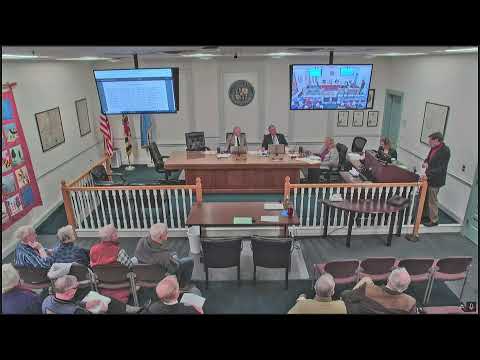
Chestertown mayor presses Kent County on tax differential; county staff provide cost breakdown
Summary
Chestertown's mayor presented studies and data arguing the town is overtaxed relative to surrounding areas and asked Kent County to adopt a tax differential; county staff responded with a line-item schedule of services the county provides to municipalities and offered to pursue follow-up analysis and shared-service options.
Chestertown's mayor urged Kent County officials on Wednesday to reopen talks about a county tax differential, saying studies show the town bears a disproportionate share of the county tax burden and that the imbalance is harming local economic growth.
"Kent County now imposes the highest property taxes anywhere on Delmarva and the highest taxes on municipalities anywhere in Maryland," the mayor said, urging commissioners to reexamine a system he said has been left unresolved for decades. He cited two studies — a 1997 University of Maryland review and a 2024 study paid for by three Eastern Shore municipalities — that he said support a tax setoff or rebate of roughly 10–15 percent for Chestertown.
The mayor framed the request as economic development policy: he said Chestertown, which occupies a small percentage of county acreage, contributes a large share of property and income tax revenues but has the county's lowest median household income. He argued that high municipal tax burdens discourage investment, reduce job creation and contribute to slow county growth rates.
County finance staff and department heads responded with a schedule that attempted to quantify county services provided to incorporated towns. Pat (Chief Financial Officer) explained that the county estimated roughly $4,000,824 in annual costs for services that benefit municipalities, allocated by observed call volume and estimated hours. She highlighted that 52 percent of emergency medical services call volume is in municipalities and that the sheriff's office logs a substantial share of its calls inside municipal boundaries, producing an estimated $903,375 allocation of sheriff office salary-and-benefit costs to those jurisdictions.
Commissioners and staff told the mayor they are willing to pursue a detailed reconciliation of the competing studies and the county's own numbers. A county official said shared-service options — including a joint approach to police coverage and road maintenance — could reduce duplicate costs, but emphasized any formal change would require detailed modeling and negotiation.
No formal motions or votes occurred at the meeting. County staff agreed to share the detailed call logs and methodology with Chestertown's mayor so the parties can reconcile differences in accounting and revisit whether a tax differential or other adjustments are warranted.
The discussion concluded with a commitment to follow up: county staff will provide the requested underlying data and department-level breakdowns; the mayor and county officials agreed to schedule working sessions to compare assumptions and to explore specific shared-service pilots.
Why it matters: A change in county policy on municipal tax differentials could shift hundreds of thousands of dollars in annual county revenue allocation and affect local budgets, economic development prospects, and how emergency and public-works services are funded and delivered across Kent County.