Get Full Government Meeting Transcripts, Videos, & Alerts Forever!
Get email alerts on the Bail Reform topic
No spam. Unsubscribe anytime.
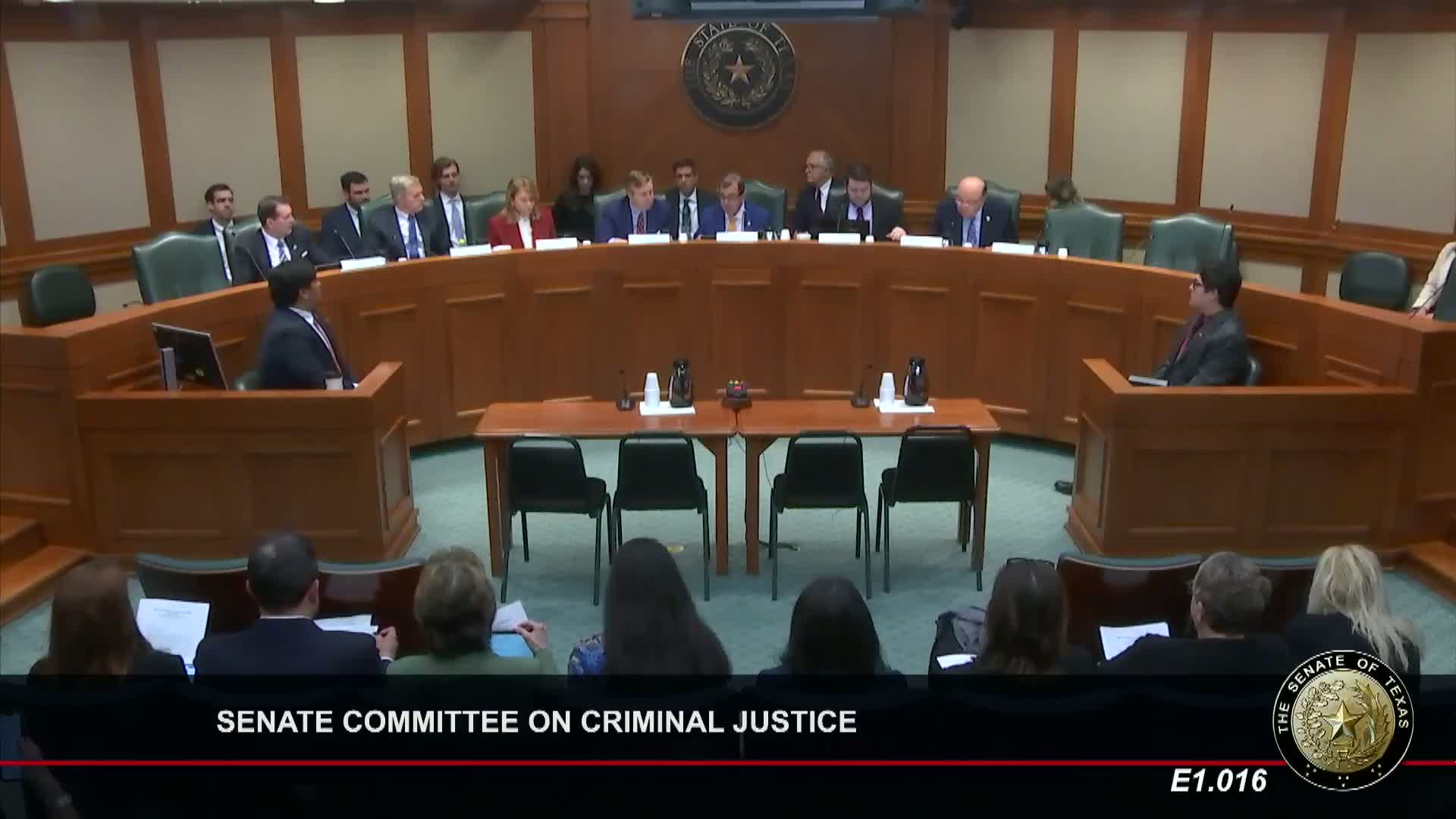
Senate committee hears SJR 1 to deny bail for certain noncitizens accused of felonies
Summary
The Senate Committee on Criminal Justice debated a proposed constitutional amendment (SJR 1) that would bar bail for people defined in the resolution as “illegal aliens” accused of felony offenses, with supporters citing recent violent crimes and opponents warning of constitutional and due-process problems.
Senate committee members heard extended testimony on Senate Joint Resolution 1, a proposed constitutional amendment that would require judges to deny bail for people the resolution defines as "illegal aliens" when accused of certain felony offenses.
Supporters said the measure is aimed at preventing violent offenders who lack ties to the United States from fleeing before trial. Senator Joan Huffman, the bill sponsor, described the resolution as intended to mirror federal authority and said it is named in a committee substitute as Jocelyn’s Law after a Harris County victim. "SJR 1 shows the state's commitment to protect our citizens and assist the federal government in their efforts to prevent violent illegal aliens from terrorizing our communities," Huffman said during her presentation.
Backers, including victims' family members who testified, urged the committee to act quickly. Alexis Nungare, whose daughter Jocelyn was killed, told senators she felt outraged that "judges are allowed to provide bail for evil people who do heinous things," and said the defendants in her daughter's case were a flight risk.
Opponents raised constitutional and practical objections. Emily Anaya, a second‑year law student, said denying bail based on immigration status raises equal‑protection concerns and departs from the long‑standing constitutional framework for bail. The Texas Civil Rights Project and other witnesses warned judges would be forced to make immigration‑status determinations in criminal court and said the resolution's definition risks sweeping in lawful or naturalized U.S. citizens. "The blanket application of denial of bail based on immigration status would force potentially thousands of people...to remain incarcerated in pretrial detention with no consideration on the likelihood of their guilt," Sarah Cruz of the ACLU of Texas testified.
Committee discussion touched on procedural questions and practical limits: who would determine immigration status at arrest, how detainees could contest a status finding, and whether federal or state databases would be reliable. Lone Star Defenders said most Operation Lone Star felony defendants their office has handled are U.S. citizens and argued judges already have tools to set high bonds when appropriate.
No final committee vote on SJR 1 was recorded in the transcript. The committee previously adopted a committee substitute for SJR 1 for discussion by unanimous consent after Senator Parker moved adoption; the committee chair announced the substitute had been adopted for consideration.
Supporters urged a voter referendum, noting constitutional change via a joint resolution would put the question to Texas voters.
The committee recessed for a floor session before further action.
Ending: The hearing drew multiple victims and criminal justice officials who delivered sharply divided testimony. Proponents framed SJR 1 as a public‑safety measure addressing flight risk for noncitizens accused of felonies; opponents said it would create constitutional and procedural problems and could detain people who pose no demonstrable flight or safety risk.