Get Full Government Meeting Transcripts, Videos, & Alerts Forever!
Get email alerts on the Transportation topic
No spam. Unsubscribe anytime.
Engineering staff brief commissioners on traffic impact studies, warrants and infrastructure coordination
Summary
Celia Rathhammer and traffic staff explained how the county reviews traffic impacts for land development, when traffic impact studies are required or may be waived, how warrants for signals and other controls work, and how development partnerships can fund roadway expansions such as Gun Club Road.
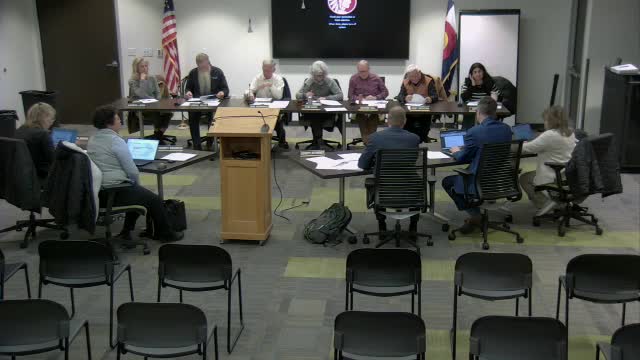
Engineering services staff gave a study-session briefing to the Arapahoe County Planning Commission on Feb. 4 covering how the county evaluates traffic impacts from development, what traffic warrants are, and how infrastructure improvements are identified and funded.
The presentation by Celia Rathhammer, Engineering Services Division manager, covered the county's infrastructure design and construction standards, the county’s use of traffic impact studies (TIS) and traffic conformance letters, pedestrian and bicycle considerations, level-of-service expectations for roadways, and coordination on major projects such as the Gun Club Road widening.
Why it matters: Commissioners said traffic impacts are a central concern for applicants and nearby residents, and the commission cited the Copperleaf amendment as an example where traffic questions have driven public testimony. Staff outlined when a TIS is required, how developers can be required to mitigate impacts whether or not a TIS is prepared, and options from signalization to underpasses to address pedestrian safety.
Key points from staff
- Traffic impact studies and conformance letters. Rathhammer said the county requires a traffic impact study for most new land development proposals and explained that case engineers may request a traffic conformance letter or an updated study if material changes occur. Rathhammer noted that "the developer may still be required to mitigate traffic delays or complete roadway improvements, whether or not, TIS is required."
- Waiver criteria. Rathhammer summarized the three criteria that can allow a case engineer to waive a full TIS: the site cannot access a state highway or county arterial; if access is to an unpaved road it must generate fewer than 50 vehicles per day; if access is to a paved road it must generate fewer than 250 trips per day (or 25 trips in an hour). Rathhammer said those thresholds are rarely met, so waivers are uncommon.
- Duration and updates. Traffic impact studies are considered valid for two years; staff may require an update or a conformance letter for later applications or significant changes.
- Warrants and controls. Staff reviewed the Manual on Uniform Traffic Control Devices (MUTCD) warrants used to decide when signals, all-way stops or hybrid pedestrian signals ("HAWK" signals) are appropriate. Rathhammer said warrants include crash-history thresholds and traffic volumes; Carl Packer, Traffic Operations Manager, added that while crashes can trigger warrants, "to my knowledge, nothing, within my tenure that has resulted in a lawsuit." Packer also described beacons and LED-embedded stop signs used where increased visibility is needed.
- Pedestrian safety and underpasses. Commissioners asked about options when heavy traffic separates neighborhoods from parks or schools. Rathhammer and staff said solutions can include channelizing pedestrians to warranted crossings, HAWK signals, pedestrian bridges or underpasses; staff noted these are costly but are sometimes included in development agreements or provided by developers. Jason Reynolds cited a recent example where an apartment developer paid for a pedestrian bridge over the High Line Canal as part of park- and trail-related mitigation.
- Coordination and funding. Rathhammer discussed the county's preliminary designs for Gun Club Road and said the county did not have the budget to build a full six-lane section on its own. She said developers may construct lanes as part of development agreements: "we have a partner that can help us build the roadway section that we need," she said, describing coordination with Copperleaf and the City of Aurora on which lanes each party will build.
Commissioner requests and next steps
Commissioners asked staff to provide the county’s level-of-service definitions and related documentation; Rathhammer agreed to circulate an excerpt. Commissioners also asked how CDOT is involved; staff said CDOT participates when an applicant needs access to a state highway and is a referral agency on such projects. Rathhammer said the county will update its transportation master plan in 2026 and will revise cross sections and signal/marking standards in future updates to the infrastructure design manual.
No formal votes were taken during the study session; staff said they will provide level-of-service definitions to the commission as requested.