Get Full Government Meeting Transcripts, Videos, & Alerts Forever!
Get email alerts on the Public Works Operations Facility Financing topic
No spam. Unsubscribe anytime.
Sumner City staff outline $66 million funding plan, seek delegation to issue revenue bonds for new public works facility
Summary
City staff presented a funding package for a new public works operations facility, including use of Sumner Meadows Golf Course proceeds, utility revenue bonds for the utility share, and a Feb. 18 delegation ordinance to authorize staff to finalize a public bond issuance.
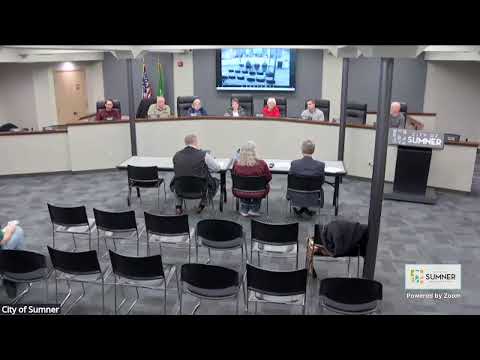
City staff on Feb. 10 presented Sumner City Council with a funding package to complete a new public works operations facility and told council it will be asked on Feb. 18 to delegate authority to finalize a revenue-bond sale to cover the utility portion of the project.
City Administrator Jason Wilson said the project has been in planning for years and that staff designed a facility to replace an undersized operations complex. “This is something that's been in the works for well over 5 years,” Wilson said during the study session.
Chief Financial Officer Cassandra Raymond told the council the all-in cost from feasibility through move-in is about $66,000,000. “Our total anticipated cost of the project from feasibility through essentially move in is $66,000,000,” Raymond said. She described a funding split that allocates about 49% of the cost to the general fund and 51% to utility funds.
Why it matters: city staff say the current operations site is crowded and will not accommodate projected staff and equipment needs. The proposed facility covers roughly 6.2 acres and about 100,000 square feet across six buildings; construction is expected to run from early 2025 to late 2026.
Project and funding details: Raymond described three project phases. Phase 1 (site demo and preloading) and Phase 2 (a north-parcel stormwater decant facility and related improvements) are underway or complete; Phase 3 is the main operations facility. The construction contract through the city’s general contractor was reported at $37,500,000; ancillary costs (site work, Puget Sound Energy street-light work, furnishings, fixtures and equipment, IT, security, construction management/administration, staff time and contingency) bring the total project estimate to about $66,000,000.
Raymond said proceeds from the sale of the Sumner Meadows Golf Course will be used to cover the general-fund share of the work, including a planned transfer of $25,300,000 from the capital reserve fund (Fund 004) to the capital facilities fund (Fund 325) for construction, and a $2,100,000 transfer from Fund 004 to Fund 200 to cover debt service on a bond anticipation note. The utility portion will be financed with utility fund balances and a revenue bond issuance.
Trust fund loan and utility rates: Raymond and staff said the Public Works Trust Fund loan used for the decant facility will have its debt service programmed into the stormwater utility rate model; stormwater rates will pay that debt service over roughly 20 years. Raymond said staff expect to pursue available incentives in that loan agreement to reduce interest costs.
Bond plan and timeline: Dave Tregester, senior vice president for public finance at DA Davidson & Co., said the city plans a public sale of revenue bonds for the utility share rather than a private placement. He presented preliminary parameters used for the Feb. 18 delegation ordinance: a maximum aggregate principal amount not to exceed $29,000,000, final maturity no greater than 30 years (staff modeled a 25-year financing), and conservative caps such as a maximum true interest cost and maximum coupon of 6 percent. Based on current market assumptions, Tregester said staff’s estimated true interest cost is about 4.26% and that debt-service modeling showed a lower payment in the first year followed by level payments of roughly $1,850,000 per year under the modeled 25-year schedule. “We had what we call an estimated true interest cost ... of 4.26,” Tregester said.
He described the municipal-bond calendar and steps before pricing: a credit rating review (Standard & Poor’s), preparation of a preliminary official statement for investors, an early-April market review with pricing (staff indicated an April pricing window), and closing roughly two weeks after pricing when proceeds would be delivered to the city and an outstanding bond anticipation note would be paid off.
Operations questions and design features: Council members asked whether the new site will be fenced (Raymond: “The facility itself, yes. It will be fenced on all sides.”) and whether the design anticipates future needs. Staff said the facility was designed as a long-term asset with room for future additions, electric-vehicle charging capacity sized into the service panels and conduit, and generator capacity to operate the site and charge electric vehicles if necessary.
Staffing and existing site disposition: Council members asked how the new facility’s staffing projections align with city growth. Jason Wilson said the facility was designed based on staffing assessments and anticipated service-connection growth rather than strictly on population counts; the city will bring a separate proposal back next year on disposal or re-use of the current operations site, noting the existing site is near the White River and has development limitations.
Contracting and project oversight: Staff clarified that the city split construction management and construction administration: an on-site construction manager (KBA) will perform day-to-day inspection while a separate firm (TCF) is responsible for design administration and answers to design queries. Raymond said furnishings and most owner-supplied equipment will likely be procured off state contracts and that IT/security work is being coordinated with the city’s IT department and a cooperative purchasing contract with Security Solutions Northwest.
Next steps: Raymond told council the Feb. 18 agenda will include two ordinances: one (Ordinance 2918) delegating authority to city staff to complete the revenue-bond financing within specified parameters, and a budget amendment (Ordinance 2920) to transfer golf-course proceeds and program construction and debt-service budgets. Staff asked council to consider the delegation ordinance on Feb. 18 so staff can proceed with rating-agency work and bond-market preparations.