Get Full Government Meeting Transcripts, Videos, & Alerts Forever!
Get email alerts on the Transgender Rights Restroom topic
No spam. Unsubscribe anytime.
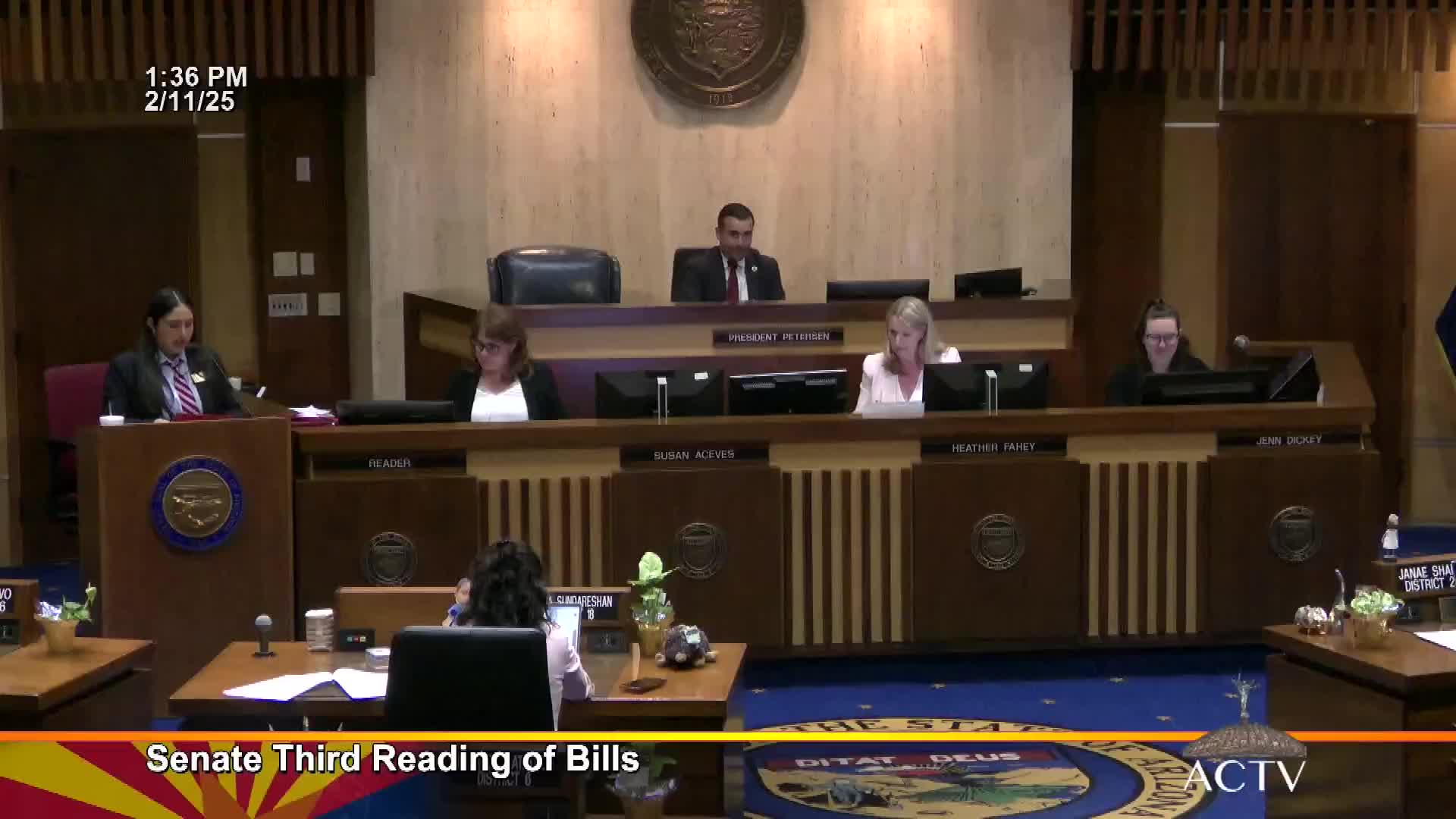
Arizona Senate approves bill restricting restroom and locker-room access by gender identity after floor debate
Summary
The Arizona Senate passed SB1003, a measure restricting restroom and locker-room use based on biological sex, after extended floor debate. The measure passed in open session; opponents cited constitutional and legal concerns.
The Arizona Senate on Feb. 11 passed SB1003, a bill that restricts restroom, locker-room and similar facility use in schools by gender identity, voting 17 ayes, 9 nays and 4 not voting. Senators spoke for and against the measure during an extended third‑reading debate before the roll call.
Supporters and opponents framed the bill as a question of safety, privacy and accommodation. Opponents said the bill would single out transgender students and expose schools to legal challenges. "SB 1003 is yet another attempt to make life harder for transgender youth...it's unconstitutional, discriminatory, and cruel," said Senator Cuby, who announced a no vote.
Proponents said the bill preserves sex‑based separations in private spaces while providing for reasonable accommodations. "This bill says...for those and rightly a small group of people that don't feel comfortable with a sex‑based separation, we're going to find a reasonable accommodation for them," said Senator Mesnard, who voted aye.
Why it matters: The measure affects student access to restrooms, locker rooms and showers and sets a statewide standard that could determine school policies around privacy and accommodations. During debate senators cited prior court decisions and federal anti‑discrimination rulings while warning of potential lawsuits and legal conflicts.
Key points from debate
- Constitutional and legal concerns: Opponents referenced court rulings, saying the bill conflicts with precedents that protect transgender students. Senator Cuby cited “Grama versus Gloucester County School Board” and Bostock v. Clayton County as part of the legal argument that denying facility access can violate federal law. He also warned the bill provides no funding for additional single‑occupancy restrooms.
- Safety and privacy arguments: Supporters, including Senator Mesnard and Senator Kavanaugh, said the bill preserves privacy in spaces where people undress and urged that accommodations be provided for students with different needs. Kavanaugh said the bill does not create criminal penalties and that civil remedies are the enforcement mechanism.
- Practical concerns about implementation: Opponents warned that schools could use claims of undue burden to avoid providing accommodations; supporters said the bill requires schools to offer reasonable accommodations without upending sex‑separated facilities.
Floor outcome and next steps
The secretary of the senate recorded the final vote as 17 ayes, 9 nays and 4 not voting. The president signed the bill in open session and the secretary was instructed to transmit SB1003 to the Arizona House of Representatives.
Votes explained on the record (selected): Senator Cuby: "I vote no." Senator Ortiz: "With that I vote no." Senator Epstein: "I vote nay on the bathroom police bill." Senator Mesnard: "I vote aye." Senator Kavanaugh: "I vote aye." Senator Miranda: "With that, I vote no." (All above are statements recorded on the floor explaining individual votes.)
What the bill text says (as read on the floor)
On third reading the title was read as adding a section relating to public schools (the transcript references amendments to Title 15). The bill, as discussed on the floor, aligns facility access to biological sex and directs schools to provide reasonable accommodations for students who do not use sex‑segregated facilities.
Context and reactions
Debate on SB1003 followed a pattern in recent sessions: multiple senators said similar measures had been introduced previously and generated public controversy. Opponents said repeated reintroduction underscores the measure's contested nature; supporters said it responds to constituent concerns about privacy in intimate spaces.
The bill will next be considered by the Arizona House after transmittal. No changes made on the senate floor were announced at the time the bill was transmitted.