Get Full Government Meeting Transcripts, Videos, & Alerts Forever!
Get email alerts on the Wireless Facilities topic
No spam. Unsubscribe anytime.
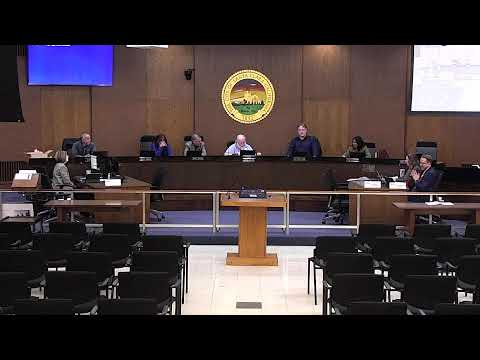
Planning Commission approves AT&T plan for three 42-foot parking-lot poles at 3111 Benton Street
Summary
The Santa Clara Planning Commission on Jan. 15 approved a conditional use permit to allow AT&T to install three 42-foot-6-inch monopoles in the parking lot of 3111 Benton Street after rejecting a 60-foot “mono-tree” design; the commission also adopted a CEQA categorical exemption for the project.
The Santa Clara Planning Commission on Jan. 15 approved a conditional use permit that allows AT&T to install three 42-foot-6-inch monopoles in the parking lot at 3111 Benton Street and adopted a categorical exemption under the California Environmental Quality Act for the project.
The decision follows more than a year of hearings and public comment on whether to place a single 60-foot “mono-tree” in the rear of the Santa Clara Baptist Church site or a three–pole alternative in the parking area. Leslie, a city planning staff member, summarized staff’s recommendation and noted recent changes by the applicant: “the backup generators will be batteries and they will not be diesel generators,” and staff earlier had recommended the mono-tree design because it “blends in with the existing adjacent trees.”
The project was presented to the commission by Steve Pro, representing AT&T and Complete Wireless Consulting, who described the application as intended to close a coverage gap that includes Santa Clara High School and nearby neighborhoods. Pro said AT&T and its consultants had examined multiple alternative sites and had met with Parks and Recreation staff; he asked the commission to approve one of the two designs that night: “I do respectfully request that the commissioners approve one of these two designs this evening.” AT&T’s radio-frequency engineer, Enrico Cornejo, addressed technical limits for park siting and interference, telling commissioners that placing antennas in Central Park would “cause interference because Central Park right now is fully covered by that site,” meaning a facility there would not provide the needed, usable coverage.
Public comment ran more than an hour and included residents, neighborhood advocates and members of a local relocation group. Ken Kratz, speaking for the AT&T Tower Relocation Group, urged the city to pursue Central Park by ballot measure, saying, “Please recommend the city council place a measure on the ballot of the next general election to let the voters decide if they desire to locate a cell phone tower in Central Park.” Other speakers raised health, property-value and aesthetic concerns and recommended additional study or a public vote. Planning commissioners pressed staff and the applicant on code changes that took effect after the application was filed; staff noted the application was deemed complete in December 2023 and must be processed under the rules in effect at that time.
Commission discussion centered on three issues: (1) technology and coverage trade-offs between lower poles and a taller disguised pole; (2) whether Central Park or other publicly owned parcels were feasible alternatives; and (3) neighborhood impacts including visual effects, shadows and property values. Parks staff and the parks director, Damon Sparacino, had reviewed park options with the applicant and advised that Central Park sites were not feasible for technical and operational reasons and that a park lease would trigger a charter-mandated voter approval because it would change the use of city parkland for longer than 180 days.
After discussion the commission first adopted a staff-recommended CEQA determination, finding the project categorically exempt per CEQA Guidelines section 15303 (new construction of small structures). The commission then voted to approve the conditional use permit for the three 42-foot-6-inch monopoles in the parking lot (staff alternative 2). The motions were recorded in the meeting minutes; the planning division noted that the item may be appealed to the City Council within seven calendar days, and the planning division advised residents that an appeal would need to be set in time for the city council to act before the federal wireless “shot clock” deadline noted in the staff report.
What’s next: The commission’s approval is the final Planning Commission action; the decision can be appealed to the City Council within seven calendar days. If the approval stands, AT&T and the property owner will proceed to obtain building permits and satisfy the conditions of approval listed in the permit, including measures on equipment screening, batteries in lieu of diesel generators and other site-specific conditions cited in the staff report.