Get Full Government Meeting Transcripts, Videos, & Alerts Forever!
Get email alerts on the Zoning Code Housing Element Measure T topic
No spam. Unsubscribe anytime.
Planning Commission backs zoning-code changes to implement housing element, recommends 50-unit administrative threshold with supplemental options
Summary
The San Mateo Planning Commission on Tuesday recommended that City Council adopt zoning-code ordinances to implement the city's 2023'024 housing element and to align the zoning code with the General Plan and Measure T, and set an administrative approval threshold of 50 units for projects meeting objective design standards while asking the council to consider eliminating the threshold.
The San Mateo Planning Commission on Tuesday recommended that City Council adopt two zoning-code ordinances to implement the city's recently adopted housing element and to align the zoning code with the General Plan and Measure T.
Staff planning manager Anira Sandhir told the commission the amendments are intended to implement policies in the 2023'024 housing element and to carry out General Plan 2040 and Measure T, which the city says created additional capacity in study areas. "Staff recommends that the planning commission recommend to the city council that the ordinances are exempt from further environmental review under section 15183," Sandhir said, referring to the California Environmental Quality Act guideline staff cited.
The proposed package includes a bundle of code changes to permit residential uses in certain commercial and office districts, align local definitions with state law for housing types such as single-room occupancy and supportive housing, clarify standards for manufactured homes and accessory dwelling units, and remove special-use-permit requirements for multifamily housing in mixed-use districts. Staff also proposed changes to implement General Plan table LU-1 densities and heights and noted additional zoning amendments (parking, floor-area-ratio, inclusionary policy alternatives) will return to the council at a later date.
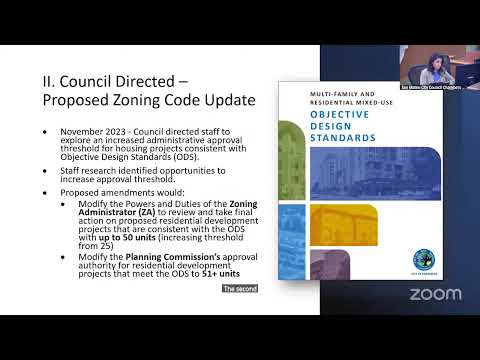
Sandhir said the housing element contains 53 policies and about 150 implementation actions. Staff said earlier edits adopted in 2023 and 2024 included objective design standards and a by-right/ministerial pathway for some sites. Staff recommended raising the administrative approval threshold for projects that meet objective design standards from 25 units (adopted in 2023) to 50 units based on a review of other cities and recent project sizes.
During public comment, Cara Cox, who said she was born in San Mateo and formerly worked in public works, urged that the city prioritize ownership opportunities in addition to multifamily rental construction. "We need to build condos. We need to create ownership in the community," Cox said, adding that many condo markets nearby have more turnover and supply than San Mateo.
Commissioners asked staff clarifying questions about lot sizes, the relationship between capacity figures and the General Plan EIR, the city's no-net-loss / RHNA tracking, the inclusionary requirement and alternative compliance, and how mobile-home-park provisions were interpreted relative to state law. Staff said the General Plan EIR studied roughly 19,700 units through 2040 and that the city's inclusionary requirement currently calls for 16% of homes in developments over 11 units to be affordable; staff said alternative compliance options are under study for a future meeting.
The commission discussed the administrative-approval threshold at length. Commissioners expressed different views: some favored retaining a threshold to preserve public hearings for larger projects, some advocated raising the threshold beyond 50 in transit-proximate study areas or for ownership-focused projects, and others said that if a project meets objective design standards it is difficult under state housing law to deny approval and that eliminating the threshold could reduce friction and developer costs.
After discussion, the commission moved and approved a recommendation to City Council that: (1) the ordinances before the commission be found exempt under CEQA guideline section 15183; (2) the council adopt an ordinance to implement the housing element; and (3) the council adopt an ordinance to amend the zoning code for Measure T and General Plan consistency. As part of the recommendation the commission amended the staff proposal to set the administrative approval threshold for projects meeting objective design standards at 50 units, and added a supplemental recommendation that the council consider eliminating the threshold (i.e., allow administrative approval for ODS-compliant residential projects regardless of unit count).
The motion passed on a 4-0 vote with one commissioner absent. Staff said the ordinances will go to City Council for introduction and a subsequent second reading for adoption; staff also noted that additional, location- or ownership-based changes would require further study and could be considered separately if council directs further research.
The commission closed the item and moved on to reports and announcements, including upcoming meetings and training opportunities.