Get Full Government Meeting Transcripts, Videos, & Alerts Forever!
Get email alerts on the Economic Development topic
No spam. Unsubscribe anytime.
Lebanon council approves water pre‑allocation MOUs for Eli Lilly’s Medicine Foundry and LP‑1X campus
Summary
The Lebanon City Council on Feb. 10 approved memoranda of understanding to reserve future water capacity for Eli Lilly projects in the LEAP District, contingent on a Citizens Energy Group supply timetable and related wastewater capacity.
Lebanon City Council on Feb. 10 approved two pre‑allocation memoranda of understanding that reserve future water capacity for Eli Lilly projects in the city’s LEAP District: the Medicine Foundry and an expanded LP‑1X manufacturing site.
The agreements authorize phased water allocations tied to the city’s supply deal with Citizens Energy Group, with initial capacity planned for 2027 and additional phased capacity in 2028. The city and presenters described the agreements as contingent on Citizens’ delivery schedule and on financing for corresponding wastewater improvements.
Why it matters: The MOUs are part of a package of utility financing and development agreements that city officials say will fund expansion of Lebanon’s water and, eventually, wastewater capacity. Eli Lilly representatives and city staff told council the projects represent major private investment, planned job creation and long lead times for water availability and wastewater treatment.
City staff presented the pre‑allocation documents and framed them as similar to the Meta/Facebook pre‑allocation the council previously approved. Jeff Jacob, a city staff member who introduced the items, said the agreements are “contemplated as part of the water bond capitalization” and reiterated that the projects are contingent on Citizens’ scheduled deliveries and the city’s bond financing for water and wastewater.
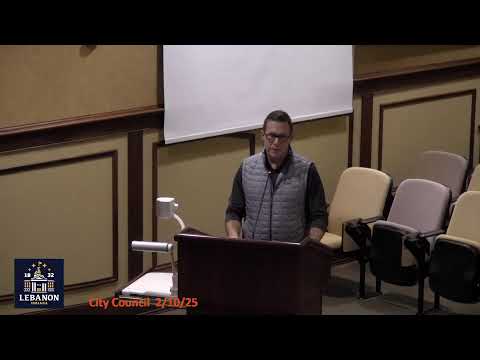
Paul Donica, identified in the meeting as project director for the Medicine Foundry, said the Medicine Foundry site will be a research and development campus — not a mass manufacturing plant — that will produce clinical trial material and support rapid response and supply‑chain resilience. “This is a very valuable investment for Eli Lilly. It’s about $4,500,000,000 additional investment into the Lebanon area,” Donica said, adding the Medicine Foundry sits on roughly 200 acres and is expected to provide “roughly 400 or so professional jobs once it’s completed.”
Ashley Judge, speaking for Lilly about the separate manufacturing campus, said the company has announced “a $9,000,000,000 investment in that manufacturing campus in the Lebanon District,” describing a 600‑acre LP campus that the company forecasts will support “over 900 Lilly, direct Lilly jobs” when fully operational.
City staff and Lilly representatives described the mechanics of the pre‑allocation: a 10% deposit is paid up front; when the city notifies the developer that water is available the developer must pay the full availability fee or risk forfeiting their reserved capacity. “A 10% deposit is paid. When we tell you that the water is available, you pay the full availability fee or forfeit that capacity,” Jeff Jacob said.
The Lebanon Utility Board previously approved each pre‑allocation on a 4‑1 vote; Jacob said the lone negative vote expressed concern that non‑LEAP pre‑allocation agreements for other shelved or approved projects should be advanced as well. Council discussion at the Feb. 10 meeting focused on timing and contingencies; council members heard that only the Meta/Facebook allocation had been charged against the new Citizens supply to date, while the city continues analysis of remaining capacity and planned phasing.
Council action: The council voted to approve both memoranda of understanding. The motion to approve the Medicine Foundry MOU was made from the floor and seconded (second recorded as Keith Campbell); the LP‑1X pre‑allocation MOU was likewise moved and seconded (second recorded as Rob Hawkins). Both motions passed by voice vote.
Context and next steps: City staff said the water supply agreement with Citizens is expected to provide 2 million gallons per day (MGD) in 2027, with additional phased capacity in 2028; staff repeatedly noted the need to ramp up corresponding wastewater treatment capacity and to complete bond financings and permitting before the water will be usable for new connections. Staff said additional non‑LEAP pre‑allocation agreements will be scheduled as analysis of available capacity continues.
Speakers quoted in this article are those who appeared in the Feb. 10 meeting record and are listed in the article’s speaker list below.