Get Full Government Meeting Transcripts, Videos, & Alerts Forever!
Get email alerts on the School Safety Weapons Detection topic
No spam. Unsubscribe anytime.
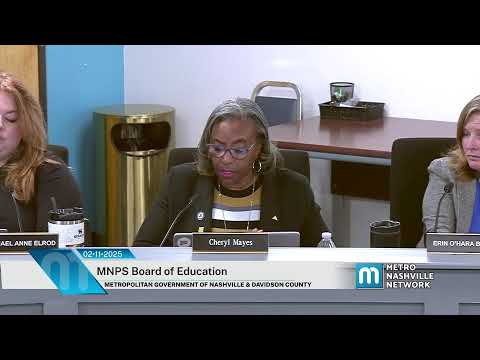
MNPS board approves amendment to expand weapons-detection pilot; contract for system integration passes 9-0
Summary
The Metro Board approved an amendment to its systems integration contract to purchase and install concealed-weapons detection equipment for high schools, expanding a pilot at Antioch and authorizing procurement tied to an existing vendor agreement.
The Metropolitan Nashville Public Schools Board of Education unanimously approved a contract amendment Monday to expand a pilot deployment of concealed-weapons detection systems in MNPS high schools and to procure related camera integrations.
The motion to consider and approve the system-integration contract amendment was moved by board member Young and seconded by board member Taylor; the roll-call vote recorded nine ayes and no dissent. "Chair Player votes aye. Madam Chair, 9 ayes," the clerk announced after a full roll-call.
Director Doctor Battle framed the purchase as an additional layer in a multi-layered safety approach that already includes badge access, vestibules, classroom locks, cameras, canine detection teams and expanded school resource officer coverage. The board was shown details of the systems proposed: AI-assisted concealed-weapon detectors manufactured by Evolv and procured through Motorola as part of an existing systems-integration contract (the district will also link alerts to the district's Avigilon camera control center). District staff told the board the initial procurement was issued via a broader services RFP released April 15, 2024, and that the vendor selection flowed from a competitive process and a board-approved contract dated Jan. 25, 2024.
District staff described differences between traditional metal-detector magnetometers and the AI-based concealed-weapon systems. Jill Lamont, vice president of education at Evolv, told the board "it's not a perfect science" but said the company fleet (more than 6,000 units globally) and continuous software updates let the system learn and reduce unnecessary alerts. Lamont said the pilot site has seen alert/secondary-screening rates "less than 10%" on typical days; district staff and vendor representatives noted some days with lower rates (one MNPS official cited figures near 7%). The district said secondary screenings often pick up nonthreat items such as eyeglass cases, laptops and container shapes; no weapons had been found during the Antioch pilot described in the presentation.
Procurement and rollout details presented to the board included: equipment, installation and training to be funded from district sources; an intended phased deployment with roughly two schools receiving installation per week to allow for troubleshooting; school-by-school determinations of "single-lane" or "dual-lane" entry configurations based on campus layout and enrollment; and staff training two weeks before each school goes live. District staff said initial staffing at pilot schools involved several staff per lane but that the required staffing level dropped quickly as operations matured. The board also heard that the contract document reviewed showed recurring equipment costs (the contract figure cited in discussion was approximately $1,250,000 per year for the high-school scope, exclusive of any additional staffing or ancillary costs).
Board members and members of the public pressed for implementation safeguards: accuracy and sensitivity settings of the AI models, worst-case scenarios (including reference to 3-D-printed weapons), FTC settlement history involving vendor marketing claims, student privacy and equity concerns, traffic and bus-unloading logistics, and communications to families. Chief of Operations Sue Sullivan, MNPS operations staff and vendor representatives answered questions about the pilot at Antioch High School, the vendor training program (which includes supervised tests and sensitivity tuning), and how district teams planned to minimize disruption during arrival.
Several public commenters urged immediate districtwide deployment and urged the board to act quickly; others urged caution, additional transparency, or investments in mental-health and threat-assessment programs as complementary strategies. The board approved the amendment on a 9-0 roll call after an extended Q&A and public comment period.
Actions recorded in the meeting materials show the motion was moved by member Young, seconded by member Taylor, and passed by roll call with the following recorded votes: Taylor (aye), Sellrod (aye), Young (aye), Vice Chair Nabata McKinney (aye), Fain (aye), Mays (aye), O'Hara Block (aye), Taylor (aye), Chair Player (aye).
District staff said they will return to the board with school-level implementation plans, communications for families, and any proposed expansions to middle and elementary schools subject to additional funding and evaluation of the high-school rollout.