Get Full Government Meeting Transcripts, Videos, & Alerts Forever!
Get email alerts on the Pfas Wastewater Monitoring topic
No spam. Unsubscribe anytime.
Senate committee approves bill requiring PFAS reporting to wastewater utilities
Summary
The Senate Agriculture committee voted 14-6 to report SB 1319, a PFAS data-collection measure directing industrial dischargers to self-report certain PFAS discharges to publicly owned treatment works and to notify the Department of Environmental Quality.
Senate Bill 1319, a measure to collect data on PFAS (per- and polyfluoroalkyl substances) discharges to wastewater systems, was reported out of the Senate Agriculture, Conservation and Natural Resources Committee on a 14-6 vote.
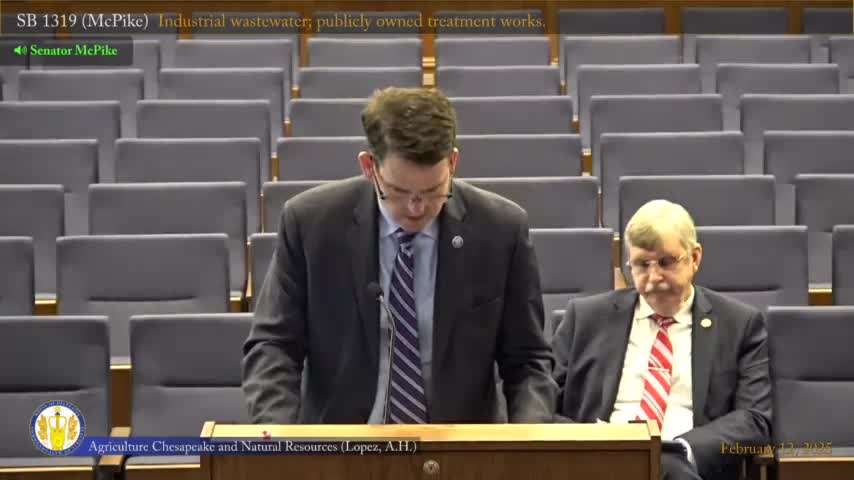
The bill, carried in the Senate by Senator Scott S. McPike, directs publicly owned treatment works to require self-reporting from industrial users when PFAS discharges are detected and to provide those reports to the Department of Environmental Quality. "This proposal will help our wastewater treatment plants address the same concerns without mandating a specific course of action," Senator McPike told the committee, describing the measure as a foundational data-collection step.
Why it matters: Committee members and witnesses said the measure is intended to map where PFAS enter wastewater systems so communities and utilities can plan capital investments and public-health responses. Jay Ford of the Chesapeake Bay Foundation said the bill helps protect public health and key Bay species, adding that recent studies show PFAS in fish and sensitive shellfish. "If we cannot get our arms around the sources, we are going to have a really tough road to plow in the years ahead," Ford said.
The legislation includes a one-line amendment lengthening a reporting window from 30 to 90 days. Senator McPike said he accepted the change after stakeholder input. The Virginia Manufacturers Association raised concerns that the bill would broaden reporting to include more than the priority PFAS substances previously addressed in state drinking-water work and could create inconsistent effluent limits at individual treatment plants. Brett Vassy of the association said the measure expands reporting from a targeted set of priority PFAS to "every PFAS chemical that exists," a point he said could produce litigation if plants attempted to set their own limits.
Committee attorneys and members discussed whether the bill imposes an independent penalty for failing to self-report. Staff told the panel that the reporting requirement would be implemented by publicly owned treatment works and that nonreporting could be addressed through violations of pretreatment agreements overseen by those utilities.
Supporters said the data will help utilities plan upgrades and investments that could address multiple contaminants simultaneously. "It's much more prudent to have that data proactive in communities across the Commonwealth," Senator McPike said during debate.
The committee approved the bill as amended. The final motion reported the measure to the Senate floor with amendments by a 14-6 vote.
The committee record shows testimony from conservation groups and manufacturing interests; the bill will next be scheduled for Senate floor consideration where additional amendments or debate may occur.