Get Full Government Meeting Transcripts, Videos, & Alerts Forever!
Get email alerts on the Curbside Voting topic
No spam. Unsubscribe anytime.
Committee pauses bill creating 5-foot buffer for curbside voting after debate
Summary
Lawmakers and election officials debated a bill that would create a five-foot perimeter around vehicles during curbside voting; after testimony for and against, the committee moved to 'pass by' the measure and suggested off-season stakeholder work.
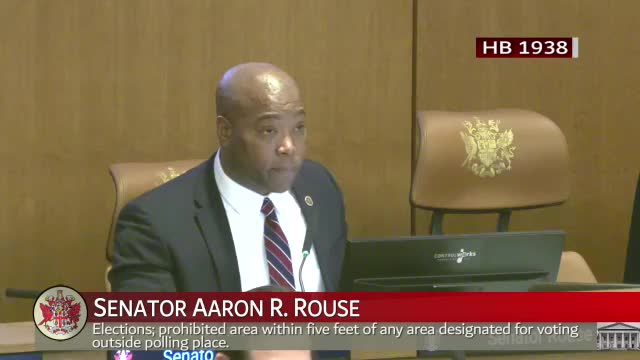
A committee hearing on HB 1938 drew extensive testimony from election officials and advocates over a proposal that would create a five-foot buffer around an automobile during curbside voting.
The bill, as it reached the committee, narrows an earlier, larger buffer (discussed in prior drafts) to a 5-foot perimeter around a vehicle while a voter is casting a curbside ballot. Sponsor testimony said the intent is to prevent people from approaching the car uninvited to hand literature or otherwise intrude; the sponsor told the committee it "is to not to have someone who is doing curbside voting to have people try to get in the car with them to give them a sample ballot or campaign literature." (as stated in testimony).
Why it matters: Curbside voting protections affect voters with mobility limitations and the procedures counties use at polling locations. Supporters said a narrow perimeter would protect curbside voters from pressure or unwanted contact; opponents said the bill risks limiting a voter’s right to receive literature and would upend local practices that already manage curbside voting.
Who testified
- David Bailey, speaking for the Voter Registrar's Association of Virginia, supported the bill and described curbside encounters he said could overwhelm a voter: "I think about my mother and the time she voted curbside, and I was glad that the people in her part of the Commonwealth were not trying to rush the car." (verbatim from testimony).
- Clara (identified online as an Albemarle County electoral board member), described local practice: election officials use a laminated placard placed on the windshield that reads "voting in process" when administering curbside voting.
- Shelley Oberlander spoke in opposition and several other electoral board members and county officials testified against the measure, arguing electoral boards and local procedures already protect curbside voters and objecting to a statutory change that could limit constituents’ ability to receive materials if they choose.
Committee discussion and procedural outcome
Members asked whether the statute’s language—cited in the transcript as referencing "24.2-649.1"—would make the buffer apply to an entire parking lot if the locality designated the lot. Counsel answered there is no detailed statutory procedure for how the area is designated and that local practice typically uses signage and a defined area rather than blanket designation of a whole parking lot.
A committee member suggested the bill be "passed by" (effectively tabled) so stakeholders could resolve questions in the off-season; another member moved that posture and the motion carried. The transcript records the committee vote as "Ayes 15, no 0." The committee also recommended off-season stakeholder conversations to refine the approach instead of immediate statutory change.
What supporters and opponents emphasized
Supporters emphasized protection and uniformity; Mr. Bailey said the 5-foot perimeter would "have some distance around the automobile" to prevent overwhelming a curbside voter. Opponents emphasized that election officials already place a visible marker on curbside vehicles and that voters should be able to receive campaign literature if they request it.
Next steps
The committee’s motion to "pass by" the bill means it did not advance during this hearing. Committee members suggested convening stakeholders in the off-season to attempt to reach a compromise on language and implementation details before reintroduction or amendment in a subsequent session.