Get Full Government Meeting Transcripts, Videos, & Alerts Forever!
Get email alerts on the Domestic Violence Penalties topic
No spam. Unsubscribe anytime.
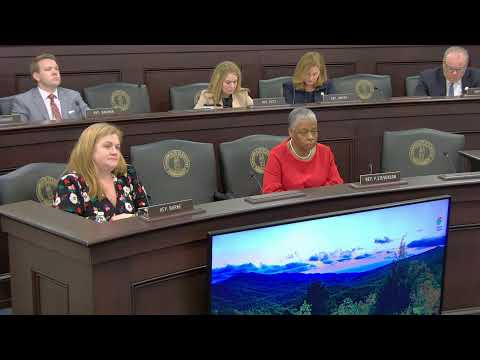
House Judiciary panel adopts substitute for HB 38 to raise penalty for repeated protective-order violations
Summary
The House Judiciary Committee adopted a committee substitute for House Bill 38 that would elevate a third violation of an order of protection to a Class D felony when the violation involves the attempted use or threat of physical force, sponsors and witnesses told the panel.
The House Judiciary Committee adopted a committee substitute for House Bill 38 that would elevate a third violation of an order of protection to a Class D felony when the violation involves the attempted use of physical force or the threat of physical harm, sponsors and witnesses told the panel.
Representative James Tipton, House District 53, the bill sponsor, told the committee the substitute narrows the bill so the felony escalation applies when repeated violations are tied to the same protective order and the same individual. "Currently, if there is a violation of an order of protection, it is a class A misdemeanor," Tipton said. "What this legislation does on the third violation of an order of protection ... that would move up to a class D felony." The committee adopted the substitute by voice vote; the motion and second were not named in the record.
The bill’s purpose, Tipton and a survivor who spoke said, is to protect people who face repeated, escalating harassment after courts issue orders limiting contact. Mary Anne Pratt, who identified herself as a survivor of domestic violence, described a series of incidents she said began with an assault on Dec. 18, 2022, and continued through repeated contacts and online harassment after an emergency protective order and later a three-year domestic violence order. "No one deserves to live in fear, and no one is alone," Pratt said during her testimony. She gave specific examples of repeated contacts, including more than 23 calls or texts within five days after an order and instances she said involved a tracking-style presence outside her home. Pratt said the accused was out on home incarceration and posted threats online, and she asked members to approve the bill so victims could regain safety.
Committee members voiced support and concern. Vice Chair Decker, who operates a homeless shelter for women and children, said Pratt’s testimony "give[s] a face and a voice to so many women" and expressed full support for the bill. Representative Stevenson thanked Pratt and asked whether the substitute covers social-media contacts; Tipton directed members to language in the committee substitute that elevates the penalty when the conduct involves attempted or threatened physical force, and said the added language reflected constituent input aimed at avoiding unintended consequences.
Representative Burke, who said she practices in the area of domestic violence, cautioned that the substitute’s requirement that the third violation be to the same petitioner could allow a single perpetrator to harass multiple partners without triggering the felony escalation. "My worry is with this change, it creates a potential for one man to victimize multiple partners and to harass and abuse them twice a piece before he ever finally gets the adequate punishment he needs," Burke said. Tipton acknowledged the concern and said he had been contacted by the attorney general’s office and that the Senate may consider changing the language; he said he intends to raise the issue with Senate members if the bill advances.
Scott West, formerly of the Department of Public Advocacy and appearing for the Kentucky Association of Criminal Defense Lawyers, urged caution about how the bill reaches a third predicate offense. West noted that violations of protective orders can be handled as contempt in family court or as criminal charges, and that two technical contempt findings in family court could constitute two predicate violations without a criminal charging decision in those instances. He also told the committee that stalking behavior tied to a protective order can already be charged as a Class D felony on a first offense in some circumstances, meaning charging decisions by prosecutors affect outcomes. "The problem is perhaps not using all the arrows that are already in the quiver," West said, arguing the issue also involves prosecutorial charging choices and how contempt findings are treated.
No floor or final House passage vote appeared on the committee record provided; committee members adopted the committee substitute and discussed next steps. Tipton said the version adopted in committee may not be final and that he expected further conversations with the Senate and the attorney general's office.
The substitute’s key change, as described in committee, is procedural and statutory: under the substitute a third violation of the same protective order by the same respondent would escalate from a Class A misdemeanor to a Class D felony if the violation involves attempted or threatened physical force. Committee discussion highlighted two unresolved issues: how courts’ contempt findings should count as predicate violations, and whether limiting the escalation to violations against the same petitioner produces gaps if a respondent later harasses different partners. Advocates, criminal-defense representatives and members recommended further review of charging practice and statutory wording before final passage.