Get Full Government Meeting Transcripts, Videos, & Alerts Forever!
Get email alerts on the Medicaid Behavioral Health topic
No spam. Unsubscribe anytime.
Kentucky Medicaid officials report rising behavioral-health spending, flag surge in peer-support billing
Summary
Department for Medicaid Services officials told the Legislature’s Budget Review Subcommittee that behavioral-health provider enrollment and managed-care spending have risen sharply; DMS plans new monitoring reports and controls after a surge in peer-support billing and other utilization trends.
Commissioner Lisa Lee of the Department for Medicaid Services told the Kentucky Legislature’s Budget Review Subcommittee on Health and Family Services on Feb. 12 that behavioral-health provider enrollment and managed-care spending have increased substantially in recent years, and the agency is instituting new monitoring and limits after a marked rise in peer-support billing.
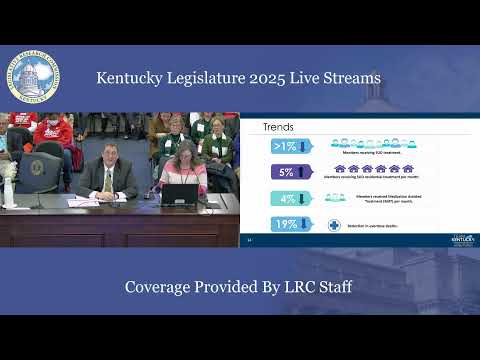
DMS serves about 1,400,000 Medicaid members statewide, Lee said, and about 90% of members are served through managed care organizations. "Medicaid is the largest payer of behavioral health services in the state," Lee said, noting that managed-care behavioral-health spending was just over $2 billion in 2023 and rose to $2.3 billion in 2024. She said a little more than $1 billion of the 2024 total was for substance-use disorder services.
The department told the committee that the number of providers billing for behavioral health services has grown from about 4,500 in 2019 to nearly 8,000 in 2024. Lee said part of that growth followed the 2014 expansion of behavioral-health coverage and an expansion in the types of provider categories eligible to enroll, such as licensed professional clinical counselors and licensed marriage and family therapists.
Committee members pressed DMS for more detail on specific billing trends and controls. Representative (Vice Chair) Williams asked about large payments for nonemergency medical transportation (NEMT) and whether that expenditure will continue. Lee said NEMT is administered through the Office of Transportation Delivery under a capitation arrangement; the office contracts with brokers who in turn contract with transportation providers. Lee said the office and brokers provide more than 2,000,000 trips per year and that Milliman performs an actuarial study to set the per‑member capitation rate.
Several legislators, including Representative Wellner and Representative Johnson, raised questions about utilization and reimbursement rates. Lee said the department combined two behavioral‑health fee schedules in 2023 (facility and nonfacility) and chose the higher reimbursement rate for codes where differences existed; that change, she said, contributed to increased payments for some codes. Lee also described a department letter issued to behavioral‑health providers that places parameters on some codes and said the agency is "looking at limiting some of the services" and "exploring some prior authorizations" for certain behavioral‑health services.
The committee singled out the peer‑support service code H0038 after a committee member noted a substantial year‑over‑year increase. "We have noticed an uptick in the peer to peer services. We are continuing to monitor that," Lee said. She told the committee DMS would monitor utilization and work with providers and MCOs; staff said DMS drafted its letter after consulting provider organizations and managed‑care organizations.
On provider reimbursement generally, DMS officials reminded the committee that a targeted rate study of home‑and‑community‑based (1915(c)) waiver providers was included in the 2024 budget. Lee and CFO Steve Bechtel said the legislature funded a portion of the recommended increases (the department requested the 70th percentile of the study), and because DMS did not reduce rates for providers already above the study recommendations, the effective funding level averages about 80–82% of the study in practice.
The department described its methods for measuring behavioral‑health spend: claims for fee‑for‑service members and encounter data from MCOs for the managed‑care population. DMS staff said they will design a single, standardized monthly behavioral‑health report (using consistent extraction parameters such as paid date versus date of service) so trends can be tracked routinely and interventions applied where necessary.
Law and oversight issues came up when legislators asked about Anthem’s exit from the Medicaid MCO market. Lee said Anthem is no longer a Medicaid managed‑care organization as of Jan. 1, 2025, following court litigation, and its membership was redistributed to other MCOs; the department noted run‑out claims will remain for a period.
Committee members also asked about fraud, waste and abuse. DMS said its Program Integrity division runs daily to monthly algorithms on claim and encounter data, pursues desk audits and other reviews when anomalies appear, and works with the attorney general’s office on investigations. Lee said DMS’s managed‑care contracts include penalty provisions and language requiring MCOs to meet contractual obligations; she said DMS meets routinely with MCOs and provider groups when questions arise.
The committee requested several follow‑up items: a standardized monthly behavioral‑health utilization report; a report on peer‑support use and any limits or prior‑authorization proposals; detailed NEMT administration and trip reports (quarterly and annual) from the Office of Transportation Delivery; code‑level follow up on several billing codes identified by members; and additional detail on the 1915(c) rate study and its implementation. Lee and Bechtel agreed to return to the committee with the requested information and materials. The chair set the next meeting for Feb. 19 at 10:00 a.m., and the committee adjourned by motion.
Ending: The committee scheduled follow‑up briefings and data reports; no formal changes to policy or rates were adopted at the Feb. 12 session.