Get Full Government Meeting Transcripts, Videos, & Alerts Forever!
Get email alerts on the Agriculture Funding topic
No spam. Unsubscribe anytime.
House Agriculture Committee approves higher audit threshold for conservation districts and lets most Ag Department employees apply for Ag Development loans
Summary
The Kentucky House Agriculture Committee on its first 2025 meeting approved two bills: House Bill 24, raising the audit threshold for conservation districts from $750,000 to $1,000,000, and House Bill 216, allowing most Kentucky Department of Agriculture employees to apply for Ag Development loans and grants; both passed by committee vote.
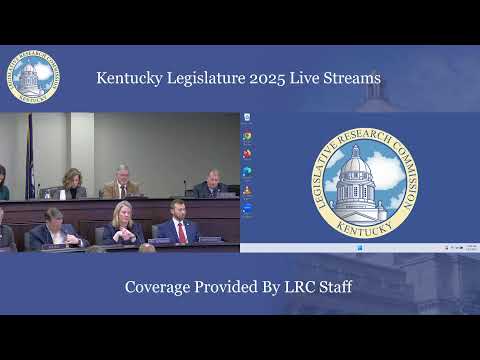
The Kentucky House Agriculture Committee on its first 2025 meeting approved two bills affecting local conservation districts and the state’s Ag Development lending processes.
House Bill 24, presented by Representative Dan Pfister, would raise the audit threshold for conservation districts from $750,000 to $1,000,000. “What this bill does is increases the threshold for the audits for the conservation districts. It'll raise it from 750,000 to a million,” Pfister said. Representative Kim King moved the bill; Representative Bivens seconded. A roll call recorded yes votes from members present and the motion passed.
House Bill 216, presented by Representative Myron Dossett with testimony from Brandon Reed, executive director of the Kentucky Office of Ag Policy, removes a prohibition that followed the office’s move into the Kentucky Department of Agriculture and that had prevented many Department of Agriculture employees from applying for loans or grants from the Ag Development Board or Ag Finance. Reed told the committee that the prohibition would remain for employees of the Office of Ag Policy who oversee those loans and grants, but that other Department employees who work in agriculture would be able to apply. “So many of those employees there with the Department of Agriculture are involved in agriculture, and this would make sure that those individuals could apply for these loans or grants,” Reed said. Committee members asked that the funding sources for those programs be clarified; Reed described the program’s funding as coming from the 1998 master settlement arrangement and House Bill 611, with a formula that directs a portion of those dollars to agriculture.
Why it matters: HB 24 affects local conservation districts’ audit obligations and administrative cost burdens; HB 216 affects eligibility for state-administered finance and grant programs that use tobacco-settlement-derived funds overseen by the Office of Ag Policy, Ag Development Board and Ag Finance Corporation. During committee discussion members noted inflation and long-standing thresholds that have not been updated in decades.
Key details and committee discussion
House Bill 24 - Presenter: Representative Dan Pfister (50th/56th district, per committee introduction). Pfister introduced the bill on behalf of interests including the Kentucky Association of Conservation Districts. Allen Brunt, identified in committee testimony as president of the Kentucky Association of Conservation Districts, participated in the presentation. - What it does: Raises the audit threshold for conservation districts from $750,000 to $1,000,000. - Discussion: Representative Ann Donworth asked how many conservation districts meet the new $1,000,000 threshold; Pfister replied, “To my knowledge, none spend or receive over a million dollars in a fiscal year.” Representative Tom Thomas and others framed the change as part of a broader need to update audit thresholds across local entities to reflect inflation. - Action: Motion by Representative Kim King; second by Representative Bivens. Roll call recorded affirmative votes from members present and the motion passed.
House Bill 216 - Presenter: Representative Myron Dossett (committee chair). Testimony: Brandon Reed, executive director, Kentucky Office of Ag Policy. - What it does: When the Office of Ag Policy moved into the Kentucky Department of Agriculture, certain prohibitions on applying for Ag Development Board or Ag Finance loans and grants applied in ways that affected Department employees. HB 216 would allow Department of Agriculture employees (other than Office of Ag Policy staff who oversee the loans and grants) to apply for those loans or grants. - Funding context: Reed said the office’s funding is derived from the master settlement arrangement (tobacco settlement) and the formula set by House Bill 611. He described a distribution formula and a split of funds for agriculture and other programs; he told the committee that the state receives the funds annually and administers them through a formula and county-level allocations. - Committee questions: Representative Ann Donworth asked whether the grants referenced were federal pass-through or state-funded; Reed and Dossett explained the funds come through the master settlement and the state formula; Representative Chris Freeland asked, jokingly, whether it would change daylight saving time, which Reed acknowledged as a separate issue. - Action: A motion and second were recorded (movers not specified in the transcript). Roll call recorded affirmative votes and the motion passed.
Votes at a glance - House Bill 24 — Motion carried (mover: Rep. Kim King; second: Rep. Bivens); roll call recorded affirmative votes from members present; outcome: approved by committee. - House Bill 216 — Motion carried (mover/second not specified in the transcript); roll call recorded affirmative votes from members present; outcome: approved by committee.
Context and background Brandon Reed summarized how the Office of Ag Policy’s funds derive from the 1998 master settlement and the implementing statute cited as House Bill 611; he said a percentage of the settlement proceeds is allocated to agriculture and other programs and that those funds are routed through a state formula and county allocations. Committee members noted the long-term impact of the tobacco-settlement-derived funding and the revolving nature of Ag Finance Corporation loans.
What’s next Both bills were approved by the Agriculture Committee and, per the committee chair, are expected to move to the House floor for further action.
Sources and attribution All quotes and attributions are taken from the committee’s public hearing transcript. Attributions in this article are limited to participants identified in the committee record.