Get Full Government Meeting Transcripts, Videos, & Alerts Forever!
Get email alerts on the Long Term Care topic
No spam. Unsubscribe anytime.
Local advocates tell Champaign County board it lacks hundreds of skilled nursing beds
Summary
A coalition called Advocates for Aging Care told the Champaign County Committee of the Whole that closures and population shifts have left the county dozens of skilled nursing beds short; the group described market analysis, outreach to potential partners and next steps but asked for continued local support.
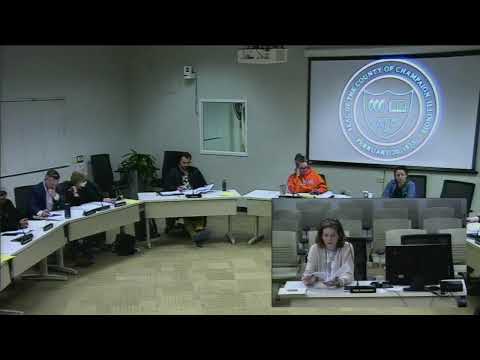
Sarah Loffenberg, a member of the steering committee for Advocates for Aging Care, updated the Champaign County Board Committee of the Whole on a local shortage of skilled nursing beds and plans to recruit a new model of senior care to the county.
"Champaign County is one of 2 counties in the state of Illinois that has a nursing home bed shortage," Loffenberg said. She told the committee that Livingston County is short nine beds and that Champaign County is short 337 beds, a deficit the group attributes to a rising older population and the closure of three nursing homes in the prior three years.
The group said a county needs-assessment supported by Champaign-Urbana Public Health and a market study from national consultant Greystone found the county has roughly 411 licensed beds and is at about 54 percent of a stated national benchmark for residents aged 85 and older. Greystone recommended adding roughly 274 beds to meet the national standard for the market-area population, the presenters said.
Lori Reynolds, another steering-committee member, described local outreach and resources the coalition has assembled, including ties with Parkland College and the University of Illinois and conversations with not-for-profit and faith-based operators. "We are energized, and we believe that this is something that we can solve," Reynolds said, noting interest from a faith-based operator that has facilities in other states.
Kathy Emanuel, who described the group's market work, said Greystone advised that adding skilled nursing as part of a larger continuum of care or life-plan community improves the chance of financial viability and of attracting experienced management and financing. The group is also examining smaller "neighborhood" models and other nontraditional approaches used elsewhere, which speakers said may accept Medicaid patients while providing private rooms and other quality improvements.
Speakers said the group has held community surveys (about 800 respondents), that 70 percent of those who needed placement reported difficulties, and that the number of county residents age 60 increased 67 percent in two decades. Presenters listed several risks and barriers, including Illinois Medicaid reimbursement rates and the state moratorium on adding skilled nursing beds, but said there are waiver pathways for life-plan communities and that state lawmakers have expressed willingness to help.
The presentation asked the county to continue coordination and to consider the county as a partner as the coalition pursues operators, potential gift land, grants and legislative pilots to support higher-quality and financially sustainable skilled care.
The committee did not take formal action on the presentation; board members asked clarifying questions about Medicaid reimbursement incentives and potential pilot policy ideas that had been tried in other states.
Advocates for Aging Care said it will continue outreach to local governments, university partners and prospective operators and return with further updates.