Get Full Government Meeting Transcripts, Videos, & Alerts Forever!
Get email alerts on the Fire And Ems Oversight topic
No spam. Unsubscribe anytime.
Baltimore City oversight hearing spotlights EMS hospital delays, staffing gaps and vacant‑property fire risks
Summary
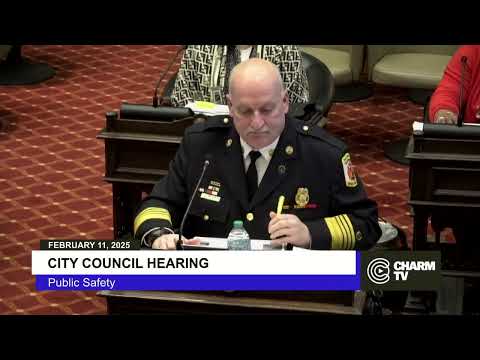
Baltimore City Council Public Safety Committee Chair Mark Conway convened an oversight briefing with Baltimore City Fire Department and EMS leaders to review apparatus deliveries, station projects, 9‑1‑1 performance and response challenges under LO25‑0006.
Baltimore City Council Public Safety Committee Chair Mark Conway convened an oversight briefing with Baltimore City Fire Department (BCFD) and Baltimore City EMS leaders to review operations, apparatus deliveries, station projects, 9‑1‑1 performance and community programs under LO25‑0006. The department outlined recent and planned equipment deliveries, station renovation timelines, changes in daily operations tied to EMS demand, and new data‑driven programs intended to reduce low‑acuity 9‑1‑1 calls.
The hearing matters because the department is handling hundreds of calls each day while reporting continuing pressure from hospital offload delays and a national paramedic shortage that affect response capacity. Committee members pressed for follow‑up data on hospital offload times and on how vacant and “codex” properties affect firefighter safety and city resources.
BCFD Chief James Wallace opened the briefing with an apparatus update and an overview of station projects. “We believe by the end of the calendar year this year we’re gonna take delivery of of upwards of 8 engines and an additional sizable amount of medic units,” Chief Wallace said, and he told the committee one of the department’s fire‑rescue boats is expected to be delivered before year‑end. Wallace described recent deliveries of new medic units and a transition to some electric support vehicles.
Committee members and department leaders described multiple capital projects funded through ESPP and ARPA. Chief Wallace said Engine 27 renovations had exceeded the originally budgeted amount and that the department was “taking a position of fiscal responsibility” to meet community needs within about $7,500,000 in available funding. He reported Engine 2’s renovation is effectively complete and that Engine 31 will begin HVAC work in spring followed later by bathroom and kitchen renovations. The department showed photos of completed ESPP‑funded gender‑neutral dorms and renovated kitchens at several houses.
Tania Reddick, Baltimore’s 9‑1‑1 director, gave call‑center performance figures and workforce status. She reported the center answered 82% of 9‑1‑1 calls within 15 seconds and that, for 2025 to date, the center had answered about 144,000 calls. Reddick also said there are vacancies: ‘‘13 vacancies in 9‑1‑1 and 4 vacancies in fire dispatch,’’ and that hiring events continue to be scheduled.
Leaders presented dispatch and response metrics: the Fire Department reported an average of about 479 unit responses per day, including roughly 285 EMS‑type responses and 194 suppression responses per day. Fire suppression leaders said a large share of suppression responses are for medical incidents, because suppression units routinely “back up” EMS when ambulance units are not available.
Assistant Chief John Idd and other operations chiefs told the committee that suppression units reached structure fires faster than the NFPA 1710 benchmark: their average time from engine en‑route to on‑scene for structure fires was 3 minutes, 8 seconds, compared with NFPA 1710’s 4‑minute benchmark. The department also reported reductions in injuries: a roughly 27% reduction in fireground injuries year‑to‑year and an approximately 55% drop in line‑of‑duty burn injuries, changes department leaders attributed to updated policy, training, on‑scene safety officers and a more cautious approach to “codex” (boarded or otherwise unsafe vacant) buildings.
Vacant and codex properties were a central topic. The department reported 5,230 codex addresses in its system and said it is running targeted inspections and using a new 3‑1‑1 reporting workflow for suspected illegal occupancy. Chief Wallace said data collected by BCFD is shared with Baltimore Police Department, Department of Public Works, the Department of Housing and the city’s homeless services office so those agencies can follow up the next morning. In 2024 the department reported 68 properties “raised” (actioned) and 179 visually returned to normal use after reinspection, figures the committee asked the department to break down into addresses and permit status.
The committee probed EMS staffing and hospital offload times. Assistant Chief James Matts and Medical Director Dr. Benjamin J. Lawner said Baltimore runs one of the busiest EMS systems per capita in the nation, with about 550 incidents per day on average and roughly 250 transports per day. Matts said hospital offload times remain a problem and presented median regional offload times that run “about 50 minutes to an hour” and noted recent ninetieth‑percentile offload reports in the 59–70 minute range; Matts said Sinai Hospital recorded a 70‑minute ninetieth‑percentile offload in a recent week. Dr. Lawner and Matts said the problem partly reflects regional capacity and the structure of state hospital funding; the committee asked the department to provide weekly, hospital‑by‑hospital offload data for follow‑up.
Panelists described local innovations and pilot programs intended to reduce nonemergent ambulance demand and spare suppression apparatus. The city’s tele‑9‑1‑1 pilot, launched in April 2024, routed low‑acuity calls for remote evaluation; directors said tele‑9‑1‑1 resolves many calls without transport. The city has also deployed a behavioral‑health diversion program in partnership with a community provider (BCRI), a community paramedic/population‑health mobile unit that has left behind more than 13,000 naloxone kits (about 26,000 doses) since the program began, and an EMS “chase‑car” ALS pilot (a non‑transport advanced unit) that had responded to more than 2,100 incidents and delivered ALS care with a typical median response of about 7 minutes, 50 seconds.
Recruitment and training were recurring themes. Nikki Lewis, director of human resources, said the hiring timeline from application to start can take up to 12 months and that the department is streamlining by combining face‑to‑face interviews and physical ability tests. She said the department has begun using the National Testing Network and has compiled a database of more than 1,000 prospective applicants. Chiefs and training staff described 105 active recruits at the Fire Academy, recent and upcoming graduations, expanded training hours, and a new “firefighter removal” course developed after exchange with FDNY instructors.
Committee members pressed for follow‑up data the department promised to provide: weekly hospital offload times by hospital; a list of the addresses returned to “normal use” after reinspection; details on apparatus delivery schedules; and an update on paramedic recruitment and retention drivers. Chair Conway closed the hearing by thanking department leaders and requesting the additional data ahead of the next quarterly oversight session.
The department provided direct quotes during the briefing; for example Chief Wallace said, “we’re proud of the fact that we’ve transitioned where we can over to electric vehicles,” and Director Reddick said the 9‑1‑1 center “answered 82% of the calls within 15 seconds.” Those figures and statements were offered as the department’s operational summary and were the basis for the committee’s requests for more granular data.
Next steps identified at the hearing: the department will deliver hospital offload metrics and the reinspection/address lists requested by council members; committee members signaled interest in pursuing broader interagency coordination on vacant properties, stabilization‑center capacity and hospital offload consequences.