Get Full Government Meeting Transcripts, Videos, & Alerts Forever!
Get email alerts on the Housing Infrastructure topic
No spam. Unsubscribe anytime.
Planning staff outline gap between projected housing demand and likely supply, propose zoning and code changes
Summary
Planning Department staff presented a preliminary briefing on the housing and infrastructure study requested by Metro Council Resolution RS2024-288, saying Nashville faces higher housing demand than current zoning and development patterns are likely to deliver and proposing code, zoning and infrastructure analyses to close the gap.
Planning Department staff presented a preliminary briefing on the housing and infrastructure study requested by Metro Council Resolution RS2024-288, saying Nashville faces higher housing demand than current zoning and development patterns are likely to deliver and proposing code, zoning and infrastructure analyses to close the gap.
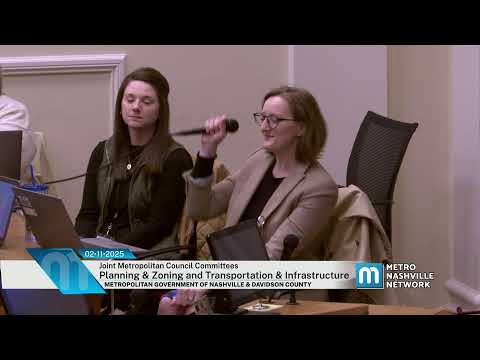
Greg Claxton, who leads the study team in the Planning Department, told the Planning, Zoning and Transportation Committee that the Unified Housing Strategy (UHS) estimates roughly 90,000 housing units of demand over the next 10 years and that the department’s “likely build‑out” analysis under current zoning produces an estimated 60,000–70,000 units. Claxton said the team is considering an additional planning “buffer” of about 10,000–25,000 units to account for uncertainties in economic and household trends.
The gap between demand and modeled likely build‑out is central to the study’s three questions: what limits housing production under current rules, where the city should add housing consistent with Nashville Next, and what infrastructure and amenities are required to support that growth. Claxton said staff will test alternate zoning scenarios and assess the financial feasibility of middle‑housing types — duplexes, triplexes, townhomes and small multifamily — to determine where changes would be effective.
The presentation summarized methods and sources. Staff said the study is funded from FY 2024 budget savings, is supported by a consultant team led by Opticos, and coordinates with other Metro work including the Unified Housing Strategy, the multimodal Mobility Master Plan (which updates Access Nashville 2040 and integrates Choose How You Move), Metro Water, parks and the fire department. Claxton described a parcel‑level “build‑out capacity” model that uses 10 years of permitting data to estimate both maximum theoretical capacity and the likelihood each parcel will redevelop, producing the 60,000–70,000 likely‑supply figure.
Staff highlighted several findings and lines of work they will pursue: an economic feasibility analysis to show which missing‑middle housing types are likely to be built; draft code amendments to enable those types where feasible; changes to building‑code thresholds (for example, how stair‑access and the split between residential and commercial code apply to small multifamily); and options for targeted zoning‑map adjustments consistent with Nashville Next’s centers and corridors. Claxton said the Unified Housing Strategy expects about 50–55% of future production to be for‑sale housing, though he noted sale versus rental mix cannot be mandated by zoning alone.
Infrastructure coordination was a major focus. Director Diana Alacron and planning staff said the multimodal Mobility Master Plan work will overlay existing modal plans, the major and collector streets plan and transit plans to identify gaps and needed right‑of‑way and connectivity. Staff said Metro will produce examples of street construction cost‑sharing and will work with NDOT, WeGo and Metro Water to identify infrastructure gaps that raise development costs in some outlying areas.
Committee members asked about vacant and underutilized properties, the role of short‑term rentals and how growth outside Nashville impacts local demand. Claxton and staff said vacancy and redevelopment likelihood are included in the parcel model, short‑term rental impacts would be assessed within the regulatory review and that historical outflow to ring counties was considered as part of demand uncertainty rather than modeled as an explicit absorption scenario.
Staff gave a tentative schedule: community outreach events will begin at the end of the month, preliminary findings and recommendations will return to the committee in March, detailed community engagement in April and May, and final recommendations to Metro Council in June. Staff posted materials at engage.nashville.gov/housingandinfrastructure and said they will share the project website and schedules as events are confirmed.
Claxton emphasized the study is exploratory and data driven: “We don’t have recommendations for you today. We will have preliminary findings for you at the March,” and staff repeatedly framed the work as aligning with Nashville Next while testing alternate scenarios to address the quantified gap between demand and likely supply.
Questions that committee members posed and that staff said they will pursue included: fiscal impacts of different development patterns (Smart Growth America work from the Nashville Next process was cited as background), detailed economic feasibility of bonus or incentive programs recently enabled by the state, the relative ease of meeting rental demand compared with ownership demand, and how infrastructure costs and responsibility (public vs. private) affect development feasibility. Staff also said they will recommend monitoring and revisiting the program in two years if adopted.
The meeting included no formal votes on zoning or code changes. The committee was briefed on next steps and public meeting dates; staff requested CIB priority lists be submitted by the posted deadline so departments can evaluate capital needs tied to development.