Get Full Government Meeting Transcripts, Videos, & Alerts Forever!
Get email alerts on the Solar Ground Mounted topic
No spam. Unsubscribe anytime.
Lincoln aldermen ask tighter rules, aesthetics controls for ground-mounted solar
Summary
Aldermen discussed changing the city's ground-mounted solar rules after a business inquiry, focusing on visibility, fence height and glare; councilors asked staff to draft revised language and bring it back to committee for consideration.
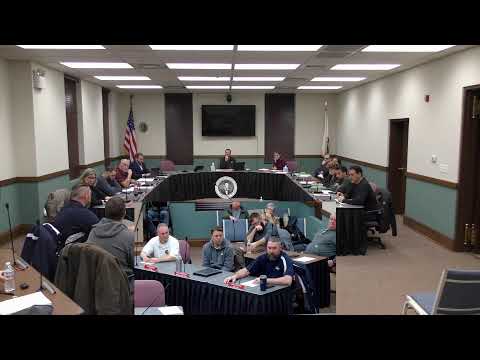
Alderman Bateman urged the Committee of the Whole on Feb. 11, 2025, to revise Lincoln's ground-mounted solar rules so the city would have greater control over size, fencing and visual impact. "I'm not trying to do this to kill ground mounted solar, but I think we need to have more control over it," Bateman said.
The discussion grew out of a business inquiry about placing panels behind a commercial property visible from Woodlawn Road and a comparison Bateman made with an existing Peoria, Illinois ordinance. Bateman said he prefers the city keep several topics in scope, including removing or tightening fence-height language and adding aesthetics language such as "shadow box" fencing that does not shade panels.
The item matters because the city currently treats ground-mounted systems as special uses and has existing decommissioning language; aldermen said they want rules that address applications for smaller commercial installations as well as larger solar farms. "I would like to make it any size," Bateman said, describing his intent that smaller commercial projects also come to the council for review rather than be treated differently based on an arbitrary acreage threshold.
Speakers discussed glare, panel tilt and typical panel heights. City staff told the council the panels currently in town are non-tilt installations and that full-tilt systems elsewhere can reach roughly 7 to 12 feet in height. Alderman Parrot asked who would assess glare; staff replied the ordinance already contains language and that modern panels are typically made to reduce glare, but added that complaints typically arise only after installation.
Alderwoman McClellan and other council members asked staff to compare Lincoln's existing regulations with sample ordinances from nearby communities (Bateman cited Peoria) and to return with proposed language. City Attorney Hovlett and staff were asked to prepare draft revisions before the committee's next meeting so the council could consider specific ordinance language addressing: required special-use review, maximum fence heights and acceptable fence types, glare standards and decommissioning requirements.
The council did not vote on an ordinance that night; members agreed to have staff produce revisions for a future Committee of the Whole meeting. The item was placed on a future agenda for additional review and drafting.