
Committee hears support for extending manufactured‑dwelling park closure credit; advocates stress preservation work
Get AI-powered insights, summaries, and transcripts
Sign Up Free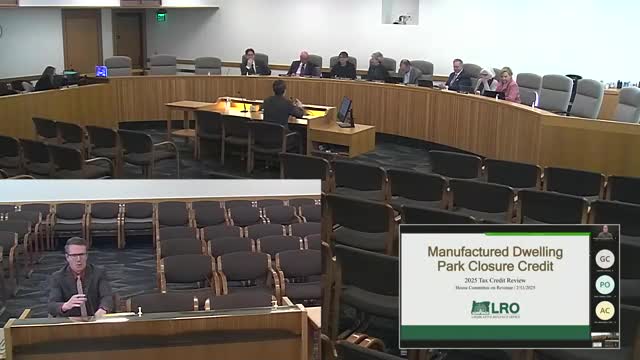
Summary
House Bill 2,090 is a six‑year sunset extension of the manufactured‑dwelling park closure credit. LRO described the refundable $5,000 credit and related direct payments from park owners; advocates said preservation and resident ownership remain critical as parks sell or face closure.
The House Committee on Revenue opened a public hearing on House Bill 2,090, a placeholder bill that would extend for six years the manufactured‑dwelling park closure income tax credit.
Kyle Easton of the Legislative Revenue Office summarized the credit’s purpose: to mitigate costs for households forced to move when a manufactured‑dwelling park closes. Easton said the credit is a $5,000 refundable income tax credit available when a park is closed by the landlord or through eminent domain and that the manufactured dwelling must be the taxpayer’s owner‑occupied principal residence at the time of the closure. He noted the credit was enacted around 2007 and replaced an earlier, move‑focused credit.
Easton also reviewed related direct payments required by Oregon statute from park owners when a park closes. He said those payments are sized by unit type, historically $5,000 for a single‑wide up to $9,000 for larger units, and that the statutory amounts have been increased and indexed so current direct payments approximate $8,000 for a single‑wide and about $13,300 for larger units. Easton said the direct payments may be stacked with the refundable tax credit, and Oregon law provides a subtraction so those direct payments are not subject to Oregon income tax.
Committee members sought additional data. Representative Reschke asked how many manufactured‑home parks remain in Oregon; Easton said Oregon Housing and Community Services tracks parks and that he could provide the number, estimating roughly "a thousand to 1,100" parks when pressed.
Peter Hainline, testifying for CASA of Oregon, described the nonprofit’s work preserving manufactured‑housing communities and converting parks to resident ownership. Hainline said CASA has helped convert 28 parks to resident ownership and urged the committee to retain the credit as a modest but meaningful relief for households affected by closures. He also noted 40 park sales were reported to the state in the 14 months following the legislature’s opportunity‑to‑purchase notification law and said preservation resources remain limited.
Representative Smith asked about priorities between this credit and programs that would replace or upgrade very old manufactured homes to reduce utility burdens. Hainline and members noted the state has multiple programs and proposed funding streams related to preservation and replacement, including recent and proposed state investments, and said preservation and targeted replacement both have roles.
The committee closed the public hearing on HB 2,090 without taking final action.