Get Full Government Meeting Transcripts, Videos, & Alerts Forever!
Get email alerts on the Education topic
No spam. Unsubscribe anytime.
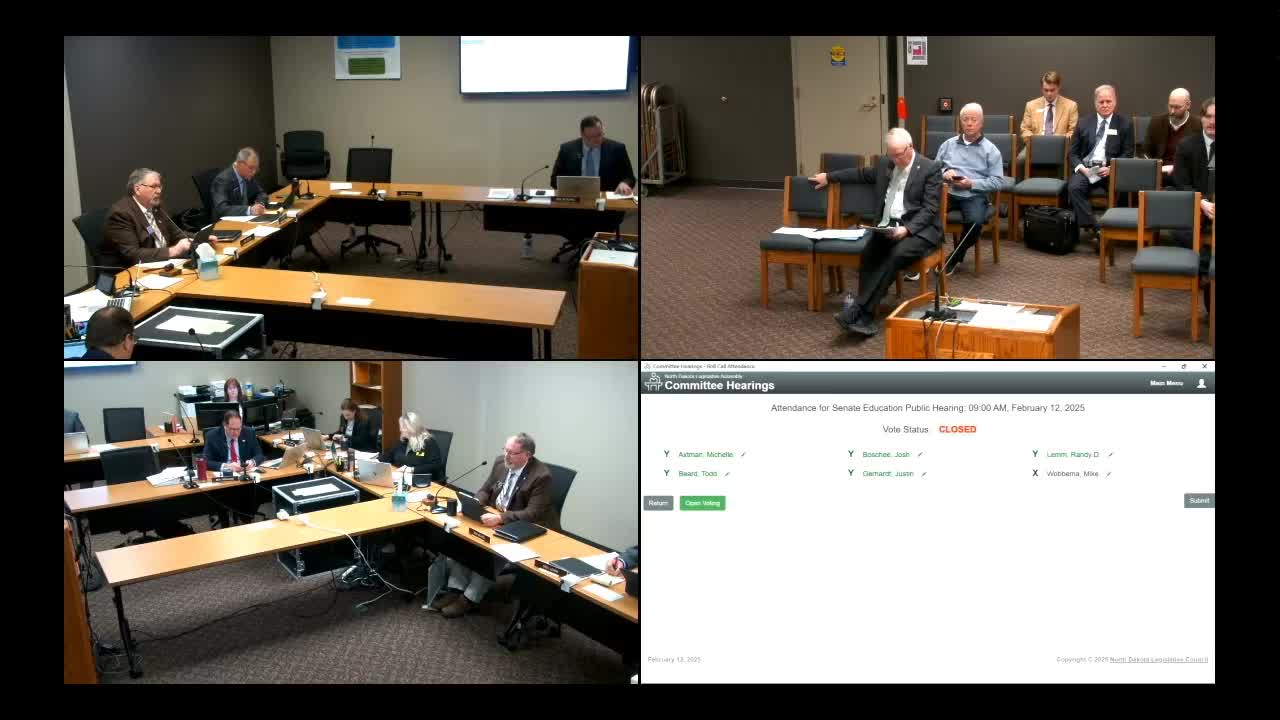
Senate Education Committee hears testimony on SB 2355 to request inclusion of ‘intelligent design’ in next science standards review
Summary
Senate Education Committee members heard more than two hours of testimony on Senate Bill 2355, a proposal that would ask the state Department of Public Instruction (DPI) to include intelligent design among topics considered when the state next rewrites its elementary and secondary science content standards, bill sponsor Senator Dwyer said.
Senate Education Committee members heard more than two hours of testimony on Senate Bill 2355, a proposal that would ask the state Department of Public Instruction (DPI) to include intelligent design among topics considered when the state next rewrites its elementary and secondary science content standards, bill sponsor Senator Dwyer said.
The bill would not force immediate changes to classroom instruction, Dwyer told the committee, because it asks DPI to include intelligent design only “the next time” the state science standards are revised. “This bill has absolutely nothing to do with religion, but everything to do with continuing the search for truth,” Senator Dwyer said during his presentation.
Supporters said presenting intelligent design alongside evolution would develop students’ critical thinking by exposing them to multiple theories. Mara Heidbreder of North Dakota Family Alliance Legislative Action testified the proposal would “teach students how to think rather than what to think.” She said intelligent design is grounded in scientific methods and evidence and urged a “do pass” recommendation.
Opponents — including the American Civil Liberties Union of North Dakota, college researchers and practicing science faculty — said intelligent design is a religious theory, not a scientific one, and that placing it in K–12 science standards would violate the Establishment Clause and invite litigation. Cody Schueller of the ACLU of North Dakota told the committee that federal courts have repeatedly held that teaching creationism in public schools is unconstitutional and cited the 2005 federal case arising from the Dover Area School District, where the court ruled that intelligent design is a relabeled form of creationism. “Teaching intelligent design in public school science classes is patently unconstitutional and should it become law, it will inevitably violate the students’ and the parents’ constitutional rights and invite litigation,” Schueller said.
Multiple scientists and science educators who testified said intelligent design does not meet core criteria of science because it lacks testable hypotheses and is not subject to revision based on empirical evidence. Magdalene Mercado, a PhD student in evolutionary biology, said, “Intelligent design makes no testable hypotheses” and warned that including it in science classes would take time away from teaching the scientific method. Neuroscientist David Randeros and a group speaking on behalf of biological scientists also urged rejection of the bill, noting the risk to STEM education quality and the potential legal and reputational costs for the state.
Senators on the committee asked procedural and policy questions. Senator Axman asked whether the amendment language — which uses the word “permit” — would leave implementation to individual teachers; Dwyer answered that the intent was for the standards to include intelligent design while allowing teachers flexibility in how they present the material. Senator Baucher raised concerns about recruiting and retaining science teachers should the bill be adopted; Dwyer said the bill was intended to protect teachers who chose to present intelligent design from reprimand.
Dwyer said he and DPI staff negotiated an amendment to avoid jeopardizing federal funds that help pay for the standards-writing process; the amendment frames the request so DPI can still receive federal support for convening writing committees. The sponsor emphasized the bill does not call for replacing evolution in curricula but for including intelligent design in the standards-writing discussion the next time DPI updates science content.
No committee vote was taken at the hearing. The committee received both pro and con testimony, then closed the hearing and recessed. Committee members did not adopt a recommendation on the bill during the session recorded in the transcript.
The hearing record included references to prior litigation and federal case law discussed by witnesses; opponents pointed to the Dover litigation (Kitzmiller v. Dover Area School District, 2005) and referenced Supreme Court precedents on religion in public schools as reasons the state should reject the proposal.
The committee hearing provided senators with a range of perspectives — the bill sponsor and faith-based supporters argued for intellectual openness and classroom flexibility, while scientists, civil liberties advocates and many educators warned the measure is religious in character, legally vulnerable and harmful to science education.