Get Full Government Meeting Transcripts, Videos, & Alerts Forever!
Get email alerts on the Water And Infrastructure topic
No spam. Unsubscribe anytime.
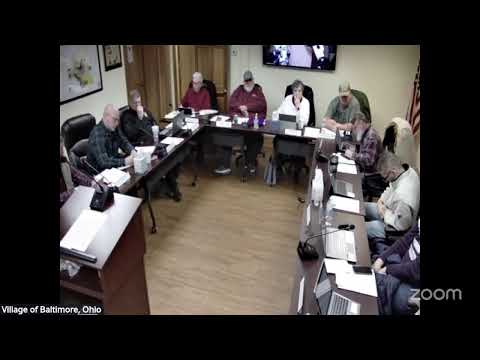
Baltimore Village flags $53,000 water-fund shortfall; council asks staff for prioritized repairs and meter replacements
Summary
Council reviewed the draft budget and identified a $53,000 shortfall in the water fund tied to engineering costs for the Elmwood–Jefferson project. Council asked staff to provide a prioritized list of water and sewer repairs and cost estimates, and discussed buying and installing water meters to reduce unbilled water loss.
Baltimore Village council members and staff reviewed the village’s proposed budget and identified a $53,000 shortfall in the water fund, driven largely by engineering costs for the Elmwood–Jefferson project and uncollected water from failing meters.
The village’s finance staff reported total cash of about $1,990,177.47 and outstanding checks of $11,008.20, and noted $289,306.20 in checks written last month. The water fund was shown “in the red” by roughly $53,000 after staff added an estimated $120,000 in engineering fees for the Elmwood–Jefferson water and street project. Staff said the village applies a 60%/40% split (60% water, 40% streets) to engineering costs and that the water share of those engineering costs was the item pushing the fund into deficit.
“This map shows the older mains — many are 4-inch and 6-inch lines — and several are failing,” Matt, the village administrator, told council while describing a project map prepared by the streets/water crew. He urged the council to prioritize immediate repairs and funding sources. “If you have specific projects…put pen to paper and the next service lead say, ‘I need this for this project,’ and then we can start digging those,” he said.
Council and staff discussed three primary responses: (1) pursue grants and low- or zero-percent loans to fund immediate water-line replacements, (2) consider reallocating general-fund carryover to cover engineering or capital costs up front, and (3) spend on additional meter purchases and installations to reduce unbilled water loss.
Staff reported there are about 40 water meters on hand that have not yet been installed and said meter reporting failures have contributed to substantial unbilled water. Council members noted multiple recent water-main breaks; staff reported a string of breaks in recent months that were on older mains. The council directed public works and finance staff to produce a prioritized list of water- and sewer-related repairs with estimated costs and recommended funding sources. Council members emphasized that list should show which repairs are emergencies and which could be scheduled.
On funding, staff said the village has roughly $555,000 in general-fund carryover before plugging in this year’s proposed budget; after proposed allocations the carryover drops to about $164,000. Council members asked whether tax-fee receipts or reallocation of current revenue shares (currently about 54% general fund, 40% street, 3% pool) could be adjusted to cover debt service on any borrowing for capital repairs.
Matt and other staff signaled they are actively pursuing grants and negotiating agreements with regional partners. The sewer/wastewater staff reported a carried-over balance in the sewer improvement fund used for membrane purchases, and said the village is exploring both a new press option and a near-term agreement with an out-of-town paper mill expected to bring revenue soon.
Council members repeatedly instructed staff to return with a ranked list of specific water and sewer projects (with costs) so the council can consider targeted transfers, borrowing, or grant applications. The council also discussed buying and installing replacement meters immediately to reduce ongoing unbilled water losses and to restore metering capability in problem areas.
Ending: Council did not adopt a final budget at this meeting. Staff will supply a prioritized repair list and cost estimates at an upcoming meeting so the council can consider specific reallocations, grant applications, or borrowing options.