Get Full Government Meeting Transcripts, Videos, & Alerts Forever!
Get email alerts on the Adoption Licensing topic
No spam. Unsubscribe anytime.
Committee advances bill to clarify adoption agency licensing, fees and revocation rules
Summary
The Senate Human Services Committee voted 6-0 to advance House Bill 1120, which reorganizes Century Code provisions governing licensed child-placing agencies, clarifies conflict-of-interest investigations, consolidates revocation language and allows reasonable adoption-related fees to cover up to six weeks after delivery.
Bismarck — The Senate Human Services Committee on an uncontested 6-0 vote advanced House Bill 1120 on procedural and substantive changes to state law governing child-placing agencies and adoption procedures.
Kelsey Bless, a licensing unit representative for the Department of Human Services, told the committee she appeared “in support of House Bill 11 20, which was introduced at the request of the department.” She said the bill is intended to clarify Century Code sections related to adoption, reduce duplication across statutes and provide consistency for prospective adoptive parents, birth families, custodial agencies and licensed child-placing agencies.
The measure moves language about compensation and fees from Century Code 14-15-09 into section 50-12-09 to remove duplication; it amends 14-15-11 to expressly allow the department to serve as an approved source to complete an adoption investigation when a licensed child-placing agency has a conflict of interest; it reorganizes the rules on “reasonable fees” charged to adoptive families, and it consolidates separate revocation provisions into 50-12-10. The bill also seeks to repeal an out-of-state licensing section that the department says is already addressed in the North Dakota Administrative Code (75-03-36-05).
Bless told the committee the department licenses four child-placing agencies: three focused on adoption placements and one that assists with treatment foster care. She said the department had 13 conflict cases last year in which an alternate agency was asked to complete a home study (for example, where a couple was cohabiting rather than married). Bless said the licensing unit has 21 staff who could perform a home study in the event an agency recused itself for conflict reasons, and that the department proposed the 50-12-09 reorganization to make compensation parameters clearer.
The bill also removes a reference to “certified foster care providers” in the adoption-notice section; Bless said those certified providers generally offer short-term care (respite or emergency shelter) and cannot form the durable licensing relationship typically needed for adoption. The bill would allow reasonable fees related to a birth parent’s expenses to be charged up to six weeks after delivery to capture extended hospital stays or delivery-related medical complications.
Committee discussion included examples of conflict cases — for example, where a blood relative who has not married a long-term partner is the preferred adoptive placement and a faith-based agency will not handle an unmarried cohabiting couple — and whether same-sex couples have been approved historically (Bless said courts make final adoption decisions and that such adoptions have occurred). The committee asked for and received confirmation that the change is largely a statutory cleanup resulting from prior adoption-redesign work.
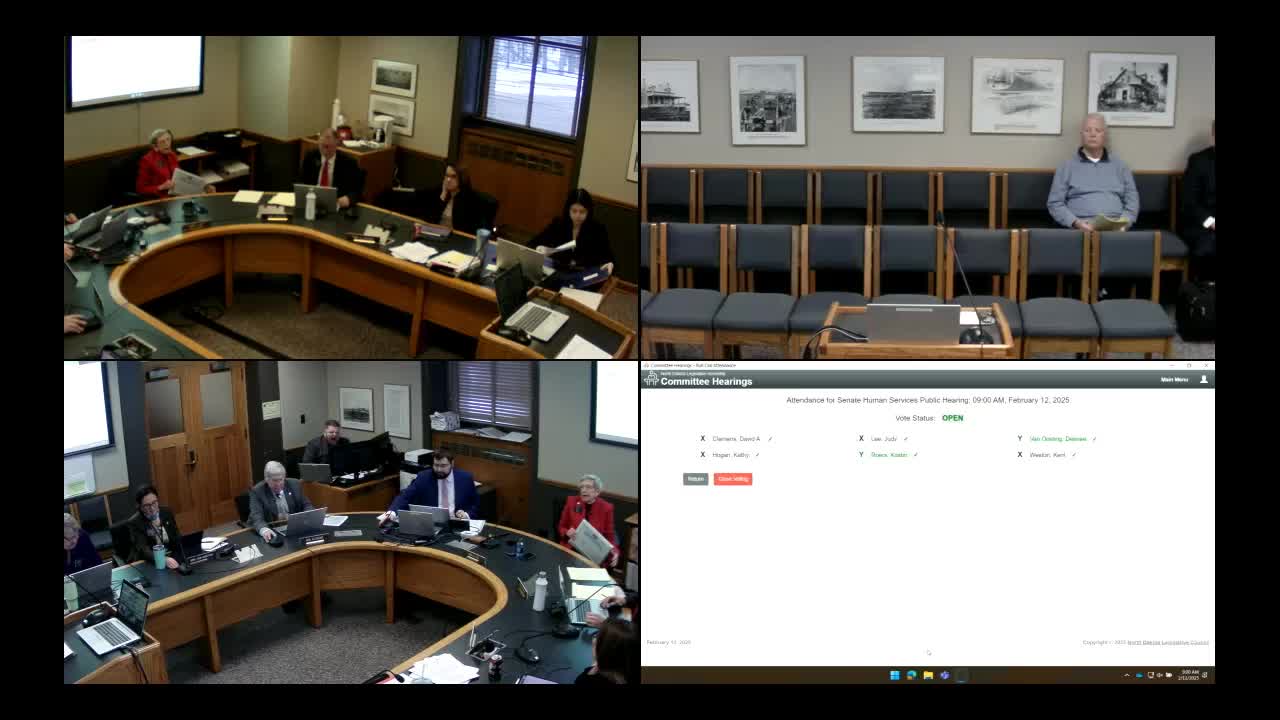
Senator Rohrs moved the committee recommendation (do pass) on House Bill 1120; the motion was seconded. On the roll call, Senators Lee, Weston, Rohrs, Hogan, Van Osteen and Clemens voted aye and the motion passed 6-0. Committee minutes record a volunteer carrier will be named for the bill.
The committee record shows the department asked that two narrowly focused repeal provisions be removed from separate parts of code and consolidated (for example, false-reporting revocation language consolidated into 50-12-10). No fiscal note was stated in committee.
The bill will move forward with the committee recommendation; further action will be scheduled by the Senate leadership and the bill’s carrier.