Get Full Government Meeting Transcripts, Videos, & Alerts Forever!
Get email alerts on the Education Finance topic
No spam. Unsubscribe anytime.
Minnesota officials say universal school meals boosted participation, helped local farmers
Summary
ST. PAUL, Minn. — Minnesota's Free School Meals program served more than 50 million school meals in 2023'24 and produced large year‑over‑year gains in participation and household savings, state education officials told the Senate Education Finance Committee on Feb. 12, 2025.
ST. PAUL, Minn. — Minnesota's Free School Meals program served more than 50 million school meals in 2023'24 and produced large year‑over‑year gains in participation and household savings, state education officials told the Senate Education Finance Committee on Feb. 12, 2025.
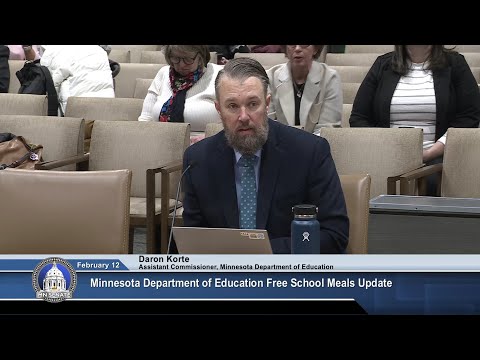
The Minnesota Department of Education reported a roughly 15% increase in lunches and a roughly 40% increase in breakfasts statewide after the program began July 1, 2023. "We saw about a 15% increase in lunches served," said Darren Corte, assistant commissioner for the Office of Student Support Services at the Minnesota Department of Education. "Even more impressive was the 40% increase that we saw in the number of breakfasts served." The department estimated families saved about $267,000,000 in the program's first year, based on per‑meal costs used in claims processing.
Why it matters: lawmakers and school officials said higher participation reduces stigma, stabilizes school nutrition budgets, and shifts staff time from paperwork to menu quality and local purchasing. "This program provides more than just meals," said Stacey Copeland, director of nutrition services for Saint Paul Public Schools. "It is about equity, dignity and opportunity, eliminating shame and stigma for students." Several speakers connected improved access to likely gains in classroom focus, attendance and student well‑being.
Most of the hearing described program data and on‑the‑ground experience rather than new legislation. MDE told the committee the Minnesota Free School Meals law was signed by Gov. Tim Walz on March 17, 2023, and the department used targeted outreach, auditing of claims and temporary USDA extensions to maximize federal reimbursements and encourage eligible sites to use the Community Eligibility Provision (CEP). "We requested extensions from USDA, which allowed schools to have more time to apply for that CEP provision," Corte said.
Key figures and program details offered to the committee
- Total school meals served in 2023'24: "over 50,000,000 school meals," including breakfast and lunch (MDE). - New sponsors and sites: about 22 new sponsors joined the program in the first year; 63 nonpublic sponsors and 167 of 181 charter schools participated (MDE). - Participation change: ~15% increase in lunches (roughly 14,000,000 more lunches) and ~40% increase in breakfasts (about 13,000,000 more breakfasts) compared with 2022'23 (MDE). - Estimated household savings: approximately $267,000,000 in the first year, using $2.25 per breakfast and $3.50 per lunch over 180 school days (MDE'provided calculation). - Statutory reference: MDE said the statute amended was cited as 124D.111 (as amended) when the program was enacted.
Farm to school and local markets
Multiple witnesses described how the universal meals program strengthened farm‑to‑school purchasing and opened new, reliable markets for small and mid‑sized producers. Laura Cullip, co‑owner of Loon Organics and a farm advocate with the Minnesota Department of Agriculture, said selling to nearby schools created predictable wholesale opportunities for her farm: "The ability to have a wholesale market open up for us within 5 miles of our farm . . . has been a huge benefit and support for our farm." Joan Olsen of Prairie Drifter Farm and Amy Hague, a regional farm‑to‑school coordinator for a three‑district cooperative, described similar benefits and cited increased local purchasing and stronger supply relationships.
School nutrition directors reported that higher participation made it easier to invest in local products and kitchen capacity. "That 10% increase allows us to invest 10% more in our local partners," Amy Hague said of her three‑district program, noting the districts were on track to invest roughly $1 million locally in the year she described. Mankato nutrition director Darcy Stueber said the program allowed districts to focus on culturally relevant menus and sourcing instead of paperwork.
Voices from classrooms, cafeterias and families
Teachers, parents and community leaders offered consistent anecdotal support. Mandy Young, a Saint Paul teacher and a Saint Paul Federation of Educators representative, said classrooms saw fewer drowsy students and less teacher spending on snacks: "Teachers like me are noticing that more students are eating. And I'm noticing fewer of them are asleep throughout the school day." Parent testimony emphasized both the time and cost savings. Kate Lundquist, a parent in Brooklyn Park with six school‑age children, said the program saved her family the equivalent of "a car payment" and reduced household stress around meals.
Public health and research perspectives
National and local public‑health witnesses framed school meals as a preventive health investment. Crystal Fitzsimmons, interim president of the Food Research & Action Center (FRAC), praised Minnesota as a national leader and said universal school meals reduce stigma and unpaid meal debt while improving the nutritional environment. Pediatrician Diana Kutz, chair of pediatrics at Hennepin Healthcare, described clinical cases where food insecurity contributed to growth and attention problems and said reliable school meals are a straightforward way to reduce those risks.
Concerns and next steps noted at the hearing
Several lawmakers and witnesses urged continued monitoring and operational improvements. Senator Lucero asked whether statewide food‑waste metrics exist; MDE replied that waste is not tracked at the state level and that the department is exploring partnerships to measure food waste. Several speakers noted uncertainty in federal funding streams and urged vigilance: "We have to be mindful of these cuts that are coming from the federal government," said a legislator during committee discussion.
Committee action and outlook
The hearing was informational; no committee motion or vote on new legislation was recorded. Testimony emphasized continued MDE outreach to increase CEP participation where eligible, targeted support for farm‑to‑school procurement, and follow‑up on operational issues such as measuring waste and menu diversity. The committee adjourned at the hearing's conclusion.
Ending note
Across testimony, school staff, parents, farmers and public health experts gave largely consistent accounts that universal school meals increased participation, reduced stigma and bolstered local food purchasing. Witnesses and legislators said continued monitoring of program operations and federal funding will be important to sustain those gains.