Get Full Government Meeting Transcripts, Videos, & Alerts Forever!
Get email alerts on the Parking Daylighting topic
No spam. Unsubscribe anytime.
Seal Beach council adds $56 penalty to cost-recovery schedule to enforce new statewide "daylighting" rule
Summary
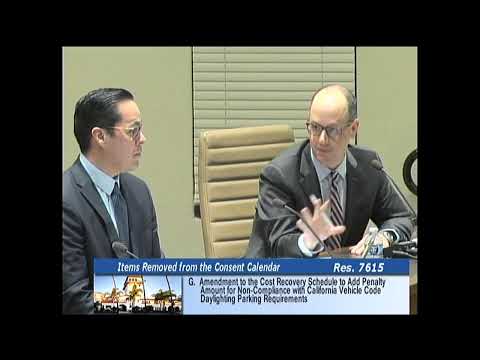
The Seal Beach City Council voted 5-0 to add California Vehicle Code section 22500(n) to the city's cost-recovery schedule and set a $56 penalty, aligning the city's fine schedule with existing parking penalties.
The Seal Beach City Council voted 5-0 to add California Vehicle Code section 22500(n) to the city's cost-recovery schedule and set a $56 penalty, aligning the city's fine schedule with existing parking penalties.
The council's action on the amendment came after a presentation by Captain Nicholas of the Seal Beach Police Department, who explained the state law that prohibits parking within 20 feet of the approach side of marked or unmarked crosswalks (15 feet where curb extensions exist) and described local implementation steps the city is taking.
The change matters because, Captain Nicholas told the council, the law is statewide and went into effect Jan. 1; without an updated fee schedule the city would lack a specified penalty amount to attach to citations for the new violation. The captain said the department's outreach to other California parking managers showed widespread variation in how cities are handling the law and that the state provided no implementation funding.
'This is a state law. It's also an unfunded state law,' Captain Nicholas said in presenting the item, adding that Seal Beach's goal will be education first and enforcement by discretion.
Nicholas estimated the daylighting requirement could remove "300 or more" parking spaces in Old Town Seal Beach, where parking is already scarce. He also said the department has been using social media, a newspaper column and presentations to schools and community groups to publicize the rule.
Council members asked how enforcement would work and whether the rule applies in private gated areas where the city currently provides vehicle-code enforcement, such as Leisure World. City staff and the city attorney said enforcement authority exists for public streets and noted prior agreements allow Seal Beach police to enforce vehicle-code provisions inside Leisure World; staff said they would confirm applicability and coordinate with departments on any required striping or signage.
City Attorney Garelli advised that adding a $56 penalty aligns the daylighting violation with existing city parking fines and that not adopting a local penalty would not nullify the state law; officers could still issue citations but there would be no city-specified fine amount to collect. The council discussed balancing education against enforcement and the burden of implementing curb-painting or signage.
Councilman Steele and others urged caution about unfunded mandates but supported providing the police department the tools to address habitual offenders. Captain Nicholas said the department would not undertake aggressive, citywide ticketing campaigns but would continue education and use enforcement discretion, reserving tickets for repeat violators.
The item passed on a 5-0 vote. Staff said the $56 penalty would take effect on adoption of the resolution and that the department will continue public education and report back as needed on signage, engineering studies or targeted enforcement locations.
Votes at a glance
- Amendment to cost-recovery schedule to add California Vehicle Code section 22500(n) (daylighting): motion adopted; vote 5-0; penalty set at $56; effective on adoption.
Context and next steps
Captain Nicholas and staff said there is no state funding for implementation, no single accepted best practice among other California cities, and that painting curbs or adding signs would require coordination with public works and planning staff and budget consideration. Staff said they would follow up with engineering and public-works recommendations if the council directed further study.
The council directed staff to proceed with the resolution to add the penalty; council members emphasized education and discretionary enforcement rather than an immediate, broad crackdown.